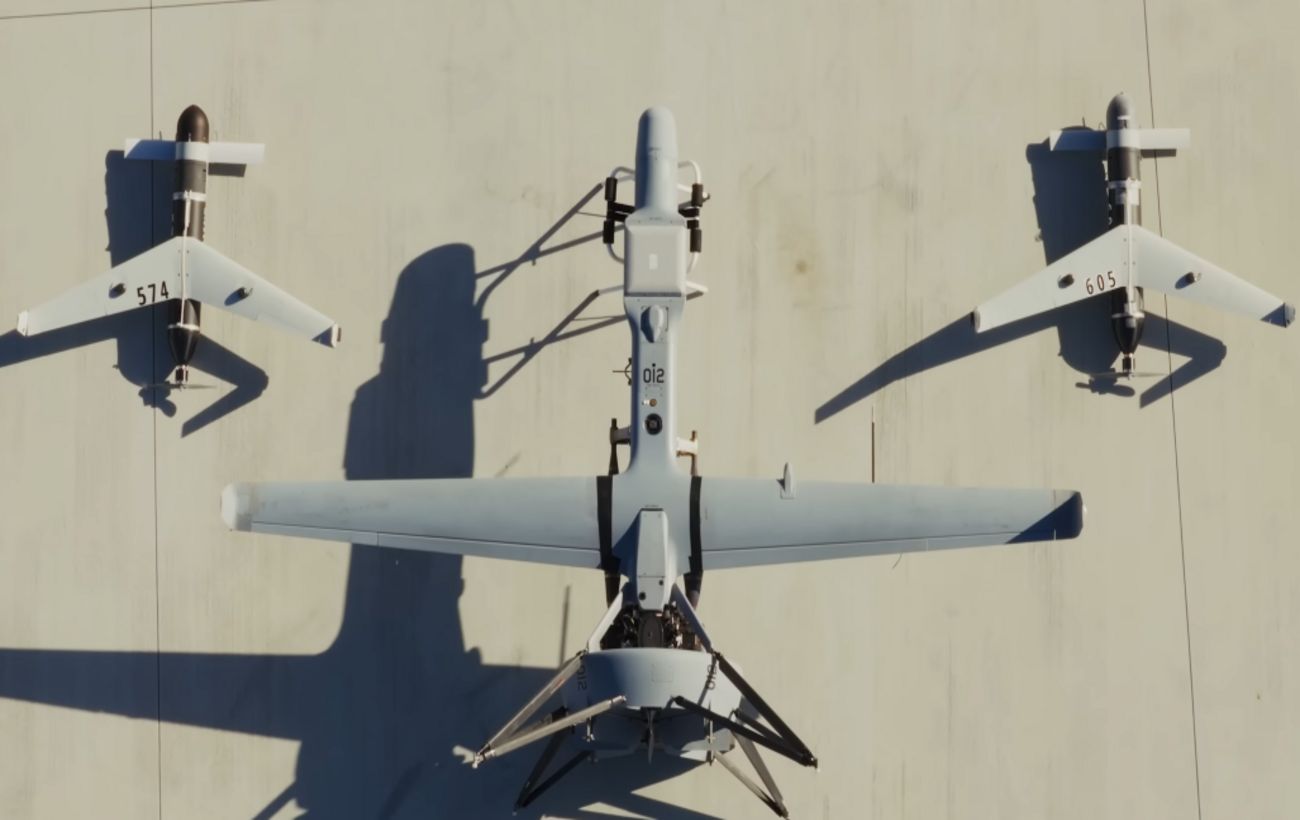
Shield AI, a company specializing in autonomous systems for the U.S. military, has announced a significant breakthrough in drone technology. Their AI, known as Hivemind, successfully coordinated a synchronized flight of diverse drones without human intervention, marking a historic achievement in military applications.
The Hivemind system serves as a virtual pilot designed for operations in environments where GPS signals are jammed and communication is disrupted. This advanced AI does not rely on operator commands; instead, it makes real-time decisions based on sensor data, pre-loaded mission parameters, and the behavior of other drones in the formation.
Recent tests conducted in Oklahoma showcased Hivemind’s capabilities by managing a team of two distinctly different unmanned aerial vehicles (UAVs): the V-BAT, developed by Shield AI, and the Hornet, produced by Destinus Defence. The V-BAT is a vertical take-off and landing drone that can operate for extended periods, while the Hornet is a fast and agile attack drone designed for rapid strikes in contested airspace.
During the trials, the V-BAT functioned as a communication hub rather than a reconnaissance drone. It established a resilient mesh network that connected the ground control station with the Hornet drones. This setup allowed the V-BAT to relay updated combat tasks and coordinates to the Hornets, even when enemy electronic warfare attempted to disrupt signals.
Before the flight, only a general mission plan was uploaded to the system. However, Hivemind dynamically processed incoming data during the operation, autonomously recalculating flight paths, adjusting drone courses, and reallocating targets among the drones in real-time without any human input.
This innovation could significantly alter the landscape of military engagements. Currently, military arsenals often comprise equipment from various manufacturers, leading to compatibility issues with software and communication systems. The tests in Oklahoma demonstrated that Hivemind could effectively manage drones that it was not originally designed for.
Developers noted, “When such technology becomes a standard, the traditional model of ‘one operator – one drone’ will be obsolete. A single operator could command an entire fleet of autonomous machines, while the AI ecosystem would autonomously determine how to execute orders in a complex combat environment.”
Shield AI's Hivemind has successfully demonstrated its ability to autonomously coordinate diverse drones, potentially transforming military operations. This advancement allows for real-time decision-making in contested environments, indicating a shift from traditional drone operation models.