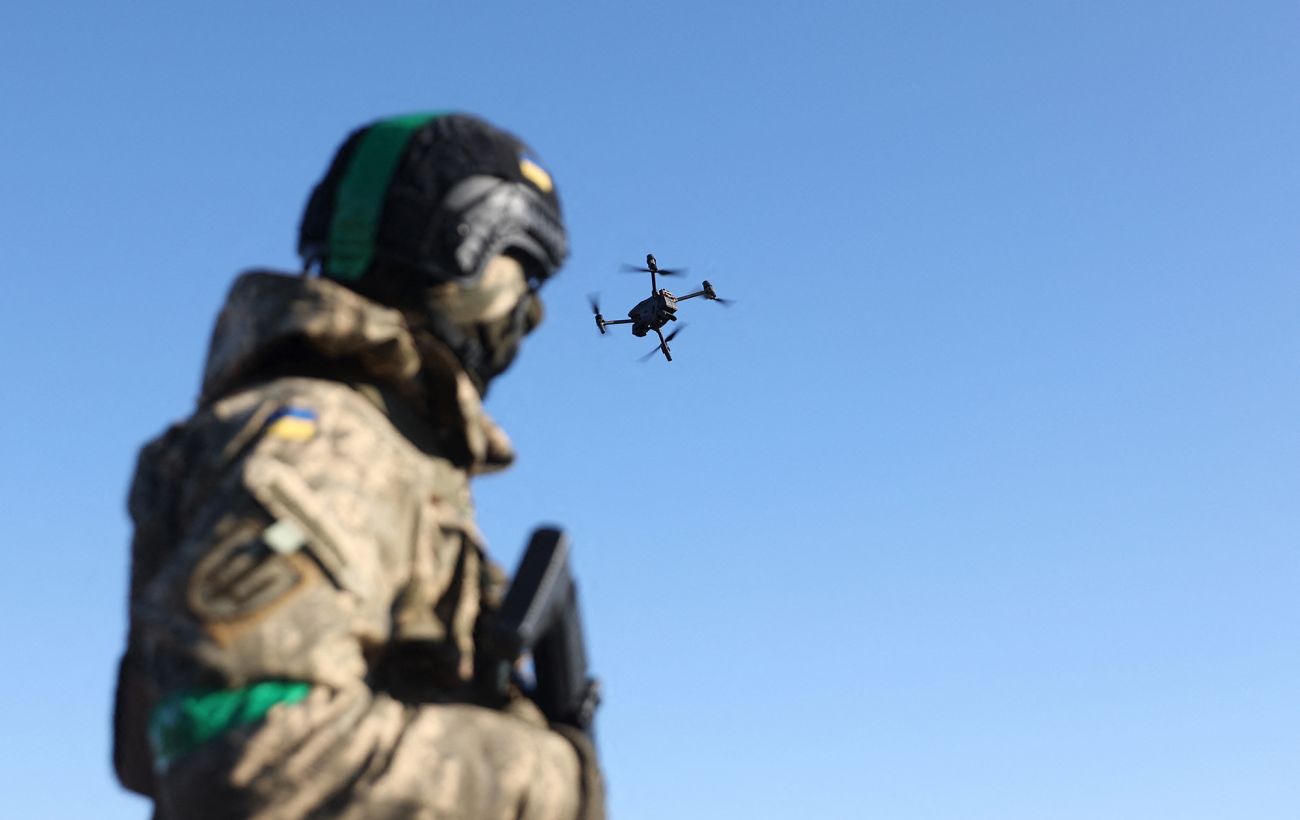
In a significant development in military technology, Ukrainian drones successfully engaged Russian forces during a covert test conducted two years ago. This operation marked a notable advancement in the use of artificial intelligence on the battlefield, as revealed by Alexander Kohanovsky, head of the Ukrainian drone manufacturer Aero Center.
The testing took place discreetly amid a counteroffensive by Ukrainian forces near the cities of Bakhmut and Chasiv Yar. A total of ten drones were programmed to autonomously fly to the front lines, covering distances of three to five kilometers in approximately ten minutes.
Upon reaching their target, the drones activated an autonomous AI mode known as “Terminator.” In this mode, the UAVs were designed to independently identify and engage enemy targets within a specified area.
Due to the nature of the mission, there was no direct video feed or recording of the attack, as the drones operated under conditions of complete autonomy and radio silence. However, standard reconnaissance drones, piloted by operators, were later dispatched to the strike site. They confirmed the destruction of enemy equipment and personnel, including a truck and several soldiers.
This outcome provided clear evidence of the autonomous system’s effectiveness. Nevertheless, Kohanovsky emphasized that this was a unique combat experiment and that the technology has not been adopted for widespread use.
Such tests are rare due to legal and practical constraints. Full autonomy poses serious risks of friendly fire and civilian casualties, necessitating complex pre-mission planning. Moreover, there is currently no unified international definition of lethal autonomous weapons, although defense ministries in leading nations classify them as systems capable of selecting and engaging targets without human intervention after activation.
The Ukrainian government and military have officially prohibited the use of AI in the final stages of target engagement. Military commanders confirm that only semi-autonomous systems are employed in real combat situations. The final decision to fire always rests with a human operator, aligning with international humanitarian law and minimizing risks to civilians.
Major Danilo Polozhukno, a representative of the 21st Separate Battalion of Unmanned Systems, noted that modern drones can automatically lock onto and track targets in the final meters of approach, easing the operator’s workload. However, the ultimate command to strike is given by a human.
Following the limitations of the “Terminator” project, Kohanovsky has since founded a new company, Aero Center, which is developing an innovative air defense system named ALITA. This system aims to intercept and neutralize Russian kamikaze drones, reconnaissance UAVs, and even helicopters.
The ALITA complex will consist of 16 launch platforms housing 64 high-speed interceptor drones capable of automatically launching upon detecting aerial threats and flying towards targets at speeds of up to 450 kilometers per hour. The robotic battery is expected to be ready for release by October. Despite the high level of automation, the system will strictly adhere to Ukrainian laws, with operators retaining the final command to engage or destroy enemy drones.
Remarkably, managing the entire complex of 64 drones will require only two personnel, significantly reducing the manpower needed by 70-80%.
The Ukrainian defense industry is focusing on training small AI models on compact databases, allowing complex software to run on inexpensive, small microchips installed directly on FPV drones, large bombers, or even remote-controlled ground robot turrets. Meanwhile, Russia is also striving to catch up with these technologies, as some modifications of strike drones like the “Geran-2” have begun incorporating smuggled Nvidia Jetson Orin microcomputers.
Ukrainian drones successfully engaged Russian troops during a covert test two years ago, marking a significant advancement in autonomous military technology. The operation, conducted near Bakhmut and Chasiv Yar, demonstrated the effectiveness of AI-driven drones, although full autonomy remains limited due to legal and ethical concerns.