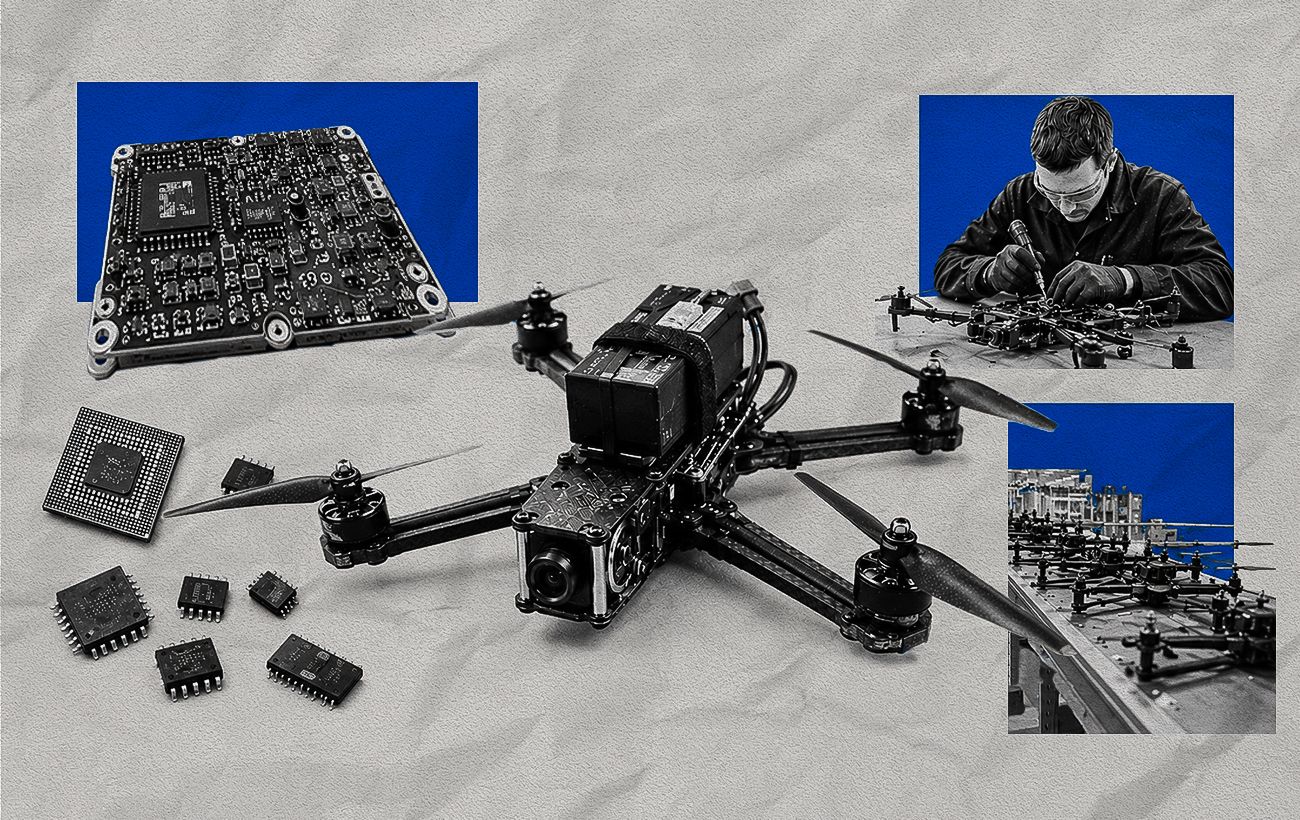
Ukraine is ramping up its production of defense components, with new factories being established to manufacture essential parts. Despite local advancements, the country still relies heavily on imports, particularly from China, for many critical components.
Recent insights reveal that Ukrainian defense firms procure most of their components from China, South Korea, and EU countries. The most significant shortages currently include microchips and fiber optic cables, which are crucial for modern weaponry.
Ukrainian manufacturers are actively working to localize production, with a focus on drone components such as cameras and software systems. However, reliance on Chinese imports remains substantial, with some companies sourcing up to 40% of their components from China. The challenge lies not only in availability but also in ensuring a stable supply of these components for ongoing military needs.
“The issue is not just about access but the consistency of supply,” stated Boris Budeyansky, director of BlueBird Tech. He emphasized the importance of receiving components in large, reliable quantities for military operations.
Key components in short supply include microelectronics, navigation modules, sensors, and optics, particularly thermal imaging matrices. Additionally, certain types of explosives are not produced in Ukraine, necessitating imports and leaving manufacturers vulnerable to price fluctuations abroad.
As the demand for drones increases, the lack of fiber optic cables has become a critical concern, as this technology is complex to produce locally. The global price for fiber optics has surged due to rising demand from the defense sector and data centers.
While China continues to dominate as a supplier, there is a gradual shift toward diversifying sources, with Ukraine increasingly looking to the EU, the United States, Taiwan, and South Korea for alternatives. This diversification aims to reduce dependency on any single market, although Chinese components often remain the most cost-effective option.
In March, The New York Times reported that Ukraine had made significant strides in drone production, achieving the ability to manufacture them with minimal reliance on Chinese components. However, experts caution that mass production without Chinese parts is unlikely in the near future due to cost and availability issues.
Ukrainian and Russian companies often source components from the same Chinese manufacturers, with strict operational schedules to prevent overlap between buyers. Budeyansky pointed out that Ukraine’s dependency on Chinese components is a broader global issue, not limited to its defense sector.
Ukraine’s defense industry has made notable progress in recent years, ramping up its production capabilities. Local firms are now producing various mechanical parts, circuit boards, and software systems, contributing to a more self-sufficient defense ecosystem.
Market players report that Ukraine is transitioning from assembling imported components to establishing a robust domestic production base. This shift includes three main processes: localizing simple and intermediate components, forming R&D teams to design indigenous solutions, and investing in manufacturing capabilities for critical components.
The Ukrainian government and industry clusters like Brave1 are encouraging the transition from prototypes to mass production, although this process is expected to take years rather than months. Recent estimates suggest that the share of Chinese components in Ukrainian drones has decreased to approximately 38%.
However, this figure varies significantly among different manufacturers, with some achieving up to 90% localization while others remain heavily reliant on Chinese imports. The focus on localization is not merely about branding but about ensuring control over critical technologies and components.
Recent initiatives include the domestic production of drone cameras, with companies planning to build specialized factories for daytime and nighttime imaging systems. Additionally, some firms are developing gimbals—camera stabilization systems with advanced software—often matching the quality of leading Western products.
Despite these advancements, challenges remain, particularly in producing complex microelectronic components, which require substantial investment and a robust internal market. Many Ukrainian manufacturers are currently unable to meet these demands.
Alexey Kolesnik, director of XTI Engineering, noted that localization boosts both the economy and the quality of Ukrainian products, with over 80% of their components now produced domestically. This approach allows for faster modernization and reduced dependency on external factors.
While European competitors express skepticism regarding the innovation of Ukrainian drones, citing a lack of technological breakthroughs, they acknowledge the resilience and ingenuity of the Ukrainian defense sector. Reports indicate that Russian forces are even repurposing Ukrainian drones for their own use, underscoring the effectiveness of Ukrainian technology.
Industry representatives argue that while complete self-sufficiency is not feasible, critical segments of the supply chain must be localized to enhance combat effectiveness. Non-critical components can still be sourced globally where it is faster and more economical.
Ultimately, the goal for Ukraine’s defense sector is to blend global supply chains with localized production of essential technologies, ensuring continuity and independence in crucial areas.
Ukraine is enhancing its defense component production capabilities while navigating significant supply challenges, particularly from reliance on Chinese imports. The focus is on localizing essential technologies and diversifying supply sources to ensure military readiness.