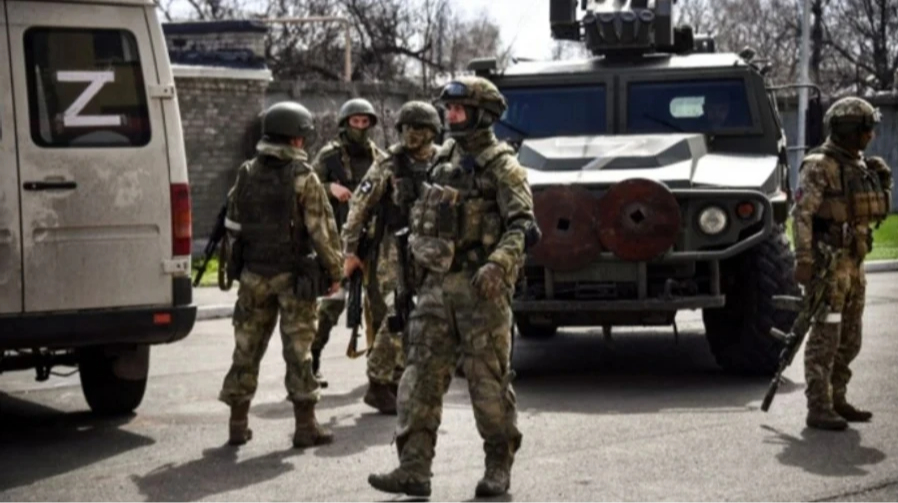
A recent investigation by media outlets from Northern Europe and the Baltic region has revealed that Russia is significantly enhancing its military infrastructure close to NATO borders. This development could enable the deployment of over 100,000 troops in the area.
The investigation, conducted by Swedish broadcaster SVT in collaboration with Norwegian NRK, Danish DR, and Estonian Delfi, utilized satellite imagery to assess the expansion of Russian military facilities near European frontiers. The findings indicate a marked increase in the number of barracks, ammunition depots, and military equipment storage sites.
In particular, construction is underway in Petsamo, located just 10 kilometers from the Norwegian border in Lapland, where new barracks and military vehicles are being assembled. Similar activities are reported in Petrozavodsk near the Finnish border, and in Sapernoye and Luzhki, both in the Pskov region, as well as in Kaliningrad.
In Kirilovsky, approximately 70 kilometers from the Finnish border, a new infrastructure complex is being developed, while existing facilities in Kandalaksha on the White Sea are also undergoing expansion. According to Finnish Army Commander Pasi Välimäki, the enhanced infrastructure could potentially accommodate around 80,000 Russian troops near Finland’s borders, a significant increase from the current estimate of 20,000.
The base in Petsamo, once completed, is expected to house up to 17,000 soldiers, compared to its previous capacity of 7,000. Overall, these new and upgraded facilities could allow Russia to concentrate up to 115,000 personnel along the borders with Northern Europe and the Baltic states.
Thomas Nilsson, head of Swedish military intelligence, emphasized the seriousness of this development, stating, “This is a threat that we must take seriously… We do not believe that this is merely for show. It is about preparing capabilities for potential confrontation with NATO in a larger conflict in the future.”
Experts suggest that the transfer of these forces to the new facilities may occur after the current active phase of the war in Ukraine concludes. Major General Brian Nielsen, commander of NATO forces in the Baltic and Poland, noted that while the immediate military threat remains low as long as Russia is engaged in Ukraine, this situation could change rapidly if a lull occurs in the conflict.
Norwegian Army Chief Eirik Kristoffersen echoed these concerns, stating, “If Russia is indeed ramping up its forces to the levels they have announced – and footage suggests they are – the military threat to Norway will increase.”
In early 2026, the UK announced plans to double its troop presence in Norway to counter Russian threats in the Arctic. The Chief of Norway’s Armed Forces acknowledged that the possibility of a future Russian attack cannot be ruled out, and preparations are being made for such a scenario.
An investigation has uncovered Russia's significant military infrastructure expansion near NATO borders, potentially allowing for the deployment of over 100,000 troops. This development raises serious security concerns among neighboring countries as military officials express apprehension about future threats.
Source: Європейська правда