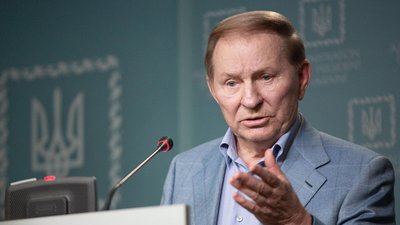
Leonid Kuchma and Viktor Yushchenko, who served as presidents of Ukraine from 1994 to 2005 and 2005 to 2010 respectively, have both renounced the Polish Order of the White Eagle. Their decision follows Poland’s recent move to revoke this honor from current Ukrainian President Volodymyr Zelensky.
In a statement relayed by Darina Olifer, a spokesperson for Kuchma’s Presidential Foundation, Kuchma expressed his discontent, stating, “Today, I have no choice but to refuse this high Polish order. Ukraine did not engage in a battle against Russia, which justified its invasion with historical claims, only for other countries to dictate our history and determine whom we should honor.”
Kuchma reflected on the historical ties between Ukraine and Poland, recalling a joint declaration made during his presidency in 2003 that emphasized mutual forgiveness. He expressed hope that the alliance between the two nations would endure despite current tensions.
“It is one thing when an enemy attacks. It is entirely different when animosity drives friends apart. It is even more alarming when those friends face a common threat. We must remember our history, but the past cannot take precedence over the future,” Kuchma stated.
Yushchenko’s decision to decline the Order of the White Eagle was reported by journalist Iryna Vannikova. He indicated that his choice was a protest against the decision to revoke Zelensky’s award.
“This award was not just for an individual. It primarily represented respect for the Ukrainian people, who are paying an extraordinarily high price for their freedom and independence,” Vannikova quoted Yushchenko.
The Order of the White Eagle was awarded to Yushchenko in 2005 by then-President Aleksander Kwaśniewski.
On June 19, Polish President Karol Nawrocki announced the revocation of Zelensky’s award, which had been conferred by former President Andrzej Duda in 2023. Following this, Ukrainian Foreign Minister Andrii Sybiha also renounced the Commander’s Cross with Star of the Order of Merit of Poland.
Other Ukrainian officials, including Kirill Budanov, the former head of Ukraine’s military intelligence and current head of the President’s Office, and his deputy Ihor Zhovkva, along with Ukraine’s ambassador to Warsaw, Vasyl Bodnar, have also declined Polish honors.
In response to the revocation, Zelensky remarked that he viewed the award as a tribute to the Ukrainian people and the Armed Forces of Ukraine.
“Ukraine is grateful to the Polish people for their support and cooperation, which plays a significant role in our struggle for independence from Russia. Ukraine never forgets solidarity and understands that cooperation among states and peoples in our region is one of the tangible guarantees of security for Ukrainians and for every neighboring state,” Zelensky stated.
Zelensky affirmed Ukraine’s openness to all constructive forms of interaction with Poland.
The controversy intensified after Zelensky issued a decree on May 26 naming a special operations unit of the Ukrainian Armed Forces after the Heroes of the Ukrainian Insurgent Army (UPA). Polish President Nawrocki criticized this move, suggesting it warranted the revocation of Zelensky’s honor.
This decision provoked backlash from some Polish historians and politicians, who reminded the public of UPA’s historical actions against Poles in Volhynia. The Polish Institute of National Remembrance condemned the glorification of the UPA, labeling it responsible for genocide in Volhynia and Eastern Galicia.
Former Polish President Lech Wałęsa, a Nobel Peace Prize laureate who has supported Ukraine, also condemned Zelensky’s decision, stating he would remove the Ukrainian flag pin he had worn since the onset of Russia’s full-scale invasion. He expressed that honoring UPA members was an affront to the memory of those lost.
On June 5, Polish Prime Minister Donald Tusk urged the Ukrainian side to seek solutions to the escalating tensions. He expressed understanding for President Nawrocki’s reaction regarding Zelensky’s honor, emphasizing the importance of a unified Polish perspective on historical matters.
Ukrainian Foreign Minister Sybiha maintained that the Ukrainian soldiers chose the name for their unit without any intention of offending Poland.
Former Ukrainian presidents Leonid Kuchma and Viktor Yushchenko have renounced the Polish Order of the White Eagle in response to Poland's decision to revoke the same honor from President Zelensky. This move highlights ongoing tensions between Ukraine and Poland regarding historical narratives and honors.