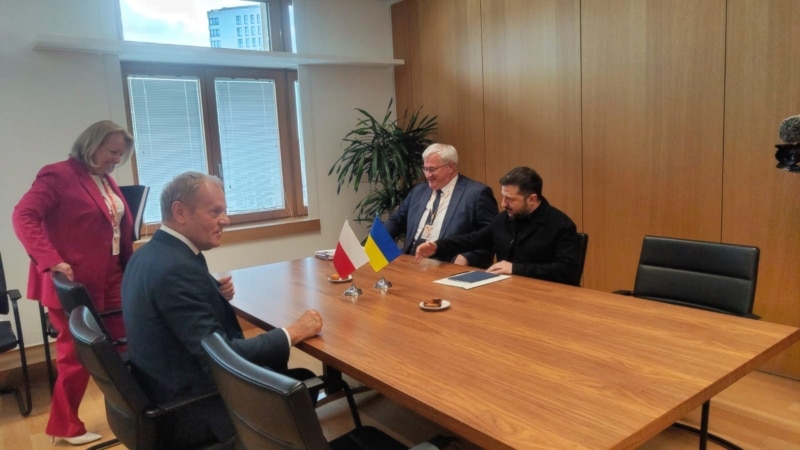
Ukrainian President Volodymyr Zelensky engaged in discussions with Polish Prime Minister Donald Tusk on June 18 during a summit in Brussels. This meeting marked the first direct interaction between the leaders since a diplomatic rift emerged over the honorary naming of a Ukrainian special operations unit after the Ukrainian Insurgent Army (UPA), which drew criticism from Polish officials.
The delegations consisted of two representatives from each side. Alongside Zelensky was Foreign Minister Andriy Sybiha, while Tusk was accompanied by Poland’s ambassador to the EU, Agnieszka Bartosz. This contrasts with Zelensky’s previous meeting with Slovak Prime Minister Robert Fico, which included three members from each national delegation, highlighting a more formal engagement with Slovakia.
The recent tensions between Ukraine and Poland were exacerbated when Polish President Karol Nawrocki initiated proceedings to revoke Zelensky’s Order of the White Eagle, a prestigious Polish honor, following the UPA naming controversy. The UPA, a military-political formation active from 1942 to 1956, is a contentious subject in Polish-Ukrainian relations due to its historical actions during World War II.
Looking ahead, a Conference on the Reconstruction of Ukraine is scheduled for June 25-26 in Gdańsk, Poland, where a high-level Ukrainian delegation is expected to attend. Notably, Zelensky has recently altered his travel routes, opting for transit through Chișinău instead of the traditional Polish city of Rzeszów, which has served as a key transit point for his international visits.
The UPA’s legacy remains divisive. Established to unify various nationalist armed groups, the UPA aimed to create an independent Ukrainian state. Its fighters engaged in conflicts against both Nazi Germany and Soviet forces, a fact acknowledged by German occupation authorities at the time. However, Soviet propaganda painted the UPA as collaborators with the Nazis, a narrative that persists in contemporary Russian discourse.
In Poland, the UPA is often viewed negatively, particularly following a 2016 parliamentary resolution that classified its actions against Polish civilians in Volhynia as genocide. The differing interpretations of the UPA’s history have led to tensions, with estimates of Polish casualties during this period varying significantly between Ukrainian and Polish sources.
Since Ukraine’s independence, public perception of the UPA has fluctuated, oscillating between viewing them as freedom fighters and as collaborators. Following the 2014 Revolution of Dignity, there has been a notable shift towards recognizing their contributions to Ukraine’s independence. In 2015, UPA veterans were granted the status of independence fighters, and a 2018 law recognized them as combatants.
Recent surveys indicate that for over two-thirds of Ukrainians, the UPA symbolizes the defense of national independence. This evolving narrative reflects a broader reassessment of historical memory in Ukraine, with UPA history increasingly integrated into national identity.
Ukrainian President Zelensky's recent meeting with Polish PM Tusk highlights ongoing diplomatic tensions stemming from historical disputes over the UPA. As both nations prepare for a major conference on Ukraine's reconstruction, the complexities of their shared history continue to shape bilateral relations.