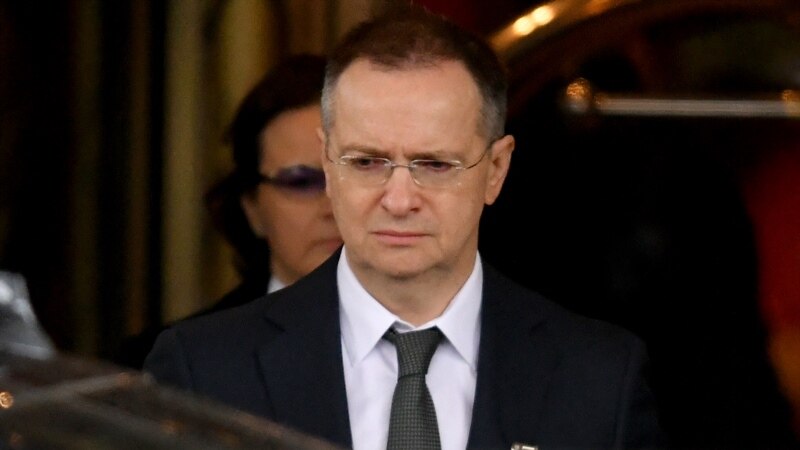
The European Union is preparing to add 42 individuals to its sanctions list, targeting notable Russians. This move comes despite previous opposition from former Hungarian Prime Minister Viktor Orbán regarding some of the proposed names.
The sanctions would include travel bans to EU countries and asset freezes within its jurisdiction, affecting leading Russian businessmen, defense industry executives, and figures in the cryptocurrency sector.
One of the key individuals proposed for inclusion is Vladimir Medinsky, a historian and assistant to President Vladimir Putin. He has been appointed as the head of Russia’s delegation for negotiations aimed at ending the war in Ukraine. The EU document identifies him as a “central figure in government propaganda,” citing his textbooks that depict Ukraine as part of the “Russian world” and his defense of the so-called “special military operation” in Ukraine.
Another significant figure under consideration is Patriarch Kirill, the head of the Russian Orthodox Church. Past attempts to sanction him were thwarted at the last minute. The internal EU document states that he has consistently justified and supported Russia’s aggressive actions in Ukraine, labeling them as “sacred.”
Russian oligarch Iskander Makhmudov, owner of a major locomotive manufacturing company, is also on the list. The EU views him as a crucial contractor for the defense industry.
Additionally, Vagit Alekperov, co-owner of Lukoil, may face sanctions. The document notes his presence at a meeting with Putin during the early days of the full-scale invasion of Ukraine, where discussions on Western sanctions took place. His invitation to this meeting indicates his close ties to Putin’s inner circle and involvement in sectors that generate significant revenue for the Russian government.
Other individuals potentially facing sanctions include Mikhail Gutseriev, a businessman with interests in oil, coal, real estate, and retail, and Mikhail Degtyarev, the current Minister of Sports in Russia, who has pledged to support the rehabilitation of Russian soldiers involved in the conflict.
Arkadi Dvorkovich, president of the International Chess Federation and a former government official, is also a candidate for sanctions due to his public support for the annexation of Crimea.
Finally, Alexander Zharov, CEO of Gazprom-Media Holding, which is a key player in Russia’s military propaganda, may be added to the list. The EU believes that under Zharov’s leadership, the company has played a significant role in shaping public opinion regarding the war.
On June 9, European Commission President Ursula von der Leyen proposed the 21st sanctions package, which aims to impose travel bans on military personnel involved in the conflict, along with expanding export and import restrictions and sanctions targeting Russia’s energy and financial sectors. The proposal is subject to review and must receive unanimous approval from EU member states.
The EU is set to expand its sanctions list with 42 new names, targeting prominent Russians involved in the war in Ukraine. This includes key figures from various sectors, reflecting ongoing efforts to hold individuals accountable for their roles in the conflict.