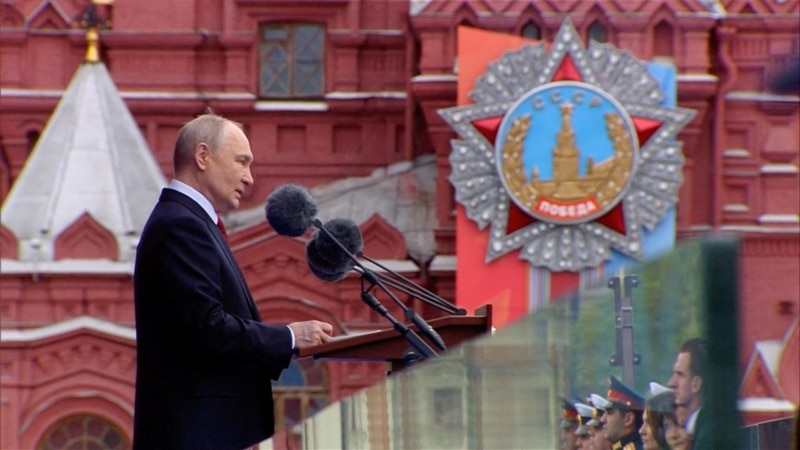
Russian President Vladimir Putin utilized the Victory Day celebrations to draw parallels between the current conflict in Ukraine and the Soviet Union’s role in World War II. This assertion aligns with his ongoing efforts to position Russia as the successor to the Soviet superpower status, while also portraying himself as a modern-day successor to Stalin.
In his address, Putin emphasized that the achievements of the Soviet Union during the war serve as an inspiration for Russian soldiers engaged in the ongoing military operations in Ukraine. He highlighted the themes of moral strength, courage, and resilience, asserting that these qualities are essential for Russia’s success on the battlefield. Furthermore, he underscored the importance of unity within the country, stating that both the frontlines and the home front must come together to support the war effort.
Analysts note that Putin has long sought to create misleading historical comparisons between the Ukraine conflict and the Soviet Great Patriotic War, aiming to rally public support for the military campaign. According to the Institute for the Study of War (ISW), the president’s focus on the sacrifices endured by the Soviet people reflects an awareness of the increasing toll the war is taking on the Russian populace. As casualties approach one percent of Russia’s total population, citizens are facing mounting financial burdens, while the Kremlin intensifies censorship and restricts mobile internet access.
The ISW reports that Putin is attempting to persuade Russians to accept these rising costs as necessary for triumph over a perceived greater evil. Analysts also suggest that his insistence on holding the Victory Day parade, despite the threat of Ukrainian strikes, indicates a refusal to acknowledge the realities of the battlefield. His call for a ceasefire during the parade was seen as a deliberate attempt to project an image of power and control within Russia, while simultaneously avoiding potential disruptions from Ukrainian attacks during the festivities.
This year’s Victory Day parade took place on May 9 in Moscow’s Red Square, marking a notable absence of military hardware for the first time in years. The Kremlin attributed this decision to the current operational situation, although the aerial segment of the parade proceeded as planned. Leaders from Belarus, Kazakhstan, Uzbekistan, Malaysia, and Laos attended the event, alongside heads of South Ossetia and Abkhazia, regions recognized by Russia but not by the international community.
During his Victory Day speech, President Putin framed the war in Ukraine as a continuation of the Soviet struggle in World War II. Analysts suggest this rhetoric aims to bolster public support amid rising costs and casualties from the ongoing conflict.
Source: Institute for the Study of War