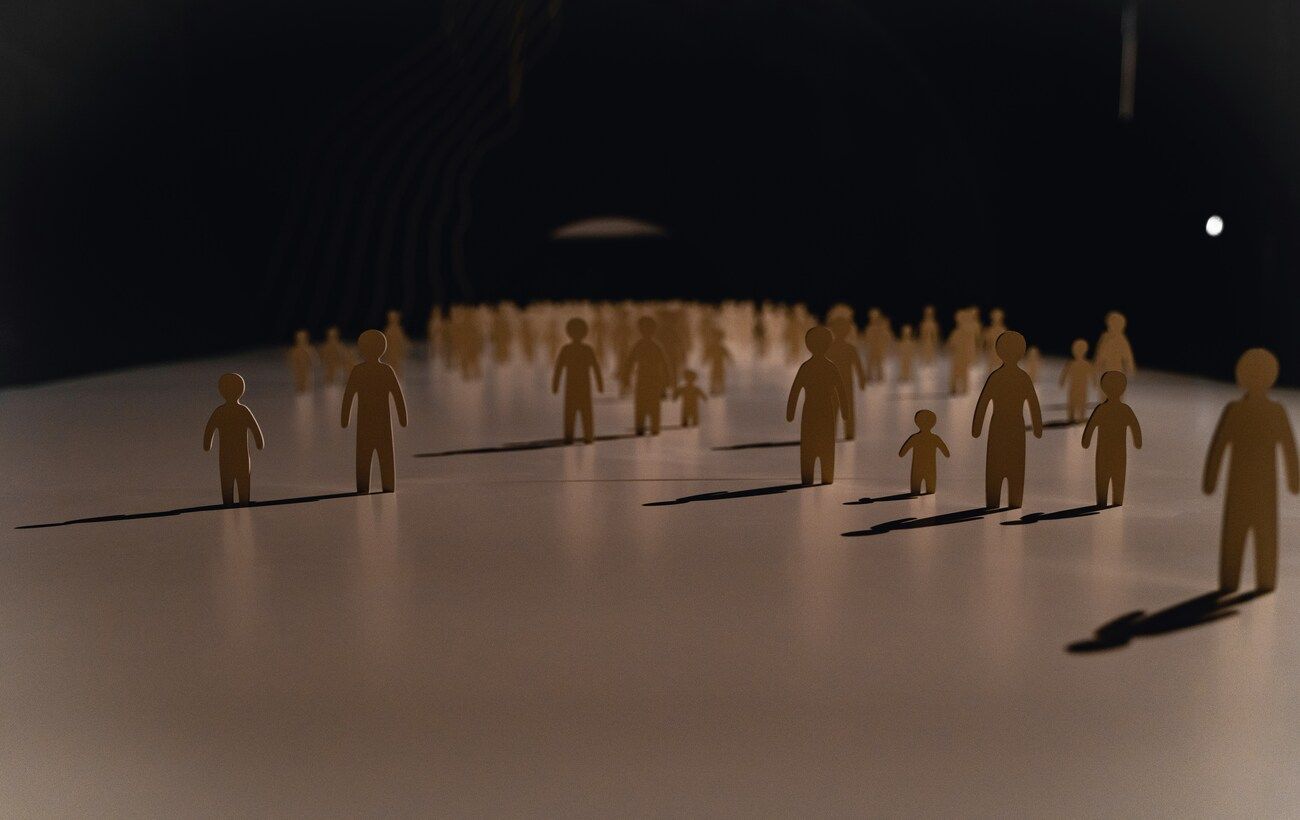
A team of international researchers has developed a mathematical model that underscores humanity’s sensitivity to sudden ecological and social disruptions. The study presents a hypothetical scenario in which the global population could be halved within 40 years due to various crises.
The concept of “carrying capacity” is central to this research. It refers to the maximum number of living beings that a planet can support sustainably, providing adequate food, water, and safe living conditions without harming the environment.
Currently, Earth’s population stands at approximately 8 billion. However, factors such as climate change, resource scarcity, large-scale conflicts, and pandemics could drastically reduce this limit.
According to the researchers, if a global catastrophe were to cause the planet’s carrying capacity to drop to 2 billion people, the world population could shrink to between 4 and 5 billion by 2064, rather than the anticipated 8 to 10 billion.
Professor Alessio Zacccone from the University of Milan, one of the study’s authors, clarified, “This is not an exact prediction or an announcement of an apocalypse. It is a mathematical model that illustrates our dependence on environmental stability. The current situation on the planet remains relatively stable.”
The researchers also revisited a well-known analysis from 1960 by Heinz von Foerster, which warned that if humanity continued to grow at the same rapid pace observed over the last two millennia, a “Day of Reckoning” would occur in 2026, leading to uncontrolled population growth.
This scenario did not materialize, as global birth rates have declined over time. However, Zacccone noted that the mathematics of such “unrestrained growth” could still apply under certain conditions.
The new calculations indicate that if humanity disregards the planet’s ecological limits, we could approach a new perilous threshold by 2078, where nature may not be able to replenish resources fast enough for human needs.
The researchers express confidence in the accuracy of their mathematical formulations, having tested them against 12,000 years of human history. The model effectively mirrored both the significant demographic explosion during the Industrial Revolution and the gradual slowdown in population growth that began around 1970.
While the scenario of the planet being able to sustain only 2 billion people is deemed unlikely—requiring extraordinary events like a nuclear winter or a complete collapse of the climate system—the researchers hope their work will aid global leaders in understanding future risks and responding proactively to global threats.
A new mathematical model reveals the potential for a significant decline in the global population due to environmental and social crises. The research emphasizes the importance of understanding ecological limits to mitigate future risks.