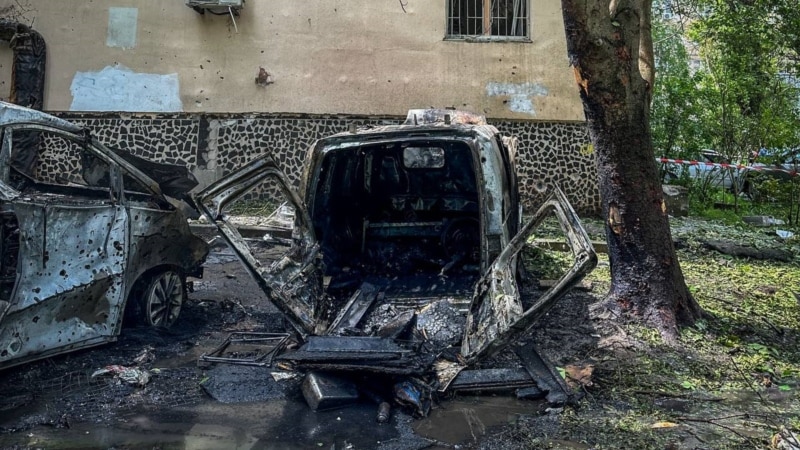
In the early hours of June 1, Russian military forces launched drone attacks on the Ukrainian cities of Odesa and Kharkiv, resulting in damage to residential buildings and injuries to civilians, according to local officials.
Serhiy Lysak, head of the Odesa Regional Military Administration, reported that four individuals sustained injuries in Odesa. He noted that a drone strike partially destroyed the first and second floors of a nine-story residential building, damaging its facade and balconies. A fire that erupted as a result of the attack has since been contained, although two single-story houses also caught fire.
In Kharkiv, Mayor Ihor Terekhov confirmed that strikes were recorded in several districts, including Osnovianskyi, Slobidskyi, Kyivskyi, and Kholodnohirskiy. He indicated that three private homes were damaged, and a garage cooperative near multi-story buildings was hit, leading to the destruction of garages and vehicles.
Oleh Synehubov, head of the Kharkiv Regional Military Administration, stated that at least two people were injured in the Osnovianskyi district. He described damage to a five-story residential building and nearby high-rises, along with significant destruction to five garages and the total loss of two others.
Russian forces have consistently targeted Ukrainian cities and civilian infrastructure using various types of weaponry, including strike drones, missiles, and multiple rocket launch systems. Ukrainian authorities and international organizations have classified these attacks as war crimes, emphasizing their deliberate nature.
Officials have highlighted that assaults on essential services and healthcare facilities aim to deprive the population of electricity, heating, water supply, communication, medical assistance, and other vital living conditions. Legal experts and human rights advocates have raised concerns that such actions could amount to genocidal acts, citing statements from Russian officials that deny the existence of Ukrainians as an ethnic group.
The 1948 United Nations Convention on the Prevention and Punishment of the Crime of Genocide obligates its 149 signatory countries to prevent and punish acts of genocide during both wartime and peacetime. The convention defines genocide as actions intended to destroy, in whole or in part, a national, ethnic, racial, or religious group.
Indicators of genocide include the killing of group members, causing serious bodily or mental harm, deliberately inflicting living conditions calculated to destroy the group, preventing births within the group, and forcibly transferring children from one group to another.
The Russian leadership has denied allegations that its military deliberately targets civilian infrastructure, resulting in civilian casualties and the destruction of hospitals, schools, and energy and water supply facilities.
Recent drone strikes by Russian forces on Odesa and Kharkiv have resulted in civilian injuries and significant damage to residential buildings. Local officials report ongoing attacks on essential infrastructure, raising concerns about potential war crimes.