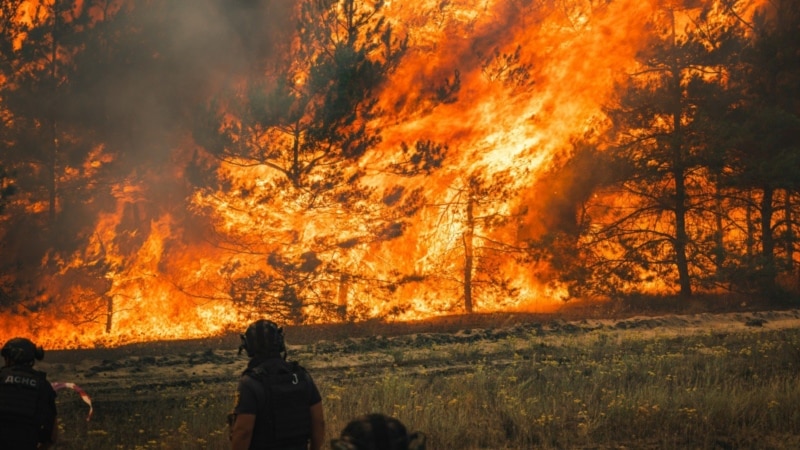
In the Chernihiv region of Ukraine, approximately 2,400 hectares of forest are ablaze due to artillery fire from Russian forces. The fires are concentrated in the Elinsky and Tikhonovitsky forestry areas near the border with Russia, where access has been restricted for forestry workers due to safety concerns.
The state enterprise “Forests of Ukraine” reported on May 7 that surveillance cameras captured the outbreak of the fire. Efforts are underway to prevent the flames from spreading to nearby populated areas.
“We are primarily creating additional mineralized strips to contain the fire. Our tractors are operating under electronic warfare protection, as the enemy targets any machinery in the area. All new firefighting equipment has been mobilized, but we currently lack the ability to deploy it fully due to the constant presence of enemy drones,” stated representatives from the enterprise.
Russian military forces have been launching regular attacks on Ukrainian cities and civilian infrastructure using various weapons, including drones, missiles, and multiple rocket launchers. These strikes have been classified by Ukrainian authorities and international organizations as war crimes, highlighting their targeted nature.
Attacks on essential services and health facilities aim to deprive civilians of electricity, heating, water supply, communication, and medical assistance, which has raised concerns among legal experts and human rights advocates about potential genocidal actions. They argue that such tactics constitute a systematic effort to eliminate the Ukrainian population.
Since the onset of the large-scale conflict, various forms of violence against Ukrainian citizens have been reported, aligning with definitions of genocide. This includes public declarations from Russian officials denying the existence of Ukrainians as an ethnic group and calls for their destruction.
The 1948 United Nations Convention on the Prevention and Punishment of the Crime of Genocide obligates signatory nations to prevent and punish acts of genocide during both wartime and peacetime. The convention defines genocide as actions intended to destroy, in whole or in part, a national, ethnic, racial, or religious group.
Signs of genocide include the killing of group members, causing serious bodily harm, and creating living conditions aimed at the destruction of the group, among other actions.
Despite the evidence of targeted strikes against civilian infrastructure, Russian leadership denies that its military is intentionally attacking non-combatants, including hospitals, schools, and essential services.
Wildfires have engulfed 2,400 hectares of forest in Ukraine's Chernihiv region due to Russian military shelling. Efforts to combat the blaze are hampered by ongoing threats from enemy drones and artillery.