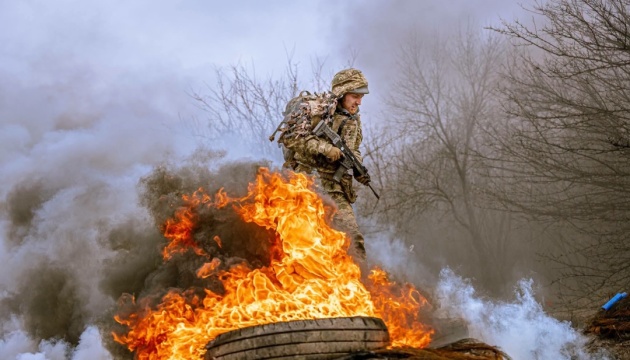
Ukrainian President Volodymyr Zelensky has announced the initiation of a significant military reform slated for June 2026. This reform aims to establish clearer service terms within the Armed Forces of Ukraine (AFU) and commence the demobilization process, which is expected to take effect in the coming years.
As part of this reform, Ukrainian soldiers stationed at the front lines will see a substantial increase in their salaries, with payments ranging from 250,000 to 400,000 hryvnias. This adjustment is intended to reflect a principle of fairness in compensating those who are directly engaged in combat.
In related developments, Zelensky reported that Russia has incurred losses of at least $7 billion this year due to targeted Ukrainian sanctions affecting its oil industry. These sanctions are part of Ukraine’s broader strategy to weaken the aggressor’s economic capabilities.
In a notable military action, Ukrainian defense forces executed their fourth strike in two weeks against oil refineries in Tuapse and Perm, as well as targeting a Buk-M3 missile system in the temporarily occupied Donetsk region. The General Staff of the Armed Forces of Ukraine confirmed these strikes, indicating ongoing military operations aimed at disrupting Russian supply lines.
Meanwhile, the situation in the Middle East remains tense. Iran has communicated its latest proposal for negotiations with the United States through Pakistani intermediaries, although details remain scarce. Reports indicate that at least 16 U.S. military bases have sustained damage from Iranian retaliatory strikes, with the actual costs of the conflict estimated to be around $50 billion, significantly higher than Pentagon assessments.
Israel has stepped up its defense collaboration with the United Arab Emirates by supplying advanced weapon systems, including an upgraded version of the Iron Dome, to counter potential Iranian missile threats.
Fatih Birol, Executive Director of the International Energy Agency, has stated that the world is facing the most severe energy crisis in history, a consequence of the ongoing conflict involving the United States and Iran.
In Ukraine, the military situation remains intense. As of May 1, 2026, there have been 55 reported clashes, with the Pokrovsk direction noted as particularly active. The Ukrainian General Staff has confirmed the destruction of Russian Su-57 and Su-34 aircraft at the Shagol airfield in Chelyabinsk on April 25.
Ukrainian forces successfully repelled a new Russian attempt to advance through gas pipelines, while the village of Korchakivka in Sumy Oblast remains under Ukrainian control, countering claims of its capture by Russian forces.
Additionally, Ukrainian intelligence reported the elimination of 41 mercenaries from the Kadyrov unit during operations in Sumy Oblast.
On the civilian front, Russian drone attacks have caused significant damage across various regions. In the first four months of 2026, there were 38 verified incidents of attacks on Ukrainian media and journalists, highlighting the ongoing risks faced by the press in the conflict.
As Ukraine prepares for the upcoming military reforms, the government continues to address the humanitarian and economic impacts of the war, with discussions on resilience plans and energy support programs ongoing.
President Zelensky has unveiled plans for a military reform starting in June 2026, which includes increased salaries for frontline soldiers. This announcement comes amid ongoing military operations and significant economic sanctions against Russia, further intensifying the conflict's impact on both nations.
