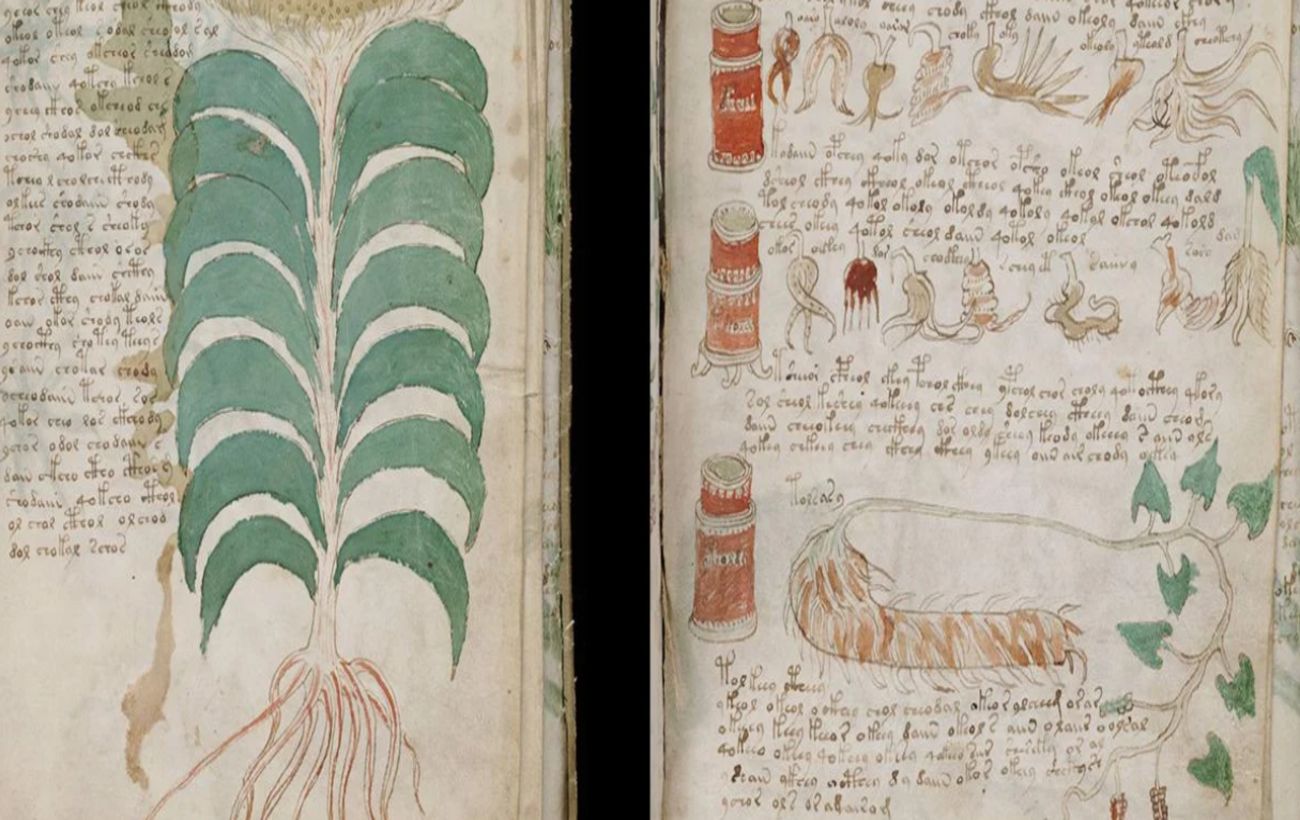
The Voynich Manuscript, often described as the world’s most mysterious book, has recently been the subject of two significant scientific breakthroughs. Researchers have not only modeled a medieval cipher but have also uncovered hidden writings from its previous owner on the original pages.
According to a study published in the journal Cryptologia, a novel encryption method called Naibbe cipher was developed, named after a medieval Italian card game. This algorithm processes Latin or Italian text by breaking it into short letter groups and substituting them using specialized structured tables.
Incorporating elements of randomness, the method utilizes common gaming tools such as dice and playing cards, which were widely accessible in 15th-century Europe. During testing on various text samples, the Naibbe cipher demonstrated remarkable effectiveness.
The output closely mirrored key characteristics of the Voynich Manuscript, including:
- the frequency of individual symbols;
- the typical length of “words”;
- specific positional patterns of signs.
Despite this, the method retains fragments of the original linguistic structure as short sequences, although no individual glyph corresponds directly to a specific letter of the alphabet.
In parallel with this mathematical modeling, significant progress was made through the examination of the manuscript itself. Lisa Fagin Davis, the executive director of the Medieval Academy of America, analyzed multispectral images of the manuscript’s first page, captured by The Lazarus Project team. This technology allows for the visualization of faded and entirely erased writings.
On the right margin of the first page, scanners revealed three hidden columns of letters: two comprised of the Latin alphabet and one featuring original symbols from the Voynich language. The researcher compared the handwriting with historical figures and determined that the marginalia were left by Johannes Marcus Marci, a Prague physician who owned the manuscript in the 1660s.
The discovered columns suggest that Marci was actively seeking the key to deciphering the text. Scholars propose two possible actions he may have taken:
- He attempted to apply two different types of substitution ciphers to the book;
- He aimed to create his own secret system based on the manuscript’s symbols.
After three years of unsuccessful attempts, Marci sent the manuscript to the renowned Jesuit scholar Athanasius Kircher in Rome in 1665, hoping he could unlock its secrets. The book was subsequently lost and only resurfaced in 1912, when it was acquired by antiquarian Wilfrid Voynich. It is currently housed in the Beinecke Rare Book and Manuscript Library at Yale University.
The findings affirm that the long-held “cipher hypothesis” remains a viable and realistic explanation for the medieval period. However, the research also delineates clear boundaries: if the manuscript is indeed encrypted, the system employed was extraordinarily complex and markedly different from the simple substitution codes of the time.
Independent experts, who were not involved in the research, have described the study as a “remarkable benchmark, but not a definitive answer.” The new approach allows for the consideration of three equally plausible scenarios: the text results from complex encryption, an entirely unknown language, or a well-crafted hoax. Nevertheless, future researchers now have a clear mathematical model that illustrates how a manual encryption method could produce such an intricate text.
Recent research on the Voynich Manuscript has revealed a new encryption method and hidden writings from a previous owner, shedding light on its longstanding mysteries. While the findings suggest the manuscript may involve complex encryption, the exact nature of its content remains uncertain.