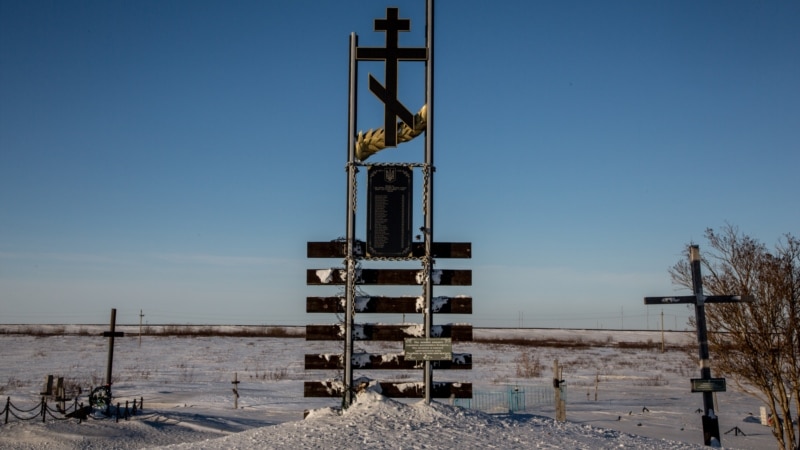
The city administration of Vorkuta, located in the far north of Russia’s European territory, has dismantled a memorial dedicated to Ukrainian victims of political repression at the Yur-Shor cemetery. This action has sparked discussions regarding the historical significance of the site and the broader implications for memory and identity in the region.
The memorial, inaugurated on October 14, 2010, featured a plaque bearing the names of 33 individuals, along with the emblem of Ukraine. Prior to its removal, city officials conducted an archival review, confirming that the cemetery contains the remains of prisoners sentenced for their involvement with the Ukrainian Insurgent Army (UPA) and the Organization of Ukrainian Nationalists (OUN). These documents were declassified and published in 2004.
In June, participants of the ongoing conflict between Russia and Ukraine expressed their grievances about the memorial during a meeting with local authorities. They argued that “the bitter truth about the crimes of the Nazis and their accomplices should not be lost. We must remember what occurred to prevent its recurrence in the future.” The group emphasized that while the burial site should remain marked, the memorial itself was deemed unnecessary in Vorkuta.
The initiative to remove the memorial received support from the Public Chamber of Vorkuta, reflecting a broader trend in the region where historical narratives are being contested. Yur-Shor is recognized as a significant site of memory associated with the Vorkuta camp complex, where prisoners from the Vorkutlag and Richlag were interred from 1944 until the mid-1950s.
The Ukrainian Insurgent Army, active from 1942 to 1956, aimed to unify various nationalist armed groups under the OUN’s leadership. Its primary objective was to establish an independent Ukrainian state and prepare for an uprising following the depletion of both the Soviet Union and Nazi Germany in World War II. The UPA’s operations were characterized by guerrilla tactics, utilizing captured weaponry from various sources, including German and Soviet arms.
Throughout its history, the UPA fought on two fronts: against Nazi Germany and later against Soviet authority. German occupation officials recognized UPA activities as anti-German resistance. However, Soviet propaganda painted the UPA as a collaborator with the Nazis, a narrative that persists in Russia today, where the group was classified as an extremist organization by the Supreme Court in 2014.
The perception of the UPA is complex and varies significantly across different countries. In Poland, actions by UPA soldiers against Polish civilians during World War II have been classified as genocide by the Polish parliament in 2016. This historical tension complicates the UPA’s legacy, which is viewed in Ukraine as a symbol of resistance and independence, especially following the 2014 Revolution of Dignity.
Since gaining independence, public opinion in Ukraine regarding the UPA has shifted, with many now recognizing its members as fighters for independence. A 2018 law granted UPA soldiers the status of combatants, and recent surveys indicate that over two-thirds of Ukrainians now view the UPA as a symbol of national defense.
The removal of the memorial in Vorkuta underscores ongoing debates about historical memory and national identity in the context of the current geopolitical landscape, particularly as Ukraine continues to confront Russian aggression.
The dismantling of a Ukrainian memorial in Vorkuta highlights ongoing tensions regarding historical narratives related to the Ukrainian Insurgent Army and its legacy. This action reflects broader societal debates about memory, identity, and the implications of historical interpretation in the context of the current conflict between Russia and Ukraine.