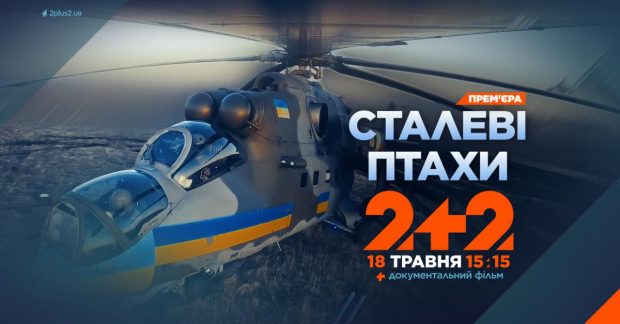
On May 18 at 15:15, the documentary film “Steel Birds” will premiere on the 2+2 channel, detailing one of the most perilous and secretive operations conducted by Ukraine’s defense forces during the Battle of Mariupol. The film unveils previously undisclosed aspects of the Ukrainian helicopters’ mission to reach the besieged Azovstal plant, surrounded by Russian forces in the spring of 2022.
Participants directly involved in the operation, including the Commander-in-Chief of the Ukrainian Armed Forces, Valerii Zaluzhnyi, former head of military intelligence Kyrylo Budanov, commanders from the Azov regiment, military pilots, and crew members, provide exclusive insights into the events.
The documentary meticulously reconstructs the early months of the full-scale invasion when Mariupol was completely encircled. At that time, the Ukrainian garrison defending the city and the Azovstal plant was effectively cut off from reinforcements. The defenders faced severe shortages of ammunition, medical supplies, and communication equipment, while the number of wounded continued to rise. Given the dire circumstances on the front lines, the only option left was to deliver aid by air.
“We could not afford to miss any miscalculations by the Russian command. If at that moment our adversary had focused on Zaporizhzhia instead of Mariupol, we would have had no means to defend it. However, due to the brave and decisive actions of Mariupol’s defenders, the Russians became fixated on Mariupol and remained there. Meanwhile, we were fortifying the defense from Zaporizhzhia to Volnovakha. To buy time, we needed the defenders of Mariupol to hold out as long as possible,” stated Valerii Zaluzhnyi in the film.
The operation was conducted under maximum secrecy, with flight paths planned through the front line, over occupied territories, and through dense Russian air defense systems. Routes were calculated down to the second, utilizing intelligence and drone data. Crews flew at night at extremely low altitudes, effectively hugging the ground to evade enemy radar.
According to those involved, the operation seemed nearly impossible. Some pilots initially doubted that a breakthrough to Mariupol was feasible, as similar missions had virtually no precedent in modern military history. Nevertheless, the volunteers recognized that this was likely their only chance to support the Azovstal garrison and rescue the wounded.
The film illustrates the coordination between military intelligence, the General Staff, army aviation, and the defenders in Mariupol. At Azovstal, defenders even organized artillery fire to distract the enemy, allowing helicopters precious minutes for landing, unloading supplies, and evacuating the injured. The entire process on the ground lasted no more than 10 to 15 minutes, as every extra second could prove fatal. Despite the immense risks, seven successful missions were carried out to Azovstal.
“We did not expect anyone would be able to break through to us. But it happened. As they say, a hand of help stretched out from the darkness of despair. It was a true triumph of human potential that can only be realized under immense pressure when fate demands it,” remarked Illya Samoylenko, an officer in the Azov brigade.
The documentary does not shy away from the tragic aspects of the operation, including the losses of the crews. Participants acknowledged that with each successful flight, the risks escalated as Russian forces intensified their efforts to target Ukrainian helicopters. Due to the extreme danger and the inability to guarantee even minimal flight safety, the operation was ultimately called off.
Nevertheless, “Steel Birds” emphasizes that the mission was unique not only for the Russo-Ukrainian conflict but also for contemporary military history. Thanks to the helicopter missions to Azovstal, critical supplies of ammunition, medical equipment, and reinforcements were delivered, and over 60 severely wounded defenders were evacuated. Some of the rescued soldiers returned to service after treatment and contributed to the rebuilding of combat units.
Participants in the film believe these flights enabled the defenders of Mariupol to hold their ground longer, tying down significant Russian forces and buying strategically important time for Ukraine during the early months of the full-scale war.
During the film’s production, news emerged of the death of Hero of Ukraine Oleksandr Shemet, who was the first to agree to fly to the besieged Azovstal.
The documentary is dedicated to all the heroes who did not return from the combat mission.
“Steel Birds” was produced by Mainstream Pictures with the support of the Ukrainian Ministry of Culture. Viewers are encouraged to tune in on May 18 at 15:15 on the 2+2 channel for details on this unique military operation and the individuals who willingly undertook an almost impossible mission to save their comrades and fight for Ukraine.
The documentary "Steel Birds" reveals the intricacies of a secretive Ukrainian operation to supply and evacuate defenders at Azovstal during the Battle of Mariupol. Featuring firsthand accounts, the film highlights the operational challenges and the critical impact of these missions on the defense efforts.