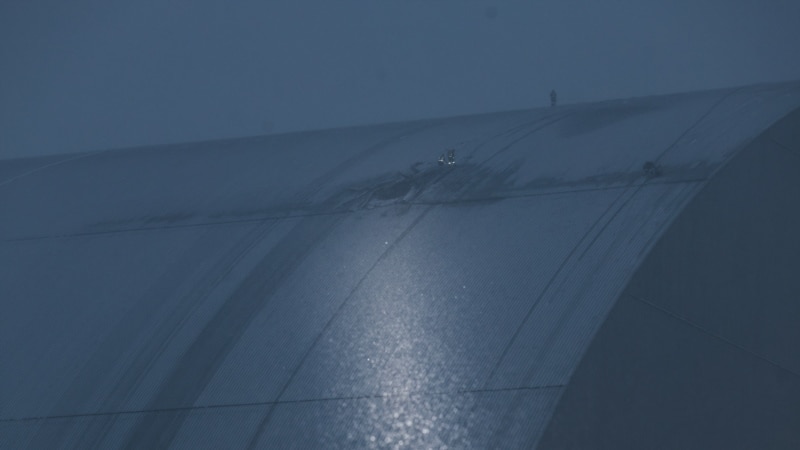
The State Specialized Enterprise “Chernobyl Nuclear Power Plant” has provided an update on the situation at the site following a drone strike on February 14, 2025. The facility’s “Shelter” structure is reportedly still functioning according to its operational regulations.
According to the statement, while the New Safe Confinement (NSC) structure sustained damage from the drone impact and subsequent firefighting efforts, it continues to partially fulfill its role in containing radioactive materials. Sergey Tarakanov, the plant’s director, noted that the NSC has lost its complete sealing properties but is still providing environmental isolation for the destroyed reactor block.
Efforts are currently underway to restore the integrity of the NSC, and no radioactive substances have been detected outside the structure. The facility remains under controlled conditions.
The report further indicated that there has been no damage to the load-bearing structures of the NSC due to the drone strike or the firefighting aftermath. Under normal operational conditions, and barring any external impacts such as military actions or natural disasters, the risk of uncontrolled release of radioactive materials is considered minimal.
Earlier today, Greenpeace Ukraine released a report ahead of the 40th anniversary of the Chernobyl disaster, warning that the ongoing conflict between Russia and Ukraine poses a direct threat to international efforts aimed at addressing significant damage to the NSC.
The organization highlighted that the damage was caused by the drone attack in February 2025. Inside the NSC are the ruins of Reactor No. 4 and its sarcophagus, which is slated for urgent dismantling. However, due to the damage to the NSC, this is currently unfeasible. The report cites Eric Schmeiman, an engineer with extensive experience at the Chernobyl plant, emphasizing that without immediate repairs, the risk of the sarcophagus collapsing significantly increases.
Sean Bernie, a senior nuclear specialist at Greenpeace Ukraine, stated that the drone strike has heightened the risk of sarcophagus collapse prior to its safe dismantling, calling for accountability and maximum sanctions against Rosatom.
In late March 2026, foreign ministers from the G7 nations discussed extensive efforts to restore the protective cover at the Chernobyl Nuclear Power Plant. The estimated cost of these repairs is approximately $575 million.
A central focus of the agenda is the repair of the massive protective dome that covers the destroyed reactor. The drone strike occurred in 2025.
Ukraine has asserted that the drone was launched by Russia and was equipped with an explosive warhead. The Kremlin has denied these allegations, claiming that Kyiv fabricated the incident to disrupt ongoing peace negotiations at that time.
While the physical damage to the dome is limited, it carries significant financial and security implications. The fourth reactor of the Chernobyl plant exploded in 1986, resulting in the worst nuclear disaster in history. The dome, constructed at a cost of $2.5 billion in 2019, was designed to prevent further radiation leaks and facilitate the dismantling of the reactor remnants.
The Chernobyl Nuclear Power Plant has reported damage to its New Safe Confinement structure following a drone strike. While the facility continues to operate under controlled conditions, concerns remain regarding the structural integrity and the potential for radioactive material release.