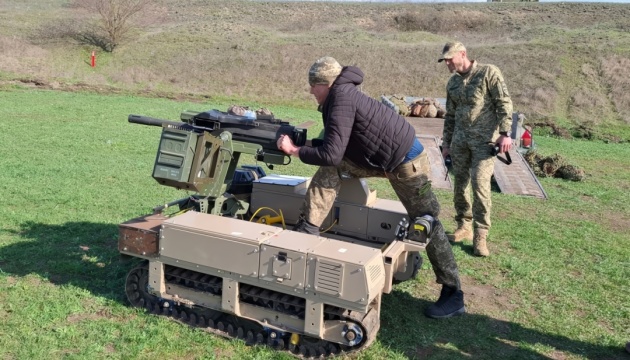
Members of the 123rd Territorial Defense Brigade are adapting ground robotic complexes to meet the evolving demands of modern warfare. Over recent years, the nature of land combat has transformed significantly, prompting military units to explore new technologies for operational efficiency.
The advancement of reconnaissance and strike drones has expanded the so-called “kill zone,” making it increasingly difficult for troops to move undetected and complicating supply lines. In response, ground robotic complexes (GRCs) are being developed to provide fire support, deliver essential supplies to the front lines, and facilitate the evacuation of wounded soldiers, thereby preserving lives.
These robotic systems are rapidly being integrated into the Armed Forces of Ukraine. The first battalion of drone systems within the 123rd Brigade was established on January 1, 2026. However, like any new technology, GRCs require adaptation for specific tasks. As a result, personnel spend considerable time on training grounds, honing their skills and testing equipment.
During a recent training exercise, a correspondent from Ukrinform observed the brigade’s activities. Upon arrival at the training site, a missile threat alert sounded, prompting the team to take cover. Despite the alarm, spirits remained high as soldiers celebrated a birthday with cake and applause.
Among the new recruits is 30-year-old Leonid, who joined the brigade just three weeks ago after a career as a long-haul truck driver. He expressed enthusiasm for his new role as a driver for the drone unit, stating, “I chose this military specialty myself. The training is challenging, but I enjoy it. The discipline here is well-structured, and the instructors are patient and thorough. The food is excellent—meat three times a day, salads, juices, and yogurts.”
Press officer Irina Vorontsova explained that the basic military training lasts 50 days and is conducted by experienced instructors, many of whom have combat experience. New recruits are introduced to various roles, including documentation, finance, and logistics. Vorontsova emphasized that each combat unit relies on multiple support services to ensure soldiers are well-equipped and prepared for their missions.
“Those who join the military through recruitment centers often have limited choices, typically filling roles with the highest demand for personnel. However, motivated individuals who approach recruitment centers have a wider selection of specialties available,” she noted.
Once the air raid alert was lifted, the team proceeded to the shooting range, where soldiers from the drone battalion were conducting live-fire exercises. The deputy commander of the unit, known as “Trainer,” highlighted the importance of these drills for refining the skills needed to operate the GRCs effectively.
“Our unit comprises individuals who have been serving since 2022. Today, we are conducting training with GRCs to ensure they are well-suited for the tasks at hand. Utilizing drones helps save the lives of our soldiers by reducing their direct exposure to danger,” Trainer explained.
He added that GRCs can navigate challenging terrains where traditional vehicles cannot, further enhancing their operational capabilities. The unit’s composition includes veterans who have transitioned from various civilian roles, including fitness trainers and sales managers, to serve their country.
Alexander, a squad commander of the first battalion, discussed the different models of GRCs currently in use, including “Lut” and “TerMIT.” He described their capabilities, such as the ability to support fire missions and conduct reconnaissance, while also addressing logistical tasks like transporting supplies and evacuating personnel.
“Our reconnaissance-strike GRC, ‘Lut,’ is equipped with a 7.62mm machine gun, while the versatile ‘TerMIT’ features a 40mm grenade launcher. Our current goal is to achieve precise targeting using video camera optics,” Alexander explained.
As the soldiers continued their training, they tested the ‘TerMIT’ and celebrated successful hits on target. However, they also recognized areas needing improvement, as the complexity of operating these systems requires ongoing adjustments and refinements.
Technician Nikita, known as “Vishnya,” shared insights into the challenges of adapting GRCs for combat. He mentioned that many systems require modifications to enhance their functionality, such as improving communication channels and battery life.
“We often upgrade the GRCs we receive from manufacturers to better suit our operational needs. Our logistics GRCs, like ‘Vola-E,’ have proven reliable in real combat situations,” he said.
Military experts emphasize the importance of maintaining effective communication between soldiers on the ground, technology developers, and manufacturers. The 123rd Brigade has established a strong connection with its suppliers, who assist in training and optimizing the GRCs.
As the soldiers wrapped up their training day, they remained committed to their work, reflecting the ongoing demands of their mission. The integration of ground robotic complexes represents a significant step forward in modern military strategy, highlighting the need for continuous adaptation to the challenges of contemporary warfare.
Alla Miroshnychenko, Mykolaiv
Photos by the author and the communications department of the 123rd Territorial Defense Brigade
The 123rd Territorial Defense Brigade is adapting ground robotic complexes to meet new battlefield demands, enhancing operational efficiency and preserving lives. As training progresses, soldiers are becoming proficient in using these advanced systems for various military tasks.
