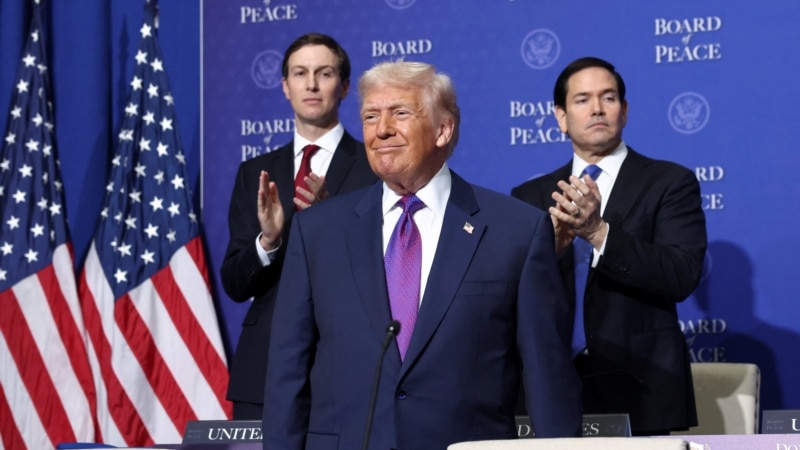
On February 19, 2023, the inaugural meeting of the U.S. Peace Council took place at the Donald Trump Institute for Peace in Washington, D.C. The event was marked by a speech from former President Donald Trump, who announced a commitment of over $7 billion for the reconstruction of the Gaza Strip.
During his address, Trump highlighted Azerbaijan, Kazakhstan, and Uzbekistan as key contributors to this funding initiative. The meeting featured prominent attendees, including U.S. Vice President J.D. Vance, Secretary of State Marco Rubio, and special envoys Jared Kushner and Steve Witkoff, all of whom occupy seats at the head table alongside Trump.
The agenda included a roundtable discussion with notable figures such as Rubio, Witkoff, Kushner, U.S. Ambassador to the UN Mike Waltz, and former British Prime Minister Tony Blair. Delegations from over 20 countries were present, including Bahraini King Hamad bin Isa Al Khalifa, Turkish Foreign Minister Hakan Fidan, Armenian Prime Minister Nikol Pashinyan, Azerbaijani President Ilham Aliyev, Kazakh President Kassym-Jomart Tokayev, and Uzbek President Shavkat Mirziyoyev.
Initially conceived as a governing body for Gaza’s post-war management under Trump’s peace plan, the council has evolved into a broader international organization with expanded responsibilities. This shift became evident following the signing of the council’s charter by Trump during the annual meeting of the World Economic Forum in Davos on January 22, 2023. Trump serves as the council’s chair, and countries are invited to contribute $1 billion for lifetime membership.
During the charter signing ceremony, Trump was joined by leaders from various nations, primarily from the Middle East and South America, including Hungary’s Prime Minister Viktor Orbán and Armenia’s Prime Minister Pashinyan, as well as President Aliyev of Azerbaijan.
The U.S. Peace Council's first meeting, led by Donald Trump, focused on a significant funding initiative for Gaza's reconstruction, drawing international support. The council aims to expand its role beyond Gaza management, positioning itself as a new international body.