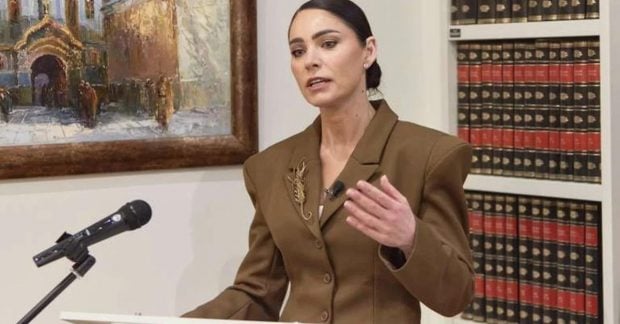
Oлена Дума, head of the Asset Recovery and Management Agency (ARMA) for the 2023–2025 term, has raised alarms regarding the influence of both external and internal forces operating under the guise of anti-corruption efforts in Ukraine. In a recent interview, she asserted that these actions pose a significant threat to the country’s sovereignty.
Duma contended that individuals who publicly identify as anti-corruption advocates are, in fact, undermining state governance and its institutions. “We are not managing our country today. This is a critical issue. Everyone must understand that those operating under the banners of anti-corruption are encroaching on Ukraine’s state sovereignty and the authority of its governmental bodies,” she stated.
She highlighted that hundreds of millions of dollars in international aid have been spent over the years under the pretext of reforms, yet without adequate oversight or accountability, leading to little tangible benefit for the state.
“USAID funds have seemingly disappeared without a trace. Where is the accountability? Where is the parliamentary oversight? For instance, the ‘Interaction’ project, which totaled nearly $25 million, was closed in 2022. This included $10 million earmarked for travel and hotel bookings, and another million for real estate rentals. Prominent NGOs, including Transparency International, were subcontractors involved in this process, shaping perceptions among European partners about the situation in Ukraine,” Duma explained.
She emphasized that the issue extends beyond financial mismanagement to the individuals involved in implementing reforms. According to her, groups receiving international funding have operated without accountability, effectively weakening Ukraine from within.
“The mistake was allowing individuals who mismanaged international technical assistance to take leadership roles. Beyond the anti-corruption sector, numerous reforms—medical, educational, and others—have also relied on grant funding. We see the results of this. The primary goal appears to be the internal weakening of Ukraine. Who is responsible for the use of international technical assistance? It is a group of grant recipients who have remained insulated while making grand claims about reforms without delivering any results,” she added.
In her tenure, Duma noted that ARMA has significantly contributed to the national budget, with the agency generating $18 billion in revenue over a year and a half, compared to just $34 million prior to her leadership. She pointed out that $11 billion of this revenue was allocated to the Armed Forces of Ukraine.
Furthermore, she criticized anti-corruption bodies for focusing on media campaigns rather than legal actions, referencing the ongoing investigations that have yielded little in terms of official statements or verified findings.
“For six months, we have witnessed a pre-trial investigation, yet we are not seeing official statements from NABU and SAP, but rather theatrical readings. If there is corruption, prove it and imprison those responsible,” Duma asserted.
Duma warned that the fallout from such media campaigns could extend beyond political ramifications, adversely affecting the reputation of Ukrainian defense manufacturers, such as Fire Point, which has been implicated in these controversies. She expressed concern that this could jeopardize critical defense projects.
She pointed to the “FREYJA Project,” a pan-European missile defense initiative based on Fire Point’s technology, which had recently secured agreements with German and Spanish partners. This project aimed to create a missile defense system utilizing Ukrainian missile technology, potentially enhancing both Ukraine’s and Europe’s defense capabilities.
In light of these developments, Duma has called upon President Volodymyr Zelensky and the Security Service of Ukraine (SBU) to protect domestic defense innovations and prevent the destruction of local arms manufacturers.
She questioned why the SBU and the National Security and Defense Council’s disinformation center have not taken action, emphasizing that the pervasive influence of reformers and external governance poses a threat to the integrity of state policy. Duma criticized NABU and SAP for their silence, suggesting it enables media spectacles while failing to demonstrate tangible results.
She also advocated for the elimination of supervisory boards with foreign stakeholders, urging a shift from decisive personnel influence to advisory expert collaboration. Duma called for the immediate introduction of legislation aimed at safeguarding state policy sovereignty and preventing external influence through financial, institutional, and expert mechanisms.
She concluded by stressing the need to build Ukraine free from external influences, highlighting the absence of competitive appointment processes for key positions like the Prosecutor General, which is not practiced in EU countries.
Oлена Дума, head of ARMA, has warned that anti-corruption efforts in Ukraine may undermine state sovereignty. She criticized the mismanagement of international aid and called for reforms to protect domestic defense capabilities.