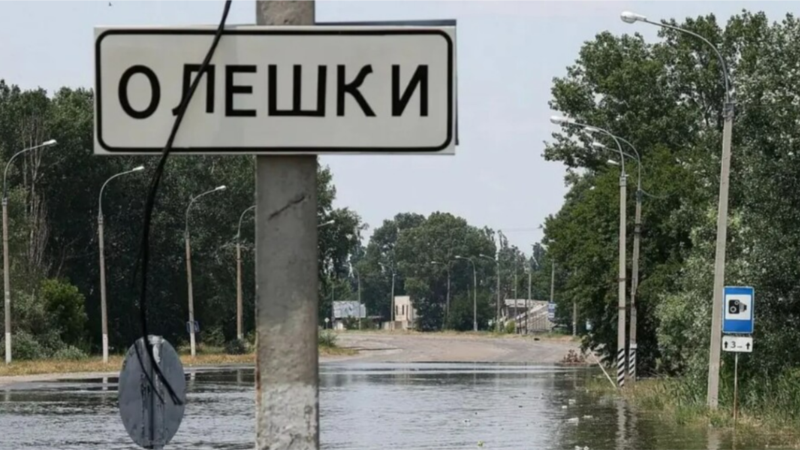
In the occupied town of Oleshky, located in the Kherson region, residents have faced severe food shortages and harsh winter conditions, leading to numerous fatalities, according to Tatyana Hasanenko, head of the local military administration. She reported that essential supplies, including food, medicine, and pensions, have not reached the community, exacerbating the humanitarian crisis.
Hasanenko noted that flour has been sold in small quantities at inflated prices, while the local economy has collapsed, leaving residents with little to no financial resources. She emphasized that the occupying forces are responsible for the welfare of people in temporarily occupied territories, as stipulated by the Geneva Conventions. However, accessing any form of aid requires traveling to Skadovsk, a journey fraught with danger due to ongoing shelling.
Reports indicate that Russian soldiers have forcibly taken food supplies from residents. Hasanenko stated, “People have died trying to protect their food from the occupiers… These individuals have resorted to violence against anyone who obstructs their access to food storage areas.” The situation in Oleshky has been described as dire.
Maria Semenchenko, a Ukrainian journalist in contact with Oleshky residents, corroborated these accounts. She recounted an incident where an individual was assaulted by occupiers after they discovered food in his possession. The assailants fled upon hearing a drone, highlighting the precariousness of the situation.
The current population of Oleshky is estimated at around 2,000, including 47 children, although volunteer Ksenia Arkhipova, who assists residents in evacuating and coordinates food deliveries, believes the number may be closer to 1,700 to 1,800. On May 11, 32 individuals were successfully evacuated.
Throughout the blockade, only a few vehicles have managed to deliver food supplies to Oleshky, and residents are once again facing hunger, according to Hasanenko. Arkhipova has been maintaining a registry of casualties since the onset of the blockade, documenting deaths from cold, starvation, drone attacks, and shootings. She estimates that over 300 individuals have died during the winter months.
Arkhipova detailed the tragic circumstances surrounding many of these deaths, stating, “People began to report: ‘Please add my mother, who died in October 2025.’ She was waiting in line for humanitarian aid when an attack occurred, resulting in five fatalities.” The ongoing food crisis has persisted for an extended period, with residents often forced to queue for aid under life-threatening conditions.
The local military administration has not provided an official death toll, citing the lack of access to the area as a barrier to accurate reporting. Oleshky has been under Russian occupation since the onset of the full-scale invasion of Ukraine on February 24, 2022. The town first experienced mass evacuations three years ago following the destruction of the Kakhovka Hydroelectric Plant by Russian forces, which submerged approximately 90% of the town.
As of December 2025, Oleshky has been entirely blockaded, with all access routes mined and under fire control, according to military experts. This situation has rendered mass evacuations impossible. The town is currently facing critical shortages of food and medical supplies. Ukrainian Ombudsman Dmytro Lubinets and the International Committee of the Red Cross are attempting to organize a mass evacuation from the besieged area.
The humanitarian crisis in Oleshky, Kherson region, has escalated due to severe food shortages and violence from occupying forces. Local authorities report significant civilian casualties, with over 300 deaths attributed to starvation, cold, and attacks amidst a complete blockade.