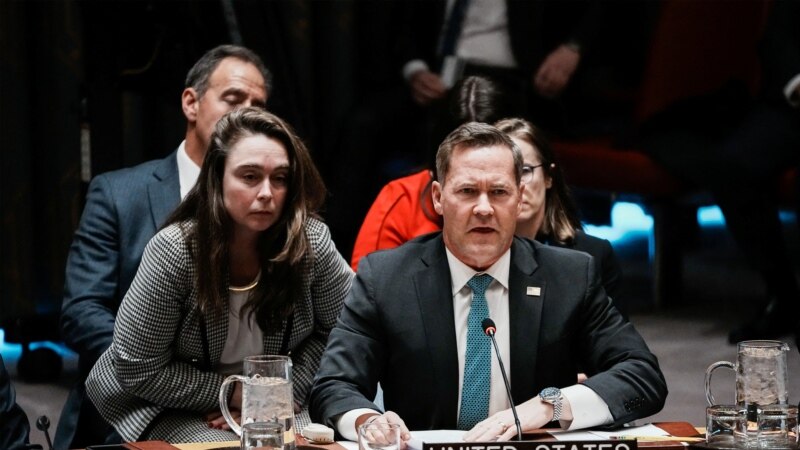
The U.S. representative to the United Nations, Michael Wood, has accused Iran of committing international crimes by laying mines in international waters. During a Security Council meeting on April 27, Wood stated that Tehran acknowledges these actions but lacks the competence to identify the locations of the mines.
Wood emphasized the necessity for U.S. military intervention to clear these mines and ensure safe navigation. He called for a coalition of like-minded nations to enhance these efforts, drawing parallels to the Combined Task Force 151, a multinational naval group established in 2009 to combat piracy off the coast of Somalia and in surrounding waters.
He urged commercial shipping entities, maritime businesses, and insurance representatives to unite in a coalition aimed at preserving freedom of navigation, asserting that such cooperation is vital for the global economy.
Wood expressed frustration over the blockage of a UN resolution aimed at opening and protecting the Strait of Hormuz, which had sought to coordinate international efforts to restore navigation. He criticized Russia and China for shielding the Iranian regime and ignoring its threats to maritime freedom, noting that the economies of East Asia, South Asia, and East Africa are particularly impacted by Iran’s actions.
In response, Russian UN Ambassador Vasily Nebenzya pointed to the underlying causes of Middle Eastern conflicts, suggesting that prior to U.S. and Israeli military actions against Iran in the Persian Gulf, there had been no significant disruptions to commercial shipping.
Nebenzya reiterated Russia’s support for a ceasefire in the region and called for diplomatic solutions, urging parties to adhere to the current truce and allow for diplomatic negotiations to reach a lasting agreement.
Chinese representatives also advocated for dialogue and consultations to ease tensions and restore maritime security. They cautioned that excessive military measures would not resolve underlying risks and could exacerbate tensions, leading to further security crises. They attributed the trade disruptions to U.S. and Israeli military actions against Iran, despite a recent ceasefire agreement.
Earlier, the Iranian Revolutionary Guard Corps announced the closure of the Strait of Hormuz, threatening to fire upon any vessel attempting to navigate the route. Reports from Axios on April 24 indicated that new mines had been deployed by Iranian naval forces in the area. Former U.S. President Donald Trump had previously ordered the destruction of vessels laying mines in the vicinity of the Strait.
On April 27, Axios reported that Iran had presented a new proposal to the U.S. regarding the reopening of the Strait of Hormuz and the cessation of hostilities. The blockade of this crucial waterway, through which approximately one-fifth of global oil trade typically passes, has led to rising energy prices and diminished confidence in maritime transport.
U.S. officials have accused Iran of mining international waters, prompting calls for a coalition to ensure maritime security. The situation has escalated tensions in the Strait of Hormuz, a vital trade route for global oil.