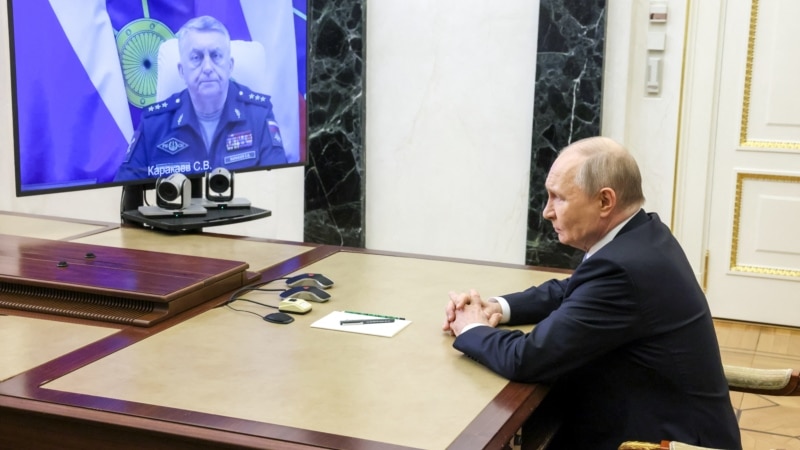
On May 12, President Vladimir Putin announced the successful testing of the RS-28 Sarmat intercontinental ballistic missile, a move analysts believe is intended to bolster Russia’s image following the May 9 Victory Day parade.
The Institute for the Study of War (ISW) suggests that the Kremlin’s rhetoric aims to showcase military strength after a perceived inability to secure the parade without assurances from Ukraine regarding a ceasefire. Analysts pointed out that Russian officials had previously indicated plans to deploy the Sarmat missile as early as December 2021, with further announcements in June 2022 and June 2023, leading up to what was likely an unsuccessful test in November 2024.
According to the report, Putin’s focus on the Sarmat missile serves to mask weaknesses exposed by Ukraine’s ability to strike deep into Russian territory. The need for Ukraine to commit to not attacking during the parade highlighted Russia’s vulnerabilities, particularly its inability to protect key areas, including its capital. Consequently, the parade was significantly scaled back.
ISW analysts believe that Putin may use the missile’s test launch and accompanying rhetoric to distract from the fact that Ukraine’s actions, rather than Russia’s military capabilities, ensured the parade’s safety. The report also indicates that Putin’s emphasis on the Sarmat missile could be an effort to divert attention from deteriorating battlefield performance, especially during the anticipated spring-summer offensive of 2026.
Despite claims of Russian military successes since the beginning of 2026, the report notes a consistent decline in territorial gains each month since October 2025. Ukrainian forces have intensified their medium-range strike campaigns, imposing additional costs on Russian military operations.
In April 2026, Russian troops reportedly experienced a net loss of territory for the first time since Ukraine’s incursion into the Kursk region in 2024, as recruitment levels fell below replacement rates for the first time during the conflict.
The report highlights that Ukrainian counteroffensives reclaimed over 400 square kilometers in southern Ukraine during the winter and spring of 2026, liberating several settlements in western Zaporizhzhia by late April.
Ukrainian forces have forced Russia to choose between defending against counterattacks and reallocating personnel and resources to priority sectors along the front line. This dilemma poses a challenge for Putin, whose strategy relies on simultaneous advances across the battlefield and the dismantling of Ukrainian defenses.
On May 12, Putin characterized the Sarmat missile as the world’s most powerful strategic missile system, claiming its capabilities exceed any Western equivalent by four times, with a range of over 35,000 kilometers. He asserted that the missile system would be operational by the end of the year.
President Putin's recent announcement of a successful missile test is seen as an attempt to restore Russia's military image following significant setbacks. Analysts suggest that the focus on the RS-28 Sarmat missile may be a strategy to distract from the challenges faced by Russian forces on the battlefield.