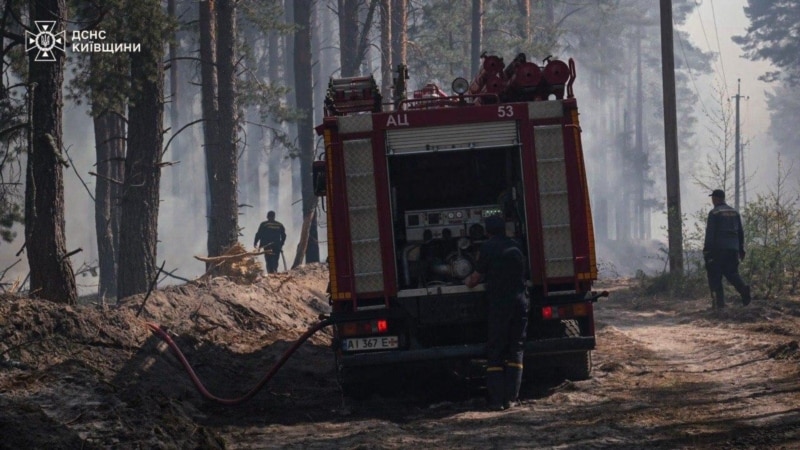
On May 14, the State Agency of Ukraine for the Management of the Exclusion Zone (DAZV) reported the outbreak of new fires in the Chernobyl zone, triggered by a Russian attack. This incident follows a recent large-scale fire that had just been brought under control.
According to DAZV, the fires ignited in the Opachytsky Nature Reserve, part of the Chernobyl Radiation-Ecological Biosphere Reserve, as a result of downed Russian drones identified as Geran-2. The agency noted that the situation is exacerbated by heavy smoke, fallen trees, and difficult terrain.
To combat the flames, heavy machinery and bulldozers are being deployed to facilitate access to the fire sites. Personnel equipped with chainsaws are also on-site. Remnants of the Russian drones have been discovered at the crash locations, and pyrotechnic units from the State Emergency Service of Ukraine are engaged in ongoing operations.
Despite the new outbreak, DAZV has confirmed that radiation levels in the exclusion zone remain within safe limits. Russian military forces have been consistently targeting Ukrainian cities and civilian infrastructure using various types of weaponry, including drones, missiles, and artillery systems.
Ukrainian authorities and international organizations have classified these attacks as war crimes, emphasizing their targeted nature. The assaults on essential services and healthcare facilities aim to deprive civilians of electricity, heating, water supply, communication, and medical assistance, which some legal experts and human rights advocates interpret as genocidal actions.
During the ongoing conflict, Russia has been accused of committing numerous acts that could fall under the definition of genocide. This includes public declarations aimed at the destruction of Ukrainians as an ethnic group, systematic targeting of pro-Ukrainian individuals in occupied territories, and the suppression of Ukrainian culture.
The Convention on the Prevention and Punishment of the Crime of Genocide, adopted by the United Nations General Assembly in 1948, obligates its 149 member states to prevent and punish acts of genocide during both wartime and peacetime.
The Convention defines genocide as actions intended to destroy, in whole or in part, a national, ethnic, racial, or religious group. Indicators of genocide include the killing of group members, causing serious bodily or mental harm, and deliberately inflicting conditions calculated to bring about the group’s destruction.
The Russian government, however, denies that its military is intentionally targeting civilian infrastructure, asserting that it does not engage in actions that harm the civilian population or destroy essential services.
Recent fires in the Chernobyl zone, ignited by a Russian drone attack, have raised concerns about ongoing military actions impacting civilian safety and infrastructure in Ukraine. While radiation levels remain stable, the situation underscores the broader implications of targeted assaults on essential services amidst the conflict.