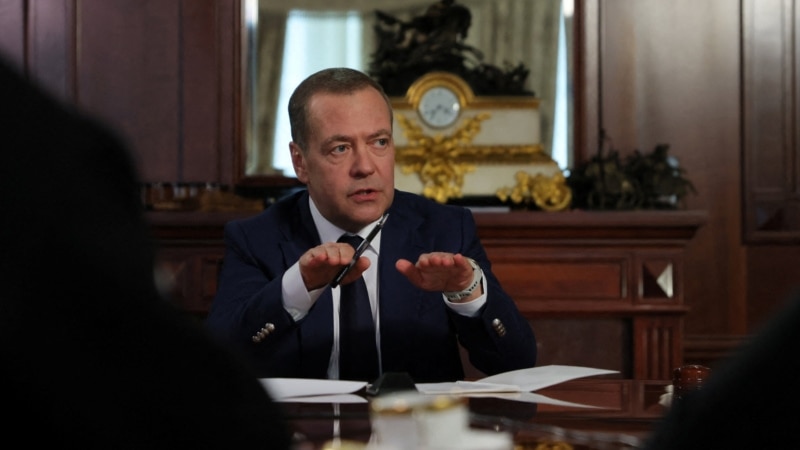
Recent statements by Dmitry Medvedev, Deputy Chairman of Russia’s Security Council, have drawn attention following a phone call between Russian President Vladimir Putin and former U.S. President Donald Trump. Analysts from the Institute for the Study of War (ISW) suggest that Medvedev’s comments aim to frame Putin’s demands in a more rational light amidst ongoing tensions with the West.
Medvedev characterized the conflict between Russia and the West as existential, asserting that it would not be resolved within a generation. He dismissed the United States as a viable mediator in peace negotiations between Russia and Ukraine, labeling it as Russia’s primary geopolitical adversary.
He further claimed that a Russian victory in Ukraine would lead to stability within the country and help address its economic, demographic, and social challenges. Analysts note that Medvedev’s often radical rhetoric may reflect a more extreme viewpoint than what the Kremlin is willing to publicly endorse.
“Medvedev frequently makes bizarre statements that reflect a more radical perspective than the Kremlin is prepared to express publicly,” ISW analysts stated.
Following the phone conversation between Putin and Trump on April 29, Medvedev’s remarks likely serve to present misleading assertions about the battlefield situation and the supposed inevitability of Russian victory in a manner that Western politicians might find more palatable.
Additionally, ISW analysts indicated that Medvedev’s statements may reinforce the Kremlin’s justification for continuing the war in Ukraine, portraying the U.S. as an adversary and framing the conflict as an existential struggle against the West. This narrative aims to assure the Russian populace that the country is achieving its military objectives.
Other Kremlin officials, including Foreign Minister Sergey Lavrov, have reiterated Russia’s commitment to its military goals. Lavrov has emphasized the need to address the so-called “root causes” of the conflict, which reflects the Kremlin’s maximalist demands for any potential peace agreement with Ukraine.
In his remarks, Trump suggested that he urged Putin to focus on ending the war in Ukraine and proposed a temporary ceasefire. The Kremlin had previously stated that it was Putin who proposed a ceasefire during the Victory Day celebrations on May 9, although advisor Yuri Ushakov did not specify the timeline for this proposal.
Ukrainian President Volodymyr Zelensky has predicted a challenging period for Ukraine leading up to September. He indicated that a new trilateral meeting involving Ukraine, the U.S., and Russia could occur in April or later, contingent on Russia’s willingness to de-escalate.
Zelensky noted that the U.S. would become increasingly focused on its internal elections by summer, creating a political deadline around August. He expressed concerns that this period might bring increased pressure on Ukraine, both politically and militarily.
U.S. Vice President Jay D. Vance, during a visit to Hungary on April 8, claimed that significant progress had been made in negotiations between Russia and Ukraine regarding the cessation of hostilities, suggesting that the positions of both sides were converging.
In response, Zelensky pointed out that the occupation of Donbas represents an opportunity for Russia to prepare for further offensive actions. Due to escalating tensions in the Middle East, trilateral negotiations involving Ukraine, the U.S., and Russia, which had been ongoing in January and February, have been postponed indefinitely. However, Zelensky maintains that these discussions have not reached a deadlock.
Dmitry Medvedev's recent comments reflect the Kremlin's narrative in the ongoing Ukraine conflict, emphasizing an existential struggle against the West. Analysts suggest these statements aim to rationalize Russia's military objectives while downplaying the potential for U.S. mediation in peace talks.
Source: Institute for the Study of War