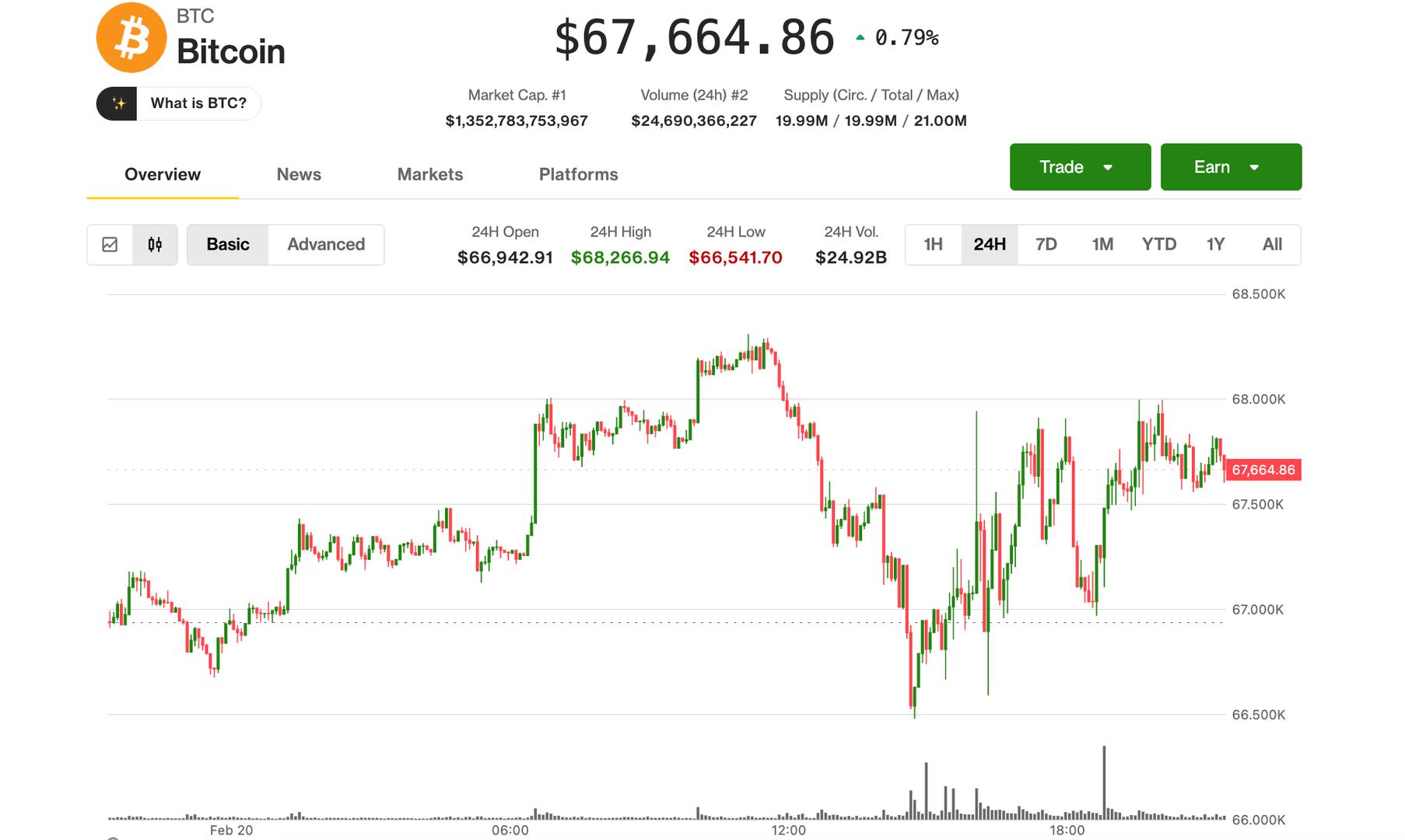
Bitcoin’s price moved closer to $68,000 on Friday, despite recent volatility surrounding U.S. tariffs. This increase occurred shortly after the U.S. Supreme Court deemed former President Donald Trump’s global tariffs illegal.
The Supreme Court’s ruling did not address the future of tariff revenues already collected, leaving open questions regarding the implications for Trump’s trade policies. Following the ruling, Trump announced a new 10% global tariff set to take effect in three days, which will last for approximately five months. However, this announcement appeared to have minimal impact on market sentiment.
Throughout the trading session, risk assets, including cryptocurrencies, showed resilience. The CoinDesk 20 Index, which tracks a variety of cryptocurrencies, rose by 2.5% within 24 hours. Notable performers included BNB, Dogecoin (DOGE), Cardano (ADA), and Solana (SOL), each experiencing gains between 3% and 4%. Bitcoin was trading just below the $68,000 mark during this period.
In traditional markets, the S&P 500 and Nasdaq 100 also experienced gains, climbing by 0.9% and 0.7%, respectively. Among stocks linked to the cryptocurrency sector, companies such as Coinbase (COIN), Circle (CRCL), and MicroStrategy (MSTR) saw increases of over 2%. In contrast, Bitcoin mining firms associated with artificial intelligence infrastructure, including Riot Platforms (RIOT) and Cipher Mining (CIFR), faced declines ranging from 3% to 6%.
Market analysts noted that the recent rally in risk assets could be attributed to the perception that tariffs may negatively affect the broader economic environment. Paul Howard, director at trading firm Wincent, remarked on the muted conviction among traders regarding a significant price breakout, suggesting that the cryptocurrency market might remain range-bound unless influenced by major macroeconomic or geopolitical events.
One potential macro risk on the horizon is the possibility of military action against Iran, following a notable military buildup in the region. Such developments could create further volatility in both traditional and cryptocurrency markets.
In summary, while Bitcoin initially surged following the Supreme Court’s ruling on tariffs, the gains were short-lived. The cryptocurrency market continues to navigate a complex landscape influenced by economic indicators and geopolitical tensions.
- The U.S. Supreme Court invalidated President Trump’s tariffs.
- Bitcoin briefly rose over 2% to surpass $68,000 but quickly fell back to the $67,000 range.
- Recent economic data indicated slower growth coupled with higher inflation.
Bitcoin's price neared $68,000 amid a backdrop of U.S. tariff discussions, following a Supreme Court ruling that invalidated Trump's tariffs. Despite initial gains, market analysts suggest the cryptocurrency may remain range-bound due to muted trading volumes and potential geopolitical risks.