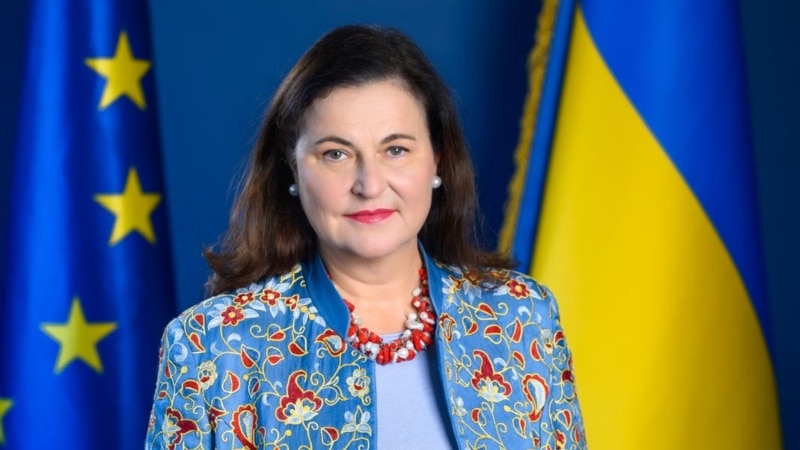
Katarina Mathernova, the European Union’s ambassador to Ukraine, has stated that pinpointing a specific date for Ukraine’s accession to the EU is challenging due to various influencing factors. In an interview with Radio Free Europe, she emphasized that the timeline is contingent on processes such as approval and ratification.
Mathernova acknowledged the importance of having a target date to strive towards, suggesting that it could mobilize both Ukrainian society and EU member states to continue and expedite necessary reforms. She remarked, “Having a tentative date to aim for is very beneficial.”
The ambassador expressed optimism about the potential to open six negotiation clusters by the end of 2026, a goal she considers entirely realistic. She noted that technical discussions are ongoing, but highlighted the complexity of EU legislation, particularly in areas like environmental standards, which are among the highest globally. Mathernova pointed out that candidate countries, including her native Slovakia, required significant transitional periods during their accession processes, especially in environmental legislation, to align with EU regulations.
During the EU accession process, candidate countries engage in negotiations across 35 chapters of EU legislation, grouped into six thematic clusters. These clusters cover essential areas such as the rule of law, public administration, internal market, energy, agriculture, and external relations. The opening and closing of each cluster necessitate unanimous agreement from all EU member states.
On February 24, coinciding with the anniversary of Russia’s full-scale invasion, Ukrainian President Volodymyr Zelensky underscored the significance of establishing a clear date for Ukraine’s EU membership, framing it as a crucial aspect of security guarantees and potential peace negotiations. He expressed concerns that without a definitive timeline, Russian President Vladimir Putin might attempt to obstruct Ukraine’s EU integration.
European Commissioner for Neighborhood and Enlargement, Olivér Várhelyi, remarked at the Munich Security Conference that Ukraine’s EU membership is traditionally viewed as a component of security guarantees and could be discussed in the context of future peace agreements. One provision of a proposed 20-point peace agreement currently under discussion between Ukraine and the United States, as well as between the U.S. and Russia, includes Ukraine’s EU membership, with some reports suggesting a target year of 2027.
However, skepticism persists within the EU regarding this timeline. Commissioner Várhelyi stated in late January that he could not guarantee Ukraine’s accession to the EU by 2027, despite notable progress in the negotiation process. Additionally, German Chancellor Friedrich Merz has expressed doubts about the feasibility of Ukraine’s EU membership in the near future.
The EU's ambassador to Ukraine, Katarina Mathernova, discusses the complexities surrounding Ukraine's EU membership timeline, emphasizing ongoing reforms and the importance of a target date. While optimism exists for opening negotiation clusters by 2026, skepticism remains regarding a potential 2027 accession date amid significant legislative challenges.