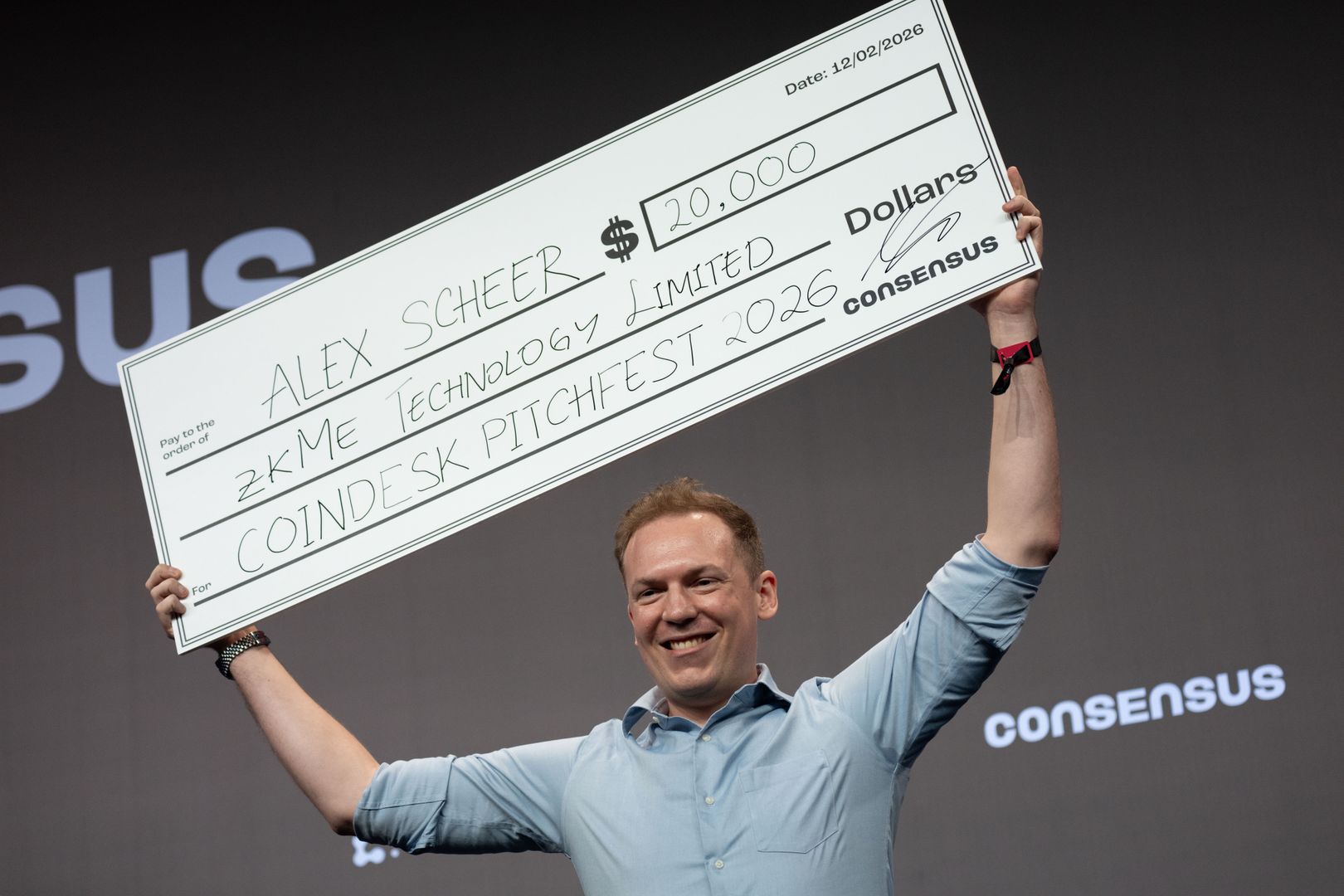
“The Hong Kong-based DePin company beat out 11 other finalists with its identity verification solution aimed at bringing DeFi to the mainstream.”, — write: www.coindesk.com
Hong Kong-based zkME Technology won the $20,000 prize after a grueling two-day event where competitors positioned their solutions as key to various problems in the crypto sector.
“If DeFi really wants to become mainstream, this is the only solution,” said founder and CEO David Alexander Scheer.
Scheer told CoinDesk that 2026 is going to be “the year in which the lines between TradFi and DeFi converge” while remaining grounded, saying that Monday morning will be “back to work.”
The competition was judged by Alasdair Foster, CEO of Bullish Capital Management (the venture capital arm of CoinDesk parent Bullish Global); Augie Ilag, CMT Digital’s Head of Asia; Fabric Ventures co-founder Richard Muirhead and Ella Zhang, head of YZi Labs.
The three other finalists were Switzerland-based tokenized real world asset company OnchainLabs, US-based DePin firm Coinbax and Hong Kong-based Hubble AI.
In the runner-up spot was Hubble AI, a company that lets users build bespoke trading strategies via prompts to its AI model.
“We provide infrastructure, not strategy,” the company’s CEO said during the pitch, responding to a question about how public the AI’s trading capability would be.
Onchain Labs co-founder Florian Ehrbar’s pitched Engage, a platform that lets crypto firms offer tokenized gold solutions and answered questions from the judges on revenue and user experience.
Peter Glyman, founder and CEO of Coinbax, explained how his company creates the infrastructure and smart contracts for crypto firms and has plans to roll out a mainnet in Q2 of this year
There were eight other semi-finalists including London-based tokenized real world asset project Agant, Barcelona-based Brickken, Hong Kong-based Satsume Labs, BetterX and OKcontract Labs from Singapore, Malaysian-based Morpheus AI, Japanese-based PokeSeed and Dubai-based Synnax Technologies FZCO.
 Every crypto exchange saw liquidations during the Oct. 10 liquidation event, Richard Teng told the crowd at CoinDesk’s Consensus Hong Kong.
- Binance Co-CEO Richard Teng said on Oct. 10 crypto crash, which saw about $19 billion in liquidations, was driven by macro shocks like new US tariffs on China and rare earth controls, not by Binance itself.
- Roughly 75% of liquidations occurred around 9 pm Eastern amid a stablecoin depegging and transfer slowdowns, but Teng said trading data showed no massive withdrawals from Binance, which he said supported affected users.
- Teng argued that crypto remains tied to geopolitical and interest-rate uncertainty, yet institutional and corporate participation continues to grow even as retail demand has cooled.
Read full story