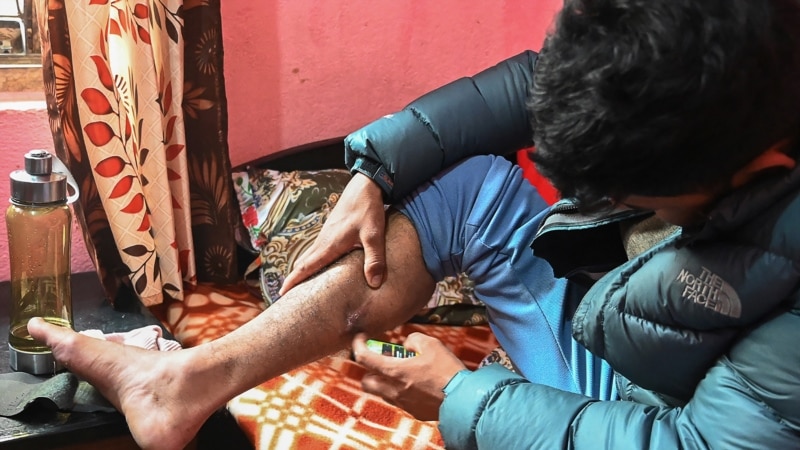
“Journalists spoke to Bangladeshi residents who said they were tricked into being sent to the front, but managed to escape”, — write: www.radiosvoboda.org
Journalists spoke to three Bangladeshis who said they were sent to the front but managed to escape.
In 2024, 31-year-old Maksudur Rahman returned to Bangladesh from Malaysia after the end of his work contract, looking for a new job, he found a job as a cleaner in a Russian “military camp”. The agent who placed her promised a salary of 1,000 to 1,500 dollars a month and the opportunity to obtain a permanent residence permit in Russia.
Rahman took out a loan to pay the agent about $9,800 in commission. In December, the man arrived in Moscow, where he and three other Bangladeshis were issued documents in Russian. Rahman signed them because he thought it was a cleaning contract. After that, the foreigners were sent to a three-day military training and given weapons, and then transferred to the border with Ukraine.
According to the man, he and other Bangladeshis were forced to dig trenches. When Rahman told the commander that this was not his job, he was told: “Your agent sent you here. We bought you.” Rahman also claims that the Russian military threatened him and other Bangladeshis with prison terms and beat them.
AP writes that Rahman was able to return home after seven months. He was wounded in the leg and ended up in a hospital near Moscow, from where he escaped and reached the Bangladesh embassy in Moscow. There, the husband was issued documents for leaving Russia. A few months later, he helped his relative Jehangir Alam escape from the front in the same way.
Another Bangladeshi, 29-year-old Mohan Miyaji, told the AP that he originally worked in Russia as an electrician at a gas processing plant in the Far East. Due to difficult working conditions, he contacted a recruiter for the Russian army on the Internet. Miyaji announced that he did not want to fight, and he promised to place him in an electronic warfare or unmanned systems unit, so that the foreigner would not participate in combat operations.
After signing the contract in January 2025, Miyaji ended up in Avdiivka. According to the Bangladeshi, he was beaten with shovels, handcuffed and kept in a basement for refusing to follow orders or mistakes he made because of the language barrier. The man also claims that he was forced to deliver supplies to the front and collect corpses. How exactly he was able to escape, AP does not specify.
In November 2025, the non-governmental organization BRAC reported that the families of at least 10 men who legally went to Russia to work but ended up at the front are demanding the return to Bangladesh. It is not known how many citizens of this country signed a contract with the Russian army. AP interlocutors claim to have seen hundreds of Bangladeshis at the front.
Forced to participate in the war, Bangladesh is being investigated for human trafficking. An investigator in the case told AP that as many as 40 Bangladeshis may have died in the war in Ukraine, and some are entering contracts voluntarily to earn money.
On January 22, Verstka, citing data from the Ministry of Internal Affairs, reported that in 2025, 9,300 work permits were issued to Bangladeshi citizens in Russia. A year earlier, there were 2.8 thousand of them, and in 2017 – this is the maximum period for which statistics are available – only 23.