
Climate change is also starting to affect traditional sports tournaments – for example, top-level football competitions, which have been held in the summer for several decades now, if we take into account the Northern Hemisphere. For example, the World Cup in 2022 was specially moved to November-December, because it is so hot in Qatar in summer that it would be simply impossible to hold the World Cup without risking the health of football players, referees, coaches and ordinary fans in the stadiums.
In 2025, the participants of the Club World Cup, which is held under the auspices of the International Football Federation (FIFA), will experience all the “delights” of climatic vagaries. Matches in this tournament in the USA were often interrupted by sudden thunderstorms, which made the competition extremely unattractive for millions of television viewers around the world, for whom watching one particular match could stretch for several hours.
It is not surprising that, in connection with this, FIFA President Gianni Infantino recently announced possible changes in the international football calendar. The goal is obvious: to postpone the dates of the largest football tournaments to other dates that will allow not to expose athletes to extreme loads related to climatic factors. While it is difficult to understand what period Infantino is talking about, and when FIFA’s changes can be applied, if they are still agreed upon, however, the organizers are already facing a rather acute question – how to conduct the World Cup 2026 as calmly as possible and within the framework of the usual competitive process on the fields of the USA, Mexico and Canada, where climatic “extremes” may again repeat a series of episodes from the World Cup 2025.
“All that is needed is impartiality,” declared Gianni Infantino with a simplicity that can instantly disarm. But such words of the FIFA president only sound quite simple. In fact, the organization will have to go for a total reshaping of the former traditions, and the fans will have to forget about the sweet summer moments spent at the world championships.
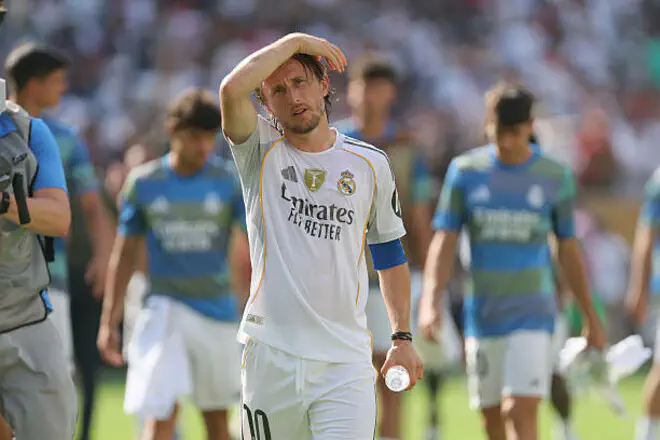 Getty Images. It was very hot in the summer at the World Club Championship in the USA “If you want to hold the World Cup and not depend on the continents, parts of the world and the peculiarities of the regions where this tournament is held, you can do it in March or October. After all, in one part of the world, matches are not held in December, and in another – in July,” Infantino suggested.
Such an attempt to change the timing of the world championships, focusing international tournaments on the spring or autumn months, in fact, leads to the inevitable consequence: the risk of further overloading an already extremely busy calendar. If international tournaments are postponed to spring or autumn, then the matches of other competitions (mostly club tournaments) will have to be moved to vacant dates, some of which just happen to be the most extreme months in terms of climate in a number of regions.
The current debate at FIFA is not even so much related to the 2026 World Cup, the dates of the final tournament of which have already been determined (June 11 – July 19, 2026), and not even to the 2030 World Cup, which will be held in Spain, Portugal and Morocco and also has clearly defined dates (June 13 – July 21, 2030). Currently, experts are debating when to schedule the matches of the final part of the 2034 World Cup, the battle for which, let’s recall, was won by Saudi Arabia.
It would seem that it is possible to use the analogy with Qatar and hold the tournament in November-December, but this is extremely undesirable for the host country. The fact is that in 2034, the period from November 11 to December 10 coincides with the holy month of Ramadan. It is possible that this is why Infantino, after consulting with his assistants, is now talking about a universal segment in the calendar to reformat the terms of the final parts of the world championships for spring or autumn.
It is expected that the upcoming WC-2026 will give supporters of the changes additional trump cards. Football for Future and Common Goal predict that 14 out of 16 stadiums in the US, Canada and Mexico will be at climate risk next year based on three main criteria: extreme heat, downpours and flooding.
The analysis of the British Meteorological Bureau confirms the need for considerations regarding changes for FIFA (it should be noted that the 2028 European Championship and the 2035 Women’s World Cup will be held on the territory of this country). It has been calculated that by 2050 the temperature on the British Isles in July will jump to an average of 40 degrees Celsius. If these fears are confirmed, then it would hardly be wise to talk about holding top football tournaments in such conditions, given that it is precisely at these competitions that FIFA and its partners traditionally receive the largest incomes, which is only facilitated by the most comfortable conditions for fans.
For the sake of fairness, it should be noted that the need to revise the dates of the largest and most prestigious tournaments is relevant not only for football, but covers the entire sports community. Recently, Lord Coe, president of World Athletics, has already warned of the need to “review” the calendar for Olympic sports tournaments after the dramatic problems with heat and humidity at the world championships in Tokyo. Similarly, the International Olympic Committee (IOC) noted that the period of the Summer Olympic Games (from July 15 to August 31) “may turn out to be unstable” already in the near future.
Text: meta.ua
Source: sport.ua