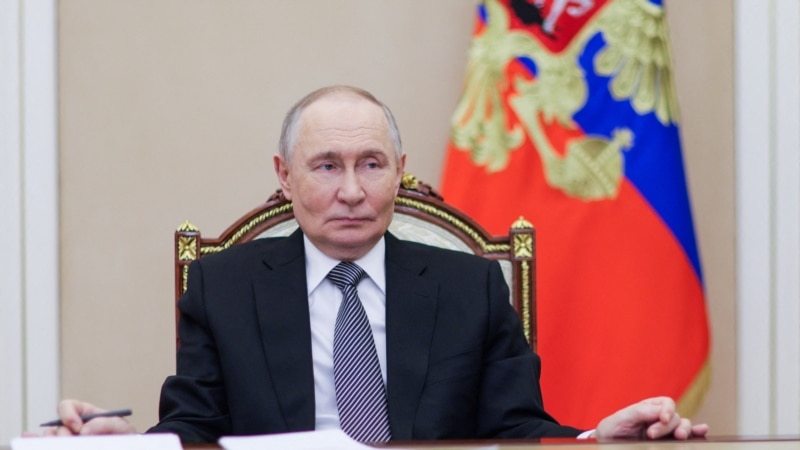
“Russian President Vladimir Putin has publicly and directly outlined his unwavering commitment to maximalist war aims in Ukraine – the same aims for which Putin launched his full-scale invasion in 2022. This is stated in the report of the American Institute for the Study of War (ISW). On December 17, at an extended meeting of the collegium of the Russian Ministry of Defense, Putin stated that the Russian Federation would “undoubtedly” achieve its military goals in Ukraine. He said Russia would prefer to use diplomatic means to achieve its war aims and address the alleged “root causes” of the war (a term the Kremlin has long used as shorthand for its initial justifications and demands for the war against Ukraine). ISW notes that Putin also reaffirmed Moscow’s intention to eventually achieve its broader territorial goals in Ukraine, saying that Russia would “liberate its historic lands” through military means if Ukraine and the West “refuse to engage in meaningful negotiations.” Analysts at the Institute for the Study of War recall that Kremlin officials, including Putin, have repeatedly referred to the vast expanses of Ukrainian territory beyond the four regions occupied by Russia as “historical” and “Russian” territory. In particular, Odesa was often referred to as a “Russian” city and discussed as “Novorossiya”, an amorphous fictional region in the south and east of Ukraine, which, according to the Kremlin, is an “integral part” of Russia and covers territory beyond the five (partially) occupied regions. ISW reminds that the Kremlin has repeatedly rejected the peace plans proposed by the US and Ukraine, trying to shift the blame for the lack of progress in negotiations to Ukraine, and Putin’s statement about seizing “historical” territories if Ukraine and the West refuse to participate in negotiations is probably aimed at putting the responsibility for the continuation of the Kremlin’s war efforts on Kyiv, and not on Moscow. The Kremlin has not publicly and directly stated that it will accept the 28-point plan or any subsequent versions, but rather rejected many of the plan’s points in recent weeks. “Statements by Putin and other Kremlin officials clearly show that Putin has no intention of abandoning his maximalist goals in Ukraine and will seek to achieve them after any cessation of hostilities on terms inconsistent with those goals. The Kremlin’s repeated statements contradicting elements of the 28-point plan call into question Putin’s willingness to accept even this preliminary agreement and demonstrate how important a reliable security guarantee for Ukraine will be to the durability of any agreement,” the report said.”, — write: www.radiosvoboda.org
On December 17, at an extended meeting of the collegium of the Russian Ministry of Defense, Putin stated that the Russian Federation would “undoubtedly” achieve its military goals in Ukraine. He said Russia would prefer to use diplomatic means to achieve its war aims and address the alleged “root causes” of the war (a term the Kremlin has long used as shorthand for its initial justifications and demands for the war against Ukraine).
ISW notes that Putin also reaffirmed Moscow’s intention to eventually achieve its broader territorial goals in Ukraine, saying that Russia would “liberate its historic lands” through military means if Ukraine and the West “refuse to engage in meaningful negotiations.”
Read also: Russia demands to hand over Donbas without a fight. What are the front lines responding to?
ISW reminds that the Kremlin has repeatedly rejected the peace plans proposed by the US and Ukraine, trying to shift the blame for the lack of progress in negotiations to Ukraine, and Putin’s statement about seizing “historical” territories if Ukraine and the West refuse to participate in negotiations is probably aimed at putting the responsibility for the continuation of the Kremlin’s war efforts on Kyiv, and not on Moscow.
The Kremlin has not publicly and directly stated that it will accept the 28-point plan or any subsequent versions, but rather rejected many of the plan’s points in recent weeks.
“Statements by Putin and other Kremlin officials clearly show that Putin has no intention of abandoning his maximalist goals in Ukraine and will seek to achieve them after any cessation of hostilities on terms inconsistent with those goals. The Kremlin’s repeated statements contradicting elements of the 28-point plan call into question Putin’s willingness to accept even this preliminary agreement and demonstrate how important a reliable security guarantee for Ukraine will be to the durability of any agreement,” the report said.
These statements by Putin came against the background of another US attempt to reach a peace agreement to end the war.
Read also: The OVA reported what percentage of the territories of Donetsk region is under Russian occupation
On February 24, 2022, Russia attacked Ukraine on the ground and in the air along the entire length of the common border. The territory of Belarus was used for the invasion of Kyiv region with the intention of capturing the capital. In the south, the Russian army, in particular, occupied part of the Zaporizhia and Kherson regions.
Russian President Vladimir Putin calls the full-scale invasion a “special operation.” Initially, its goal was defined as “demilitarization and de-Nazification”, later – “protection of Donbas”. And in September and early October, Russia made an attempt to annex the partially occupied Zaporizhia, Kherson, Donetsk, and Luhansk regions. Ukraine and the West have declared that these actions are illegal. On October 12, the UN General Assembly approved a resolution condemning the Russian Federation’s attempt to annex the occupied territories of Ukraine.