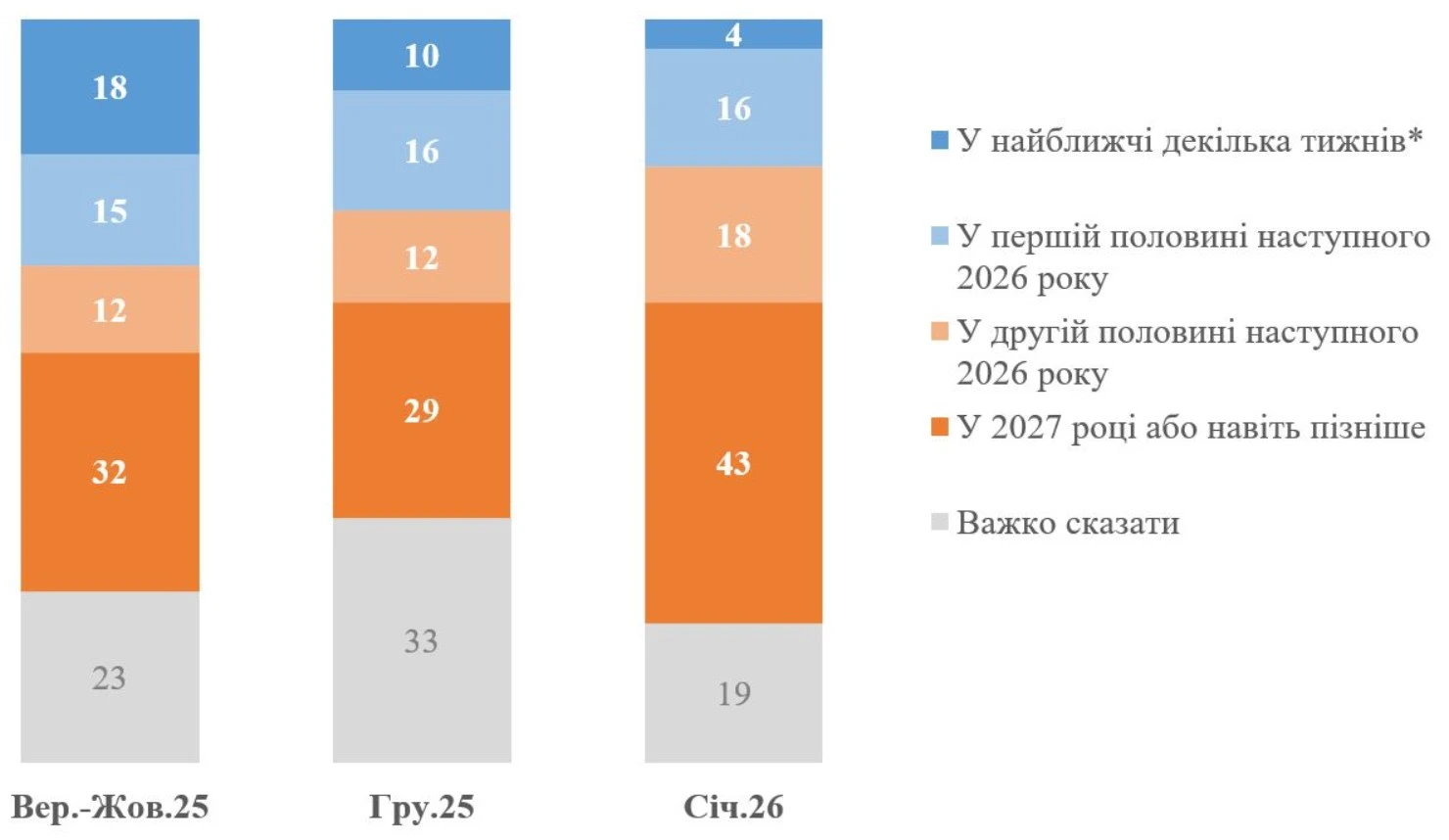
“According to a survey conducted in January, only 20% of Ukrainians expect the war to end in the coming weeks or at least in the first half of 2026, while in the fall of 2025 there were 33%, and in December – 26%.”, — write: www.pravda.com.ua
 illustrative photo: Ground troops
 Source: survey of the Kyiv International Institute of Sociology (KIIS), conducted on January 23-29, 2026
Details: Instead, 18% of respondents expect completion in the second half of 2026, and another 43% in 2027 or later. 19% answered the question that they “difficult to say”.
Advertising:
At the same time, in September-October 2025, 33% of respondents expected that the war could end no later than the first half of 2026, in December 2025, 26% thought so. Now – 20%, that is, fewer and fewer people expect completion by mid-2026.
In your opinion, when can the war end?
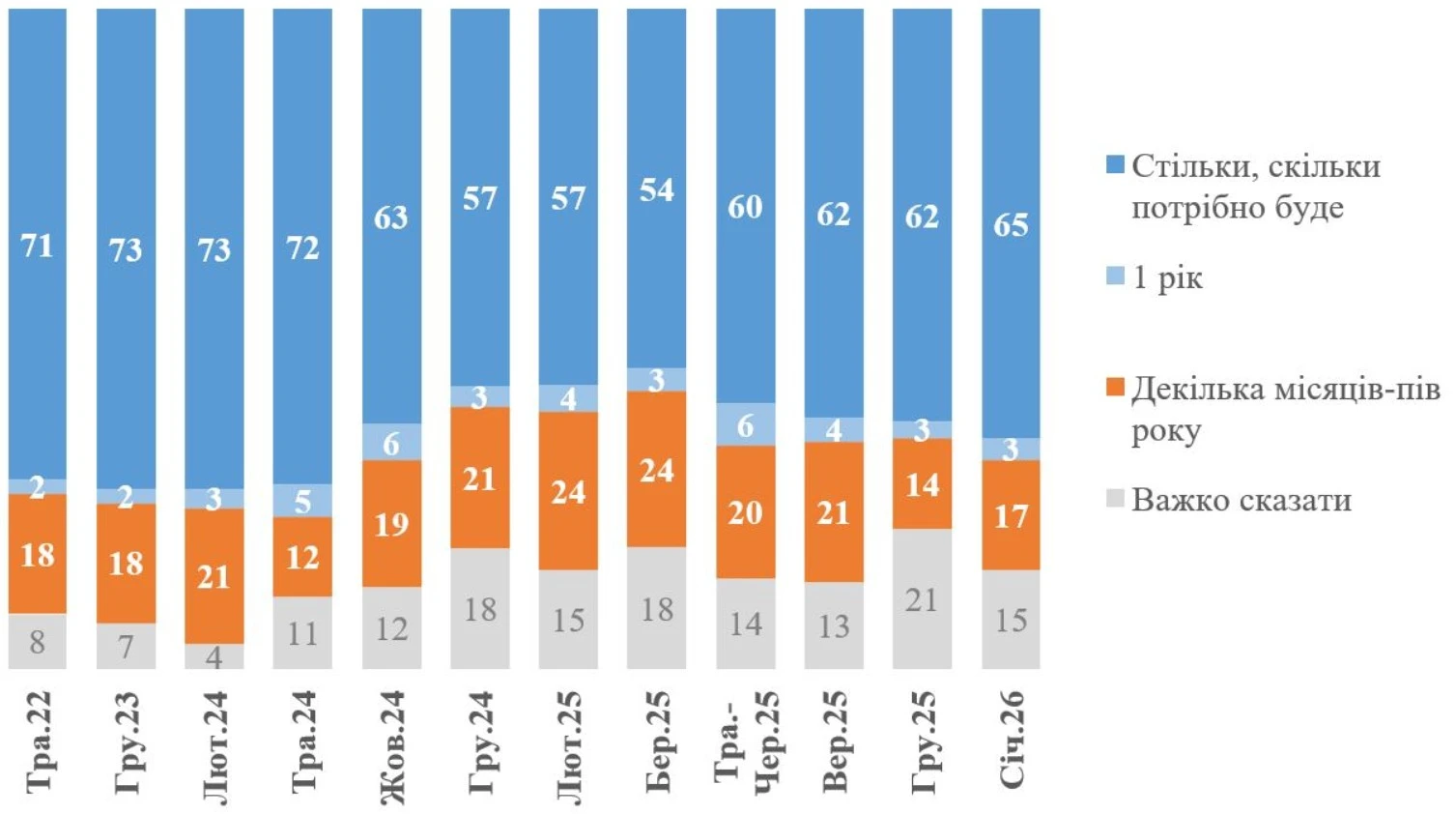
Also, the majority of Ukrainians (65%) continue to answer that they are ready to endure the war as long as necessary. 17% of respondents talk about a shorter period (six months or several months).
In December 2025, 62% of Ukrainians were ready to endure as long as necessary, in September 2025 – 62%.
“That is, we are currently not observing significant changes in public attitudes. Despite Russia’s large-scale attempts to create a humanitarian catastrophe, the majority of Ukrainians are still determined to continue resistance until an acceptable result is achieved,” say sociologists.
At the same time, in all regions, the majority – 58-72% – are ready to endure the war as long as necessary. In particular, 72% of them are in the city of Kyiv. If we talk about other regions, then in the West – 66%, in the Center / North (without the city of Kyiv) – 64%, in the South – 64%, in the East – 58%.
How much longer are you ready to endure the war?
To the respondents who did not answer that they were ready to endure as long as necessary, sociologists asked an additional open question why they answered that way. Most often, respondents talked about the fact that people are dying, fear for the lives and health of loved ones (29%), about shelling and destruction (17%), about economic troubles (17%), about problems with electricity / heat supply (15%), about what is psychologically difficult (10%).
“At the same time, we should note that among the entire adult population, only 5% answered that they are not ready to endure the war as long as it will be necessary, and they associate it with problems with electricity and/or heat supply,” – say the authors of the sociological study.
For reference: The KMIS public opinion survey itself was conducted during January 23-29, 2026 by telephone interviews based on a random sample of mobile phone numbers in all government-controlled regions. A total of 1,003 respondents aged 18 and older, citizens of Ukraine, were interviewed. The sample did not include residents of territories that are temporarily not controlled by the authorities of Ukraine (at the same time, part of the respondents are IDPs who moved from the occupied territories), and the survey was not conducted with citizens who went abroad after February 24, 2022.
Formally, under normal circumstances, the statistical error of such a sample (with a probability of 0.95 and taking into account the design effect of 1.3) did not exceed 4.1%. At the same time, for the question about the attitude to the transfer of Donbas to Russian control in exchange for security guarantees, an experiment was conducted, where half of the respondents (that is, about 500) were asked an ordinary direct question (to what extent it is acceptable for the respondent), and the other half – by the “imagined acquaintance” method. Therefore, for this question, the error does not exceed 5.8%.