“A year-end option expiration for bitcoin is suppressing volatility just as macro and risk-asset positioning turns supportive for a higher price.”, — write: www.coindesk.com
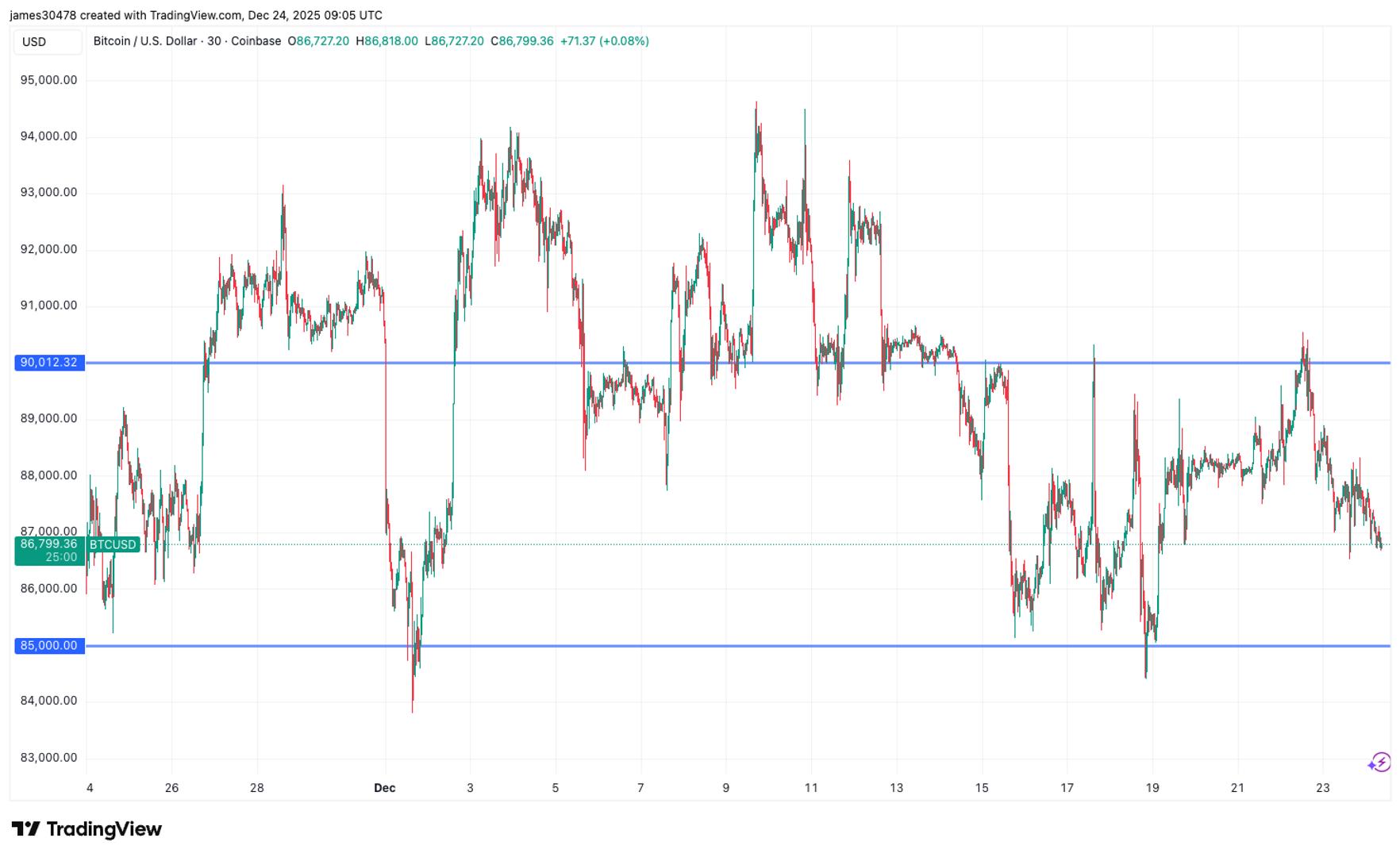
Now, those same mechanics indicate that the largest cryptocurrency could be making a break towards the high end of the range. The more likely outcome after expiry is an upside resolution towards the mid $90,000s rather than a sustained break below $85,000.
The key driver has been a heavy concentration of options around current prices. Options are contracts that give traders the right, but not the obligation, to buy or sell bitcoin at a set price. Call option holders benefit if the price rises, while put options benefit if the price falls.
On the other side of these trades are the option writers, who have to honor the contracts if the holders choose to exercise them. They hedge their risk dynamically in the spot and futures markets, and that behavior is controlled by what’s known as gamma and delta.
Delta measures how much an option’s value changes for a $1 move in the bitcoin price. Gamma measures how quickly delta changes as price moves. When gamma is high and close to spot, dealers are forced to buy and sell frequently, suppressing volatility.
According to X account, David, in December, large put gamma near $85,000 acted as a floor, forcing dealers to buy bitcoin as the price dips. At the same time, heavy call gamma near $90,000 capped rallies, with dealers selling into strength. This created a self-reinforcing range driven by hedging necessity rather than conviction.
 BTC Gamma Chart (@david_eng_mba)
With $27 billion of options approaching expiration on Dec. 26, this stabilizing effect weakens as gamma and delta decay.
This expiration is extremely large and has a bullish tint towards it. More than half of Deribit open interest rolls off, with a put-call ratio of just 0.38 (that is, there are almost three times as many call options as puts) and most open interest concentrated in upside strike prices between $100,000 and $116,000.
The max pain point, which refers to the price level at which options buyers would lose the most money at expiration and the sellers, typically dealers, would make the most, is at $96,000, which reinforces the upside skew.
In addition, implied volatility measures the market’s expectation of how much bitcoin’s price may fluctuate in the future, and the Bitcoin Volmex implied volatility index hovering near one-month lows around 45 suggests traders are not pricing in elevated near-term risk.
 L1 tokens broadly underperformed in 2025 despite a backdrop of regulatory and institutional gains. Explore the key trends defining ten major blockchains below.
This report analyzes the structural decoupling between network usage and token performance. We examine 10 major blockchain ecosystems, exploring protocol versus application revenues, key ecosystem narratives, mechanics driving institutional adoption, and the trends to watch as we head into 2026.
View Full Report
 The biggest single-day exit came from BlackRock’s IBIT, which saw $91.37 million leave the fund. Grayscale’s GBTC followed with a $24.62 million outflow.
- Bitcoin and ether spot ETFs experienced significant outflows on Dec. 24, with traders reducing risk ahead of the Christmas break.
- BlackRock’s IBIT and Grayscale’s GBTC led the bitcoin ETF outflows, while Grayscale’s ETHE saw the largest outflow among ether ETFs.
- Despite the outflows, Grayscale’s Ethereum Mini Trust ETF recorded a notable inflow, highlighting varied investor strategies during low liquidity periods.
Read full story