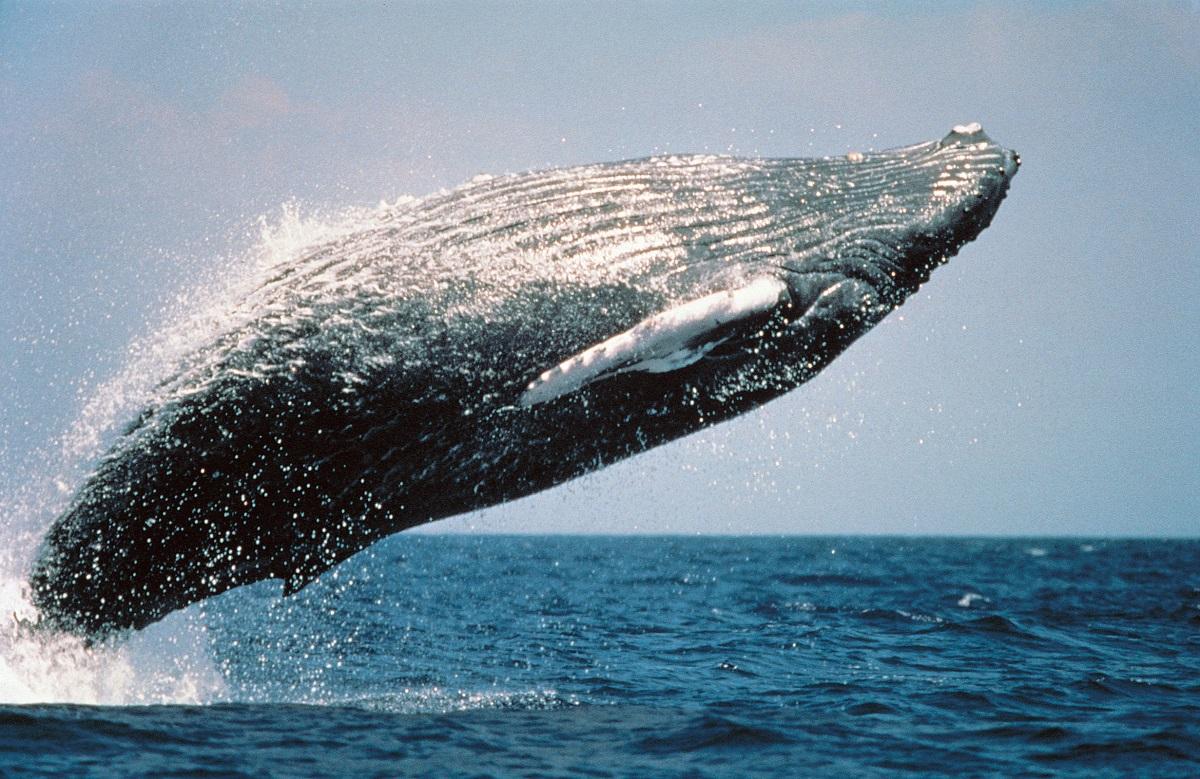
“These whales grow up to 15-19 meters in length.”, — write: www.unian.ua
These whales grow up to 15-19 meters in length.
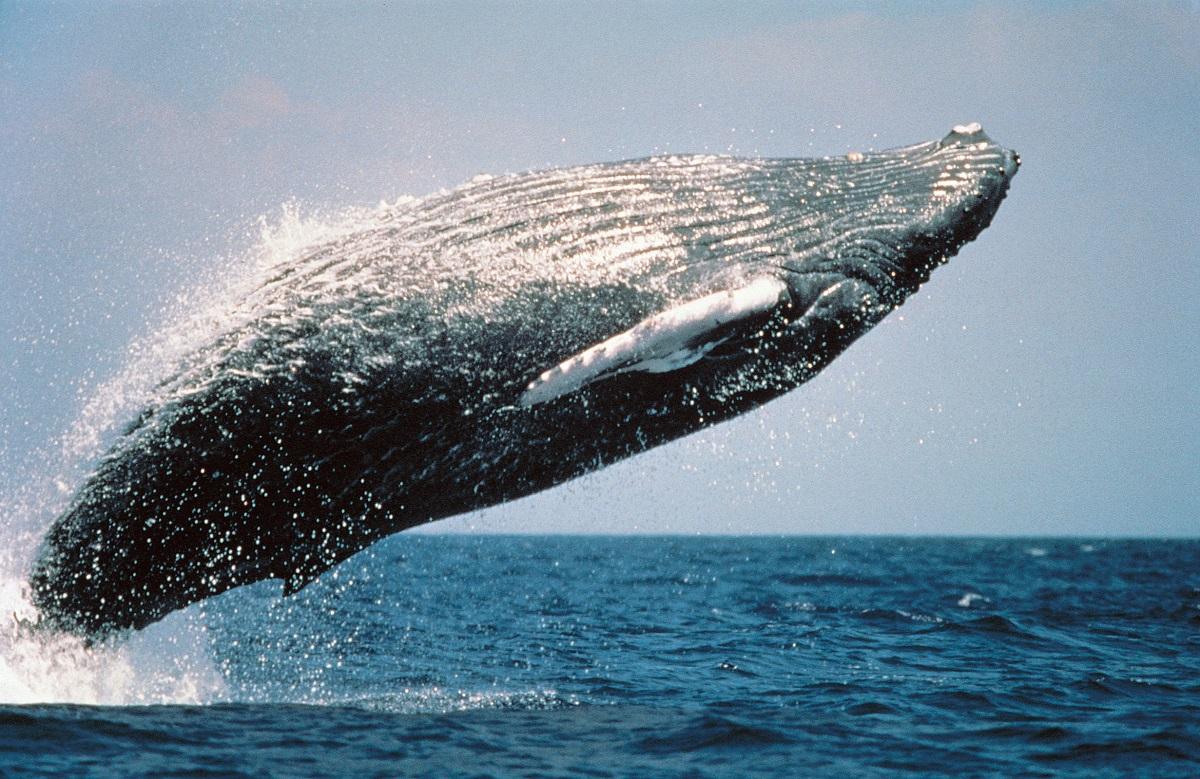 One of the distinguishing features of humpback whales is their long pectoral fins / photo – wikimedia.orgHumpback whales are stars among cetacean watchers because of their frequent surface activity. BBC Wildlife Magazine told interesting facts about these mammals.
How big are humpback whales?The publication shared that humpback whales grow up to 15-19 meters in length, which can be compared to the size of a bus. Moreover, they weigh about 40 tons on average.
One of the distinguishing features of humpback whales is their long pectoral fins. They can grow up to almost 5 meters in length.
Where humpback whales liveThe publication reminded that humpback whales are found in all large oceans. They tend to avoid the extreme areas of the Arctic and Antarctic covered in pack ice, preferring to stay closer to the coast during their long migrations.
Scientists using satellite tracking found that humpback whales sometimes interrupt their long migrations near giant seamounts. For example, they stop for a few days near the seamount of La Perouse between the islands of Reunion and Madagascar in the Indian Ocean, and in the Pacific Ocean, off the coast of New Caledonia, they stay near seamounts for a week or more before continuing their migration south.
Researchers suggest that during breaks, humpback whales feed in the waters above the seamounts, which are often rich in plankton and fish. They can also come together to mate.
What do humpback whales look like?The publication reminded that humpback whales have no teeth. Instead, they have about 270-400 baleen plates on each side of their mouths, which they use to filter krill and small fish from the water.
Since humpback whales do not have teeth to determine their age, it is difficult to say how long they can live, the publication emphasized. According to some estimates, their life expectancy is about 50 years, according to others – up to 80 years.
Humpback whales have large humped heads and large light fins. When these mammals feed, their throats expand like an accordion, and their broad tail fins often rise high before a deep dive.
The publication added that humpback whales have a dark back and a mottled light bottom, as well as a characteristic white and black pigmentation on the underside of the tail fin. On their body you can also see characteristic scars and clusters of shells. These markings allow scientists to identify individual individuals and track them for decades.
What do humpback whales eat?Humpback whales usually swallow huge gulps of water in their mouths and then push the water out through the plates, trapping their prey inside. Their diet mainly includes krill – small crustaceans, as well as other small invertebrates. Whales can also eat small schooling fish such as anchovies, sardines and mackerel.
Interestingly, some humpback whales use a method of joint hunting for fish, which scientists call “bubble netting”. When hunting, whales dive under a shoal of fish and then spiral upwards, releasing air bubbles.
As these bubbles rise, they disorient the fish and lure them into a dense clump. Then the whales can quickly swim up to the shoal and swallow a whole bunch of fish.
How humpback whales communicateHumpback whales are famous “underwater singers”. They make loud sounds that can last for hours and spread over vast distances across the ocean. The exact function of humpback whale songs is unknown, but there are many theories.
Males usually emit long complex songs during the breeding season. Scientists believe that these songs can serve to attract females.
Some researchers believe that male humpback whales can also challenge other males with their songs. Another theory holds that they perform an echolocation function, acting as sonar.
In addition, humpback whales also use grunts, grunts, and snorts to communicate with each other, and calves are known to “whisper” to their mothers, using low tones that can only be heard at a short distance. This can help them avoid predators and large males.
An ancient predator lurks in Japan, wreaking havoc on the ecosystemPreviously, scientists from the University of Liège studied how the diet of Japanese giant salamanders changes as they mature. They found that young salamanders feed mainly on small aquatic insects, making them secondary consumers in their ecosystem.
These amphibians live in the depths of Japanese rivers. Japanese giant salamanders can reach a length of up to 1.5 meters.
The researchers found out that young salamanders feed mainly on aquatic insects. When individuals reach an average length of 62 centimeters, there is a sharp shift in their diet – they begin to consume larger prey, including fish, frogs and freshwater crabs.
The scientists emphasized that the transition to larger and energy-rich prey allows these salamanders to assume the role of top predators in their ecosystem.
You may also be interested in news:
- Scientists have found a bird that lies to other animals for its own benefit – Forbes
- This fish is able to remember human faces: the biologist explained how it does it
- A small brain, but high intelligence: a biologist told about a spider with unique abilities