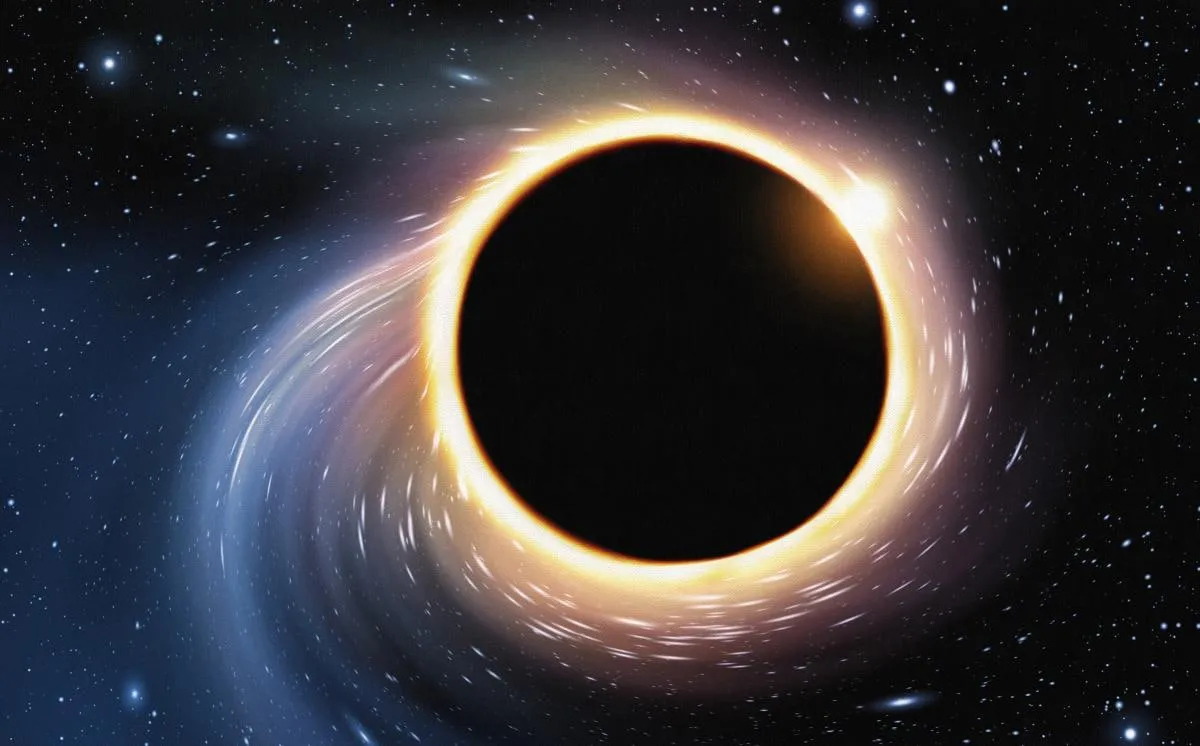
“Japanese astronomers have discovered a supermassive black hole in the early universe that is growing 13 times faster than expected and simultaneously emitting strong X-ray and radio wave signals. The discovery helps understand how such black holes formed so quickly. Interesting Engineering writes about it. As noted, the discovery, made by scientists from Waseda and Tohoku universities, challenges established theories and shows”, — write on: ua.news
Japanese astronomers have discovered a supermassive black hole in the early universe that is growing 13 times faster than expected and simultaneously emitting strong X-ray and radio wave signals. The discovery helps understand how such black holes formed so quickly.
Interesting Engineering writes about it.
As noted, the discovery, made by scientists from Waseda and Tohoku universities, challenges established theories and shows that the key physical processes that operated in the young universe are still not well understood.
“The team recorded a distant quasar – an active supermassive black hole that is intensively “feeding” – using the Subaru telescope. The object existed at a time when the universe was less than 1.5 billion years old. The black hole is in a state of extremely rapid accretion, while also glowing brightly in the X-ray range and generating powerful radio radiation from the jet,” the article states.
Such a combination of characteristics, as the researchers note, is not predicted by most theoretical models.
Eddington Boundary
Supermassive black holes, the mass of which can exceed the mass of the Sun by millions or billions, are located in the centers of most galaxies. They grow by absorbing the surrounding gas – mainly hydrogen and helium – from their galaxies.
During the fall of gas to a black hole, a compact region of hot plasma is formed – the corona, which emits X-rays. In addition, some supermassive black holes form jets – flows of matter that emit intensively in the radio range.
However, if the gas arrives too quickly, the radiation begins to exert back pressure on the falling matter, slowing down the process, the scientists note. This is how the so-called Eddington limit arises – a conditional “speed limit” of accretion.
In rare cases, black holes can temporarily exceed this limit – a phenomenon known as Nadeddington accretion – allowing them to rapidly accret mass. However, it is generally believed that under such conditions, high-frequency radiation and jet activity should weaken.
To test whether such extreme growth was possible in the early universe, scientists used the MOIRCS near-infrared spectrograph on the Subaru Telescope. Scientists measured the movement of gas near the black hole and estimated its mass from the Mg II emission line. X-ray observations have shown that the black hole is absorbing matter at a rate about 13 times the Eddington limit, making it one of the fastest-growing black holes of its class.
“This discovery may bring us closer to understanding how supermassive black holes were able to form so quickly in the early universe,” said Waseda University’s Sakiko Obuchi, the lead author of the study.
In addition, scientists recorded bright X-ray and strong radio emission, which indicates an active corona and a powerful jet. Current models of Nadeddington accretion predict that at such extreme growth rates these phenomena should be weak or disappear altogether.
“We want to find out what exactly fuels such strong X-ray and radio radiation, and whether such objects could have remained unnoticed in the survey data until now,” Waseda University said in a press release.
Researchers suggest that the quasar is in a short-term transition phase, when a powerful influx of gas has pushed it beyond the Eddington limit, and the corona and jet have not yet had time to extinguish.
If confirmed, the observation could provide a unique “snapshot” of the variable growth of black holes in the early universe, a process that is extremely difficult to record. It may also help explain the rapid growth of galaxies, as powerful jets can influence the formation of stars during the extreme evolution of black holes.
NASA has denied rumors about the “alien origin” of the 3I/ATLAS object.
It will be recalled that NASA is testing a new X-59 flying machine, which promises silent supersonic flight.
NASA is also threatening to remove SpaceX from the Artemis lunar mission.
Read us on Telegram and Sends
