“We analyze the dynamics of the work of the Verkhovna Rada, the European integration process and the parliamentary challenges of 2025.”, — write: www.pravda.com.ua
Quantitative indicators of parliamentary work only emphasize this state of tension. In particular, the number of procedural violations and the number of registered bills with one signatory increased.
From the outside, it may seem like a surge of activity, but the numbers are increasingly hiding not effectiveness, but system overload. Parliament finds itself in a situation where it has to maintain the pace of reforms against the background of a low capacity to update its own work mechanisms.
Advertising:
Experts of the Laboratory of Legislative Initiatives analyzed these processes in the Verkhovna Rada during the 13th session through quantitative data.
We understand how the numbers show the real state of the legislative machine, how the dynamics of its work change under the pressure of war, European integration and public distrust. And also — whether the Parliament manages to remain an effective decision-making center in such conditions.
More details about the main features of the work of the Verkhovna Rada during the 13th session — in Parliamentary Monitoring Laboratories of legislative initiatives.
Parliament maintains capacity, but works at reduced speeds Parliamentary dynamics in 2025 look restrained – and this restraint is not accidental, it is confirmed by quantitative indicators.
After the crisis caused by the attempt to eliminate the independence of anti-corruption bodies in July 2025, the Verkhovna Rada entered a phase of certain decline: August is traditionally unproductive (author’s note: before the start of the full-scale invasion, August was a month of vacation for people’s deputies. After the start of the full-scale invasion, people’s elected representatives do not officially have vacations, but the practice of taking a break from work for part of August is preserved. So, in 2025, the Parliament planned take a break from July 22 to August 20). More alarming signals did not disappear anywhere in autumn.
Between September and November 2025, the Parliament adopted only 38 laws (author’s note: data for the 14th session is considered for the period from September 2 to November 10, 2025) — significantly less than in the same period of 2024 (58 laws).
For comparison: during the same period of 2023 (the 10th session), 46 laws were passed, this is a session that had a record low number of laws passed. That is, even by the standards of wartime, the current result indicates a decline, which signals the gradual exhaustion of the Verkhovna Rada or the fact that crisis after the July events continues.
However, the numbers show that this decline did not come out of nowhere. During the 13th session, the Council showed the lowest performance for all “spring” sessions. And, if the trends continue, the 14th session will establish a new level of “normality”: when fewer decisions are no longer the exception, but become the rule.
However, even under such conditions Parliament is capable of making strategically important decisions. Among the adopted laws is No. 14048 (on ensuring the legality and transparency of the activities of local self-government bodies), which is necessary for receiving financial support from the EU within the Ukraine Facility, and another European integration draft law, No. 13202-1.
In general, these indicators testify to the functional capacity of the Parliament to perform its legislative functions. The Verkhovna Rada is able to act, but in conditions of constant workload and political fatigue – each time with a smaller reserve of energy and with the need for a larger amount of time.
European integration dimension: from quick wins to complex solutions When Ukraine received the status of a candidate for EU membership in June 2022, the Parliament found itself on the threshold of a major transformation. The Verkhovna Rada was expected not just to provide political support for the course towards the EU, but to do daily, systematic work — the adoption of dozens of laws that should bring Ukrainian legislation closer to the acquis of the European Union.
More than two years after the start of the accession negotiations, we have to face the truth: a fast start does not guarantee the same pace of passing the entire distance.
In order to speed up the European integration process, in July 2022 the Council adopted Resolution No. 2483, which introduced a separate procedure for consideration of relevant draft laws. Each committee was to have subcommittees on issues of adaptation of legislation to EU law. It was an important, but intermediate step — a kind of “superstructure” over the Regulation, which never underwent official changes.
At the same time, the Parliament tried to speed up the review of European integration initiatives by other means: the requirement to carry out a regulatory impact analysis was removed, separate sections devoted to adaptation to EU law appeared in the draft legislative work plans for 2024 and 2025, and after the VRU website was updated in 2025, it became possible to track the passage of draft laws with the European integration mark.
These decisions really helped to partially speed up the process in the first stages. However, it quickly became clear that without a legislative change in the Regulations, such an “accelerator” will not work forever.
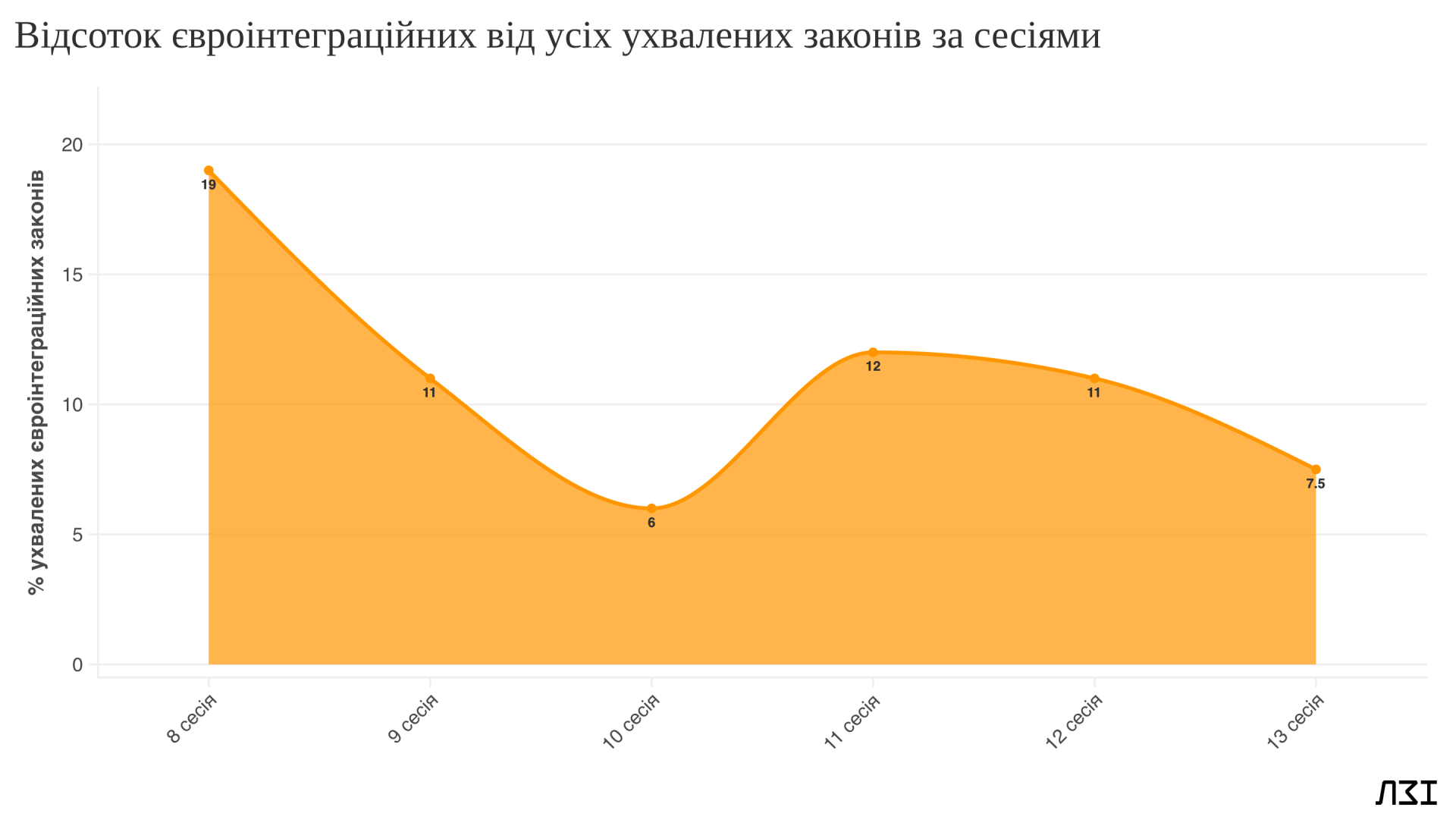
For example, in 2022–2023, the Parliament adopted dozens of European integration laws (26 for the eighth session, 22 for the 9th). But with each subsequent session, they became less and less: only four in the 10th, 16 in the 11th, 12 in the 12th, nine in the 13th, and only one in the first half of the 14th session. At the same time, the average time for consideration of such draft laws is gradually increasing. This can be a sign of fatigue (which is also talked about by people’s deputies), loss of consensus, and the ever-increasing level of complexity of decisions.
“Obvious” European integration decisions have already been adopted. Then there are more complex, technically saturated draft laws that require longer approval both within the Parliament and outside of it.
The duration of the passage of such draft laws has also increased. If in the eighth session, from registration to adoption, draft laws passed on average 403 daysthen on the 13th — already for 573 days. During the 14th session, only one law was adopted so far, it passed the procedure over 150 days.

The dynamics have changed. A fast pace is definitely a positive sign. And although European integration should be operational, but the quality and thoroughness of solutions should be a priority. The Ukrainian Parliament should take into account its own experience and recognize that every decision in this process requires inter-institutional coordination and political will.
New steps will take more time. Therefore, it is worth talking with society and international partners about realistic deadlines for the fulfillment of obligations.
The European integration process will continue to take place in “burning” deadlines, if the expectations for making operational decisions are disconnected from the practice “on the ground”.
“Silent” veto of the President A problematic aspect of the legislative process is also the President of Ukraine’s violation of the constitutional norm regarding the signing of laws adopted by the Parliament. Obviously, this problem lies outside the boundaries of the Parliament itself, but one cannot fail to react to the glaring indicators. In addition to the obvious lever – the silent veto – of control over the decisions of the Parliament, its violation threatens to declare the laws signed in this way unconstitutional.
According to the results of the thirteenth session, at least every second law adopted during the 13th session was either signed in violation of the constitutional terms or not signed at all (54%). This is the highest indicator for the entire ninth convocation, perhaps for all time. For example, Law No. 3291-IX regarding measures aimed at debt repayment on the wholesale electricity market, the Parliament adopted it in July 2023, while the President signed it only in January 2025 — after 518 days of waiting.

For today 43 laws remain unsigned and not vetoed at all. All these laws are in “legislative purgatory” and there is still no real understanding of what to do with such laws. The authors of the Constitution obviously could not imagine such a situation. This practice sets a dangerous precedent.
Signing the law is not a symbolic, but a constitutionally determined stage of the legislative process. When the President simply “keeps” the draft law in a drawer, he actually receives an additional, not provided for by the Constitution, instrument of influence on the Parliament, which is more “quiet” than the veto.
Political motives and the limited capacity of the bureaucratic apparatus can be among the reasons for the violation of the terms of signing. Yes, in the turbulent conditions of martial law at the time of signing, the law could lose its relevance, but such a number of laws signed in a timely manner does not require an explanation, but a response.
Balance of control and law-making During the 13th session of “Question Hours to the Government”, when ministers report to the Verkhovna Rada, the total more than 11 hours — this is the largest indicator during a full-scale invasion.
The use of another control tool of the Verkhovna Rada — deputy requests — has increased: during the 13th session, deputies submitted a record number of 303 for the time of martial law.
As you know, quantity is not always equal to quality. Speaking about the control function of the Parliament, it is difficult to maintain a balance. The positive thing is that the deputies still use the available control tools more actively. The thesis about their complete inability to control the actions of the Government would be unfair. However, the amount of untapped potential is amazing.
Plans to strengthen control over the Government have been approved by resolution VRU in 2016, and the plans remained.
The new tools that they wanted to introduce in the ninth convocation, such as interpellation, also remained in the status of draft laws. Tools, old or new, must deliver results. But that didn’t work either: neither the specialized committees nor the Accounting Chamber (which is an instrument of parliamentary control) noticed the problems in the work of the executive power, which resulted in the resignation of ministers Galushchenko and Grynchuk.
“Legislative Spam” Legislative spam is a systemic problem of the Verkhovna Rada. This is a mass submission of a large number of draft laws without proper preparation, support or real chances of adoption, but overload the parliamentary system and simulate law-making activity.
The situation now, at first glance, is ambiguous. The large number of registered draft laws can be partly explained by their re-registration due to a change in the Government. However, if we consider the deputies’ initiatives, the situation is somewhat different. A key indicator of spam is the record share of draft laws with only one signatory — 45% of all those registered by deputies. This is the highest figure for all sessions of the ninth convocation. In fact, almost every second paper was submitted without the support of colleagues, which indicates an almost zero chance of support in the hall.

Parliament may give the impression of a hyperactive institution with a large number of new initiatives, but about half of them have almost zero chance of becoming laws.
The Verkhovna Rada remained functional and coped with the performance of its duties, despite all the challenges, at least until the latest events related to the corruption scandal highlighted by the operation “Midas”.
How the Parliament will get out of the current crisis is an open question. However, signs of systemic institutional exhaustion have been visible for a long time. And the analysis of quantitative data makes it possible to highlight specific problems, the solution of which is critically important for the further work of the longest convocation in the history of independent Ukraine.
Much will depend on how institutions, in particular the Verkhovna Rada, will emerge from this crisis, namely on the effectiveness of the work of parliamentary bodies, such as the Temporary Investigative Commission (TCC) on Economic Security, and the decisions of the President’s Office.
The speed of work of the TSK is already noticeable a week after the searches held an open meeting with NABU, SAP and key officials and the anti-corruption committee, which analyzed the scandal on his meeting in another week.
The Parliament has already dismissed the scandalous ministers. Yermak was dismissed by the President. How new members will be appointed will be a new test for the Verkhovna Rada. If the situation repeats itself and these ministers do not feel responsible for the Parliament as the subject of their appointment, then the situation with their accountability will not change either.
It will be possible to talk about the demonstration of extraordinary stability and decision-making capacity of the institution, if the law-making process does not stop, and a functioning majority works in the Verkhovna Rada.
Realistic expectations regarding European integration, reduction of “legislative spam”, strengthening of parliamentary control and, most importantly, successful passing of the new “storm” will help turn the current support of the “floating” system into a gradual movement forward.
Andriy Voronaanalyst of the Laboratory of Legislative Initiatives
A column is a type of material that reflects exclusively the point of view of the author. It does not claim objectivity and comprehensive coverage of the topic in question. The point of view of the editors of “Economic Pravda” and “Ukrainian Pravda” may not coincide with the author’s point of view. The editors are not responsible for the accuracy and interpretation of the given information and perform exclusively the role of a carrier.