
“In 2026, the nomination “Best Podcast” will appear at the Golden Globes – podcasts have become a key media trend in the United States.”, — write: www.pravda.com.ua
This trend is particularly noticeable in the United States, where podcasts have become an important channel of political communication and are increasingly being used in election campaigns.
Here are ten reasons why podcasts have become an important element of the electoral struggle in the US.
Advertising:
1. Numbers Let’s start with the basic one – with the audience. In the US, podcasts have long ceased to be a niche format. About 40% of Americans regularly consume podcast content, and nearly half of them believe the format is more truthful than traditional news media. These data are provided by The Economist in a special issue World Ahead – an annual publication with forecasts and key trends for 2026.
For election campaigns, this is the base: there is a mass channel – it is used.
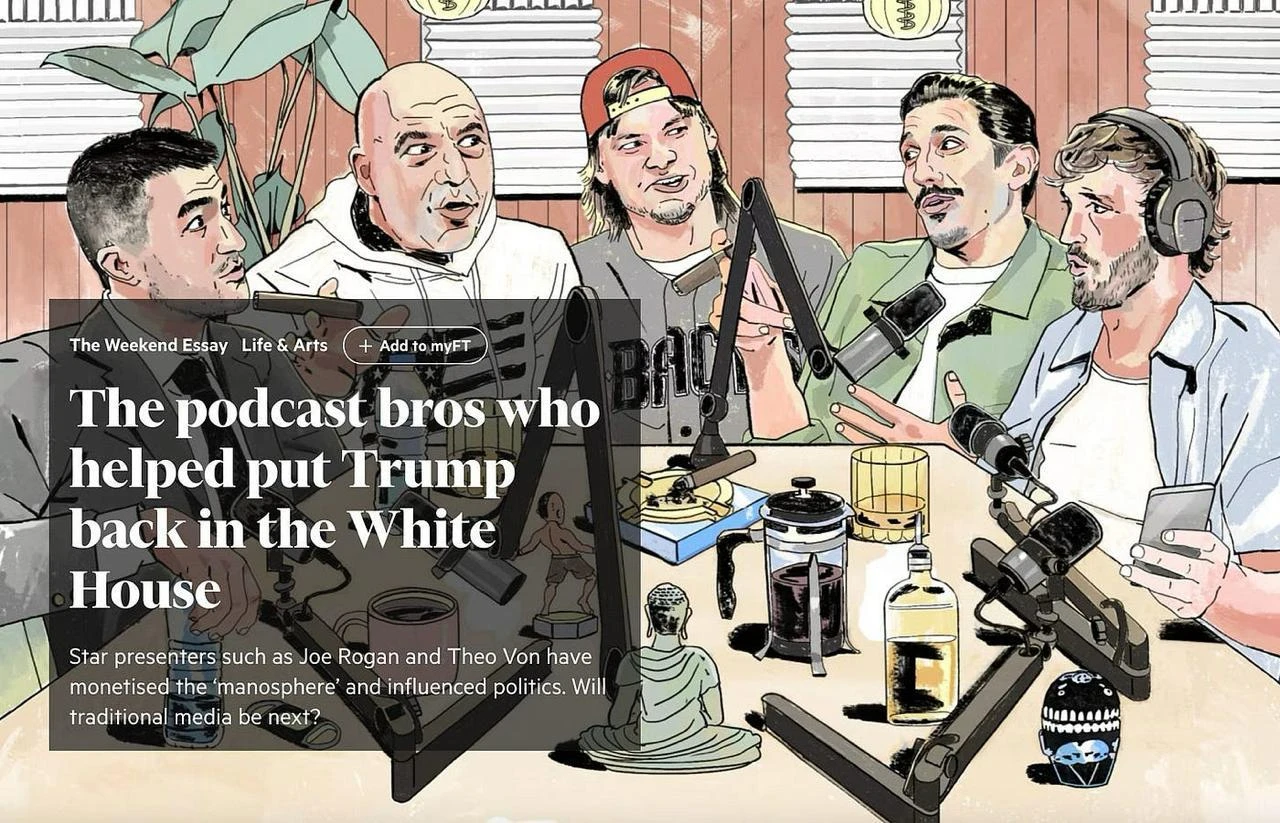 Screenshot of the Financial Times
 2. The Trump effect, or the “podcast fraternity” In this story, Donald Trump is important primarily as a trendsetter who set the podcast trend during the last presidential election in 2024.
“The podcast bros who helped get Trump back into the White House” is a good article Financial Times on this topic. Starring Joe Rogan, Tucker Carlson, Lex Friedman, Logan Paul, Theo Vaughn, Andrew Schultz, and other podcasters who have amassed multi-million audiences, including spinning narratives of mistrust of the mainstream and anti-elitist rhetoric, masculinity, and conspiracy theories.
Trump went to them instead of classic political talk shows. While other candidates opted for familiar formats like 60 Minutes on CBS, he invested time in podcasts. In total, about 17 hours of air time in podcasts, that is, almost a thousand minutes of conversations.
It is important that it was not about one high-profile performance, but about a systematic presence in popular shows. Between July and November 2024, Kamala Harris appeared on only 8 podcasts, compared to 20 for Donald Trump.
3. It copies quickly They saw that it works – they repeated it. After Trump’s victory, podcasts quickly became a reference point for other campaigns, regardless of political camp. If you don’t work with podcasts, you lose visibility and contact time with voters.
This is clearly visible in the local elections of 2025 in the USA. Democrat Zohran Mamdani, who eventually became mayor of New York, appeared on 31 podcasts. His challenger, independent candidate Andrew Cuomo, has 18. Democrat Mickey Sherrill, who became governor of New Jersey, has appeared on 18 podcasts, and Republican Jack Ciatarelli has 16.
An important nuance: this is not a final push a few weeks before the voting day, but systematic work with podcasts during the year before the election.
4. Long format and deeper contact with the voter “We have three hours – we can talk calmly.” This is the starting point for conversations on The Joe Rogan Experience podcast, one of the most popular podcasts in the US.
Two microphones. One is Joe Rogan, a comedian and commentator of UFC fights. The second one is a guest. No studio decorations and teleprompters – just a long conversation. I wouldn’t call it an interview. Most often it is a conversation.
And this is, in fact, the usual format of most such podcasts. It is the format – long, leisurely and without rigid frameworks – that is the main reason why politicians are so actively turning to podcasts. Here you can speak not in slogans, but to expand your thoughts and explain your positions and decisions – without a 30-second limit. That is, not to invest in a television slot with several prepared theses.
The loyal audience of the podcaster is already used to long formats. Hence the effect of “I am listening to an acquaintance, not a candidate.”
5. Without strict moderation The format of such podcasts is often not only about no rush and a timer, but also about the absence of strict moderation. Comedians, YouTubers and other podcast hosts usually do not pretend to be objective and are not bound by journalistic standards.
What are the disadvantages for politicians? Some pluses. Also, such podcasts often have almost no editing, editorial edits, or rigid frameworks. A political campaign gets a direct channel of communication.
6. Without instant fact-checking The logical continuation of the lack of strict moderation is the lack of instant fact-checking. Podcasts rarely stop the conversation to check a number, clarify context, or immediately ask an awkward question.
For politicians, this is another argument in favor of the format: what was said remains in the form in which it was uttered. Less correction in real time – more control over your own version of events and your own narrative.
7. Access to audiences that would otherwise not reach politics Most popular podcasters are not associated with politics. A candidate’s entry into such an environment allows reaching new audiences who rarely watch the news, do not read political media, and do not systematically follow campaigns. People come there for entertainment, humor or conversations “about life” – and already in this context they encounter politics.
For political campaigns, this is an opportunity to talk to the voter not at the time of the election, but much earlier – in an environment familiar to him, without the feeling of political agitation.
8. Content that scales easily A podcast isn’t just one long conversation. It is the raw material for dozens of other formats. The most striking fragments, conflicting moments or apt wording from podcasts are quickly cut and packed into short videos.
This content then lives a separate life in TikTok, Instagram Reels and YouTube Shorts – in the format “snack content“ for a wide audience. This is how a modern political content factory works.
However, it also works in the opposite direction: short videos become the entry point to the long format. The interested viewer is led from the “snack content” to the “main course” – a full conversation in the podcast, where the contact with the politician is much deeper.
9. The ability to be a podcaster yourself For politicians, podcasting is not only about visiting, but also about creating their own platforms. Your own podcast means full control over topics, guests, tone of conversation and regularity of content output.
For example, famous American politicians who have become podcasters themselves include Republican Senator Ted Cruz, Donald Trump Jr. with his provocative show Triggered with Don Jr. and California Governor Gavin Newsom, who may become the Democratic nominee in the next presidential election.
Thus, a politician ceases to be an invited speaker and turns into his own media. And this is no longer a one-time communication for the election, but a long-term presence in the public space.
10. Lower entry threshold It is impossible to avoid the topic of the budget here. Podcasting is much cheaper and more accessible than classic media formats. You don’t need a TV set to start whether it’s airtime or big productions – a studio/room, microphones and distribution on platforms are enough.
This allows you to start communication early, test messages and build an audience long before the active phase of the campaign. Podcasts lower the barrier to entry into political communication – that’s why they are so actively used.
Risk conclusions In the conclusions – about the risks of this format for society.
Along with the effectiveness of podcasts, the risks also increase. It is important to understand: a podcast is first and foremost a format. When politicians increasingly choose to talk to content creators rather than journalists, public policy loses some of its protective mechanisms. At the same time, quality podcasts are also made by journalists – and there are more and more such examples.
However, risks arise not because of the format itself, but because of how and with whom politicians use it. It is in this environment that long form easily creates the illusion of depth instead of actual fact-checking. Manipulations are disguised as sincerity, complex topics are disguised as casual conversation, and “warm baths” without critical questions become the norm. Added to this is another factor – the economy of attention: podcasts benefit from emotion, conflict and viral fragments, rather than accuracy and balance.
As a result, political communication increasingly operates on the logic of entertainment rather than accountability. Podcasts give politicians time and comfort, but don’t always give audiences the tools to distinguish an argument from a well-packaged message.
Dmytro Plakhta, political digital strategist
A column is a type of material that reflects exclusively the point of view of the author. It does not claim objectivity and comprehensive coverage of the topic in question. The point of view of the editors of “Economic Pravda” and “Ukrainian Pravda” may not coincide with the author’s point of view. The editors are not responsible for the reliability and interpretation of the given information and perform exclusively the role of a carrier.