
“Key messages, propaganda topics and changes in the Russian information field according to CAT-UA data.”, — write: www.pravda.com.ua
Here, for example, is a diagram with the main messages – the key content of the messages – of the Russian infofield.
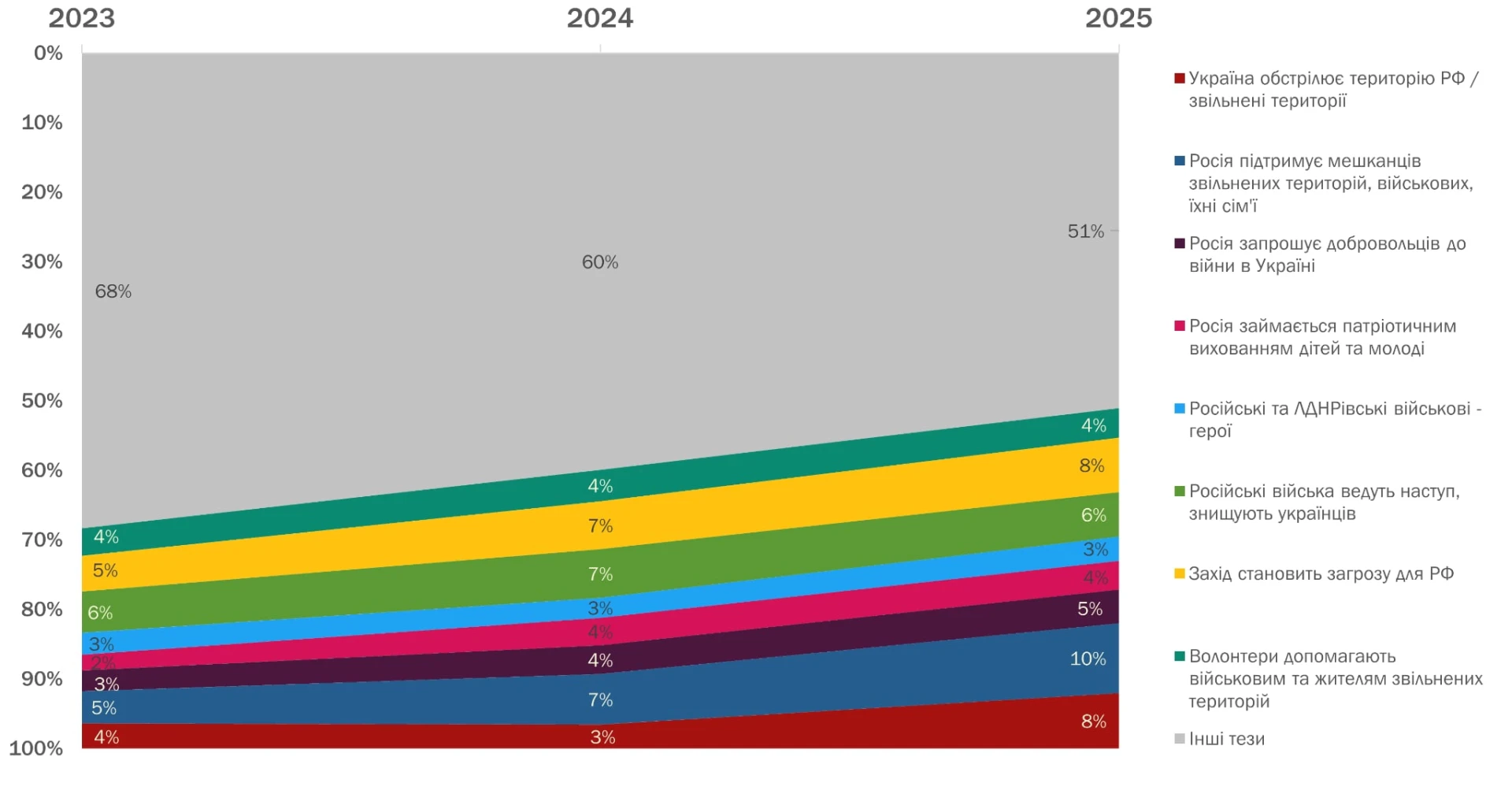 The most frequent messages in the Russian infospace for 2023-2024 and 11 months of 2025
Advertising:
4% of all messages are related to instilling the ideology of racism in children. There is also a noticeable increase in the regime’s attempts to normalize the war through narratives about helping the occupied territories and “veterans of the SVO”. In general, the Russian Federation is increasingly immersed in the usual messages every year. Previously, their communication was more diverse, now they repeat the same statements more often.
 The most frequent messages in the Russian infospace for 11 months of 2025
In August-September, there was a noticeable surge in the thesis “The West poses a threat to the Russian Federation.” Against the background of European integration negotiations with Ukraine and the introduction of new sanctions in the Russian Federation, there was an active shift in the focus of attention from the abstract “West” to a more concrete enemy – Europe, in particular the European Union. The holding of the surrogate competition “Intervision-2025” in Moscow was also accompanied by an intensification of anti-European rhetoric, as if the local “Eurovision” is a platform for the active promotion of “non-traditional” values.
The increase in the share of basic messages is also noticeable for Ukraine: we too are moving more and more along the usual track in communications. This is how, for comparison, the main topics of the infofield of Ukraine look like.
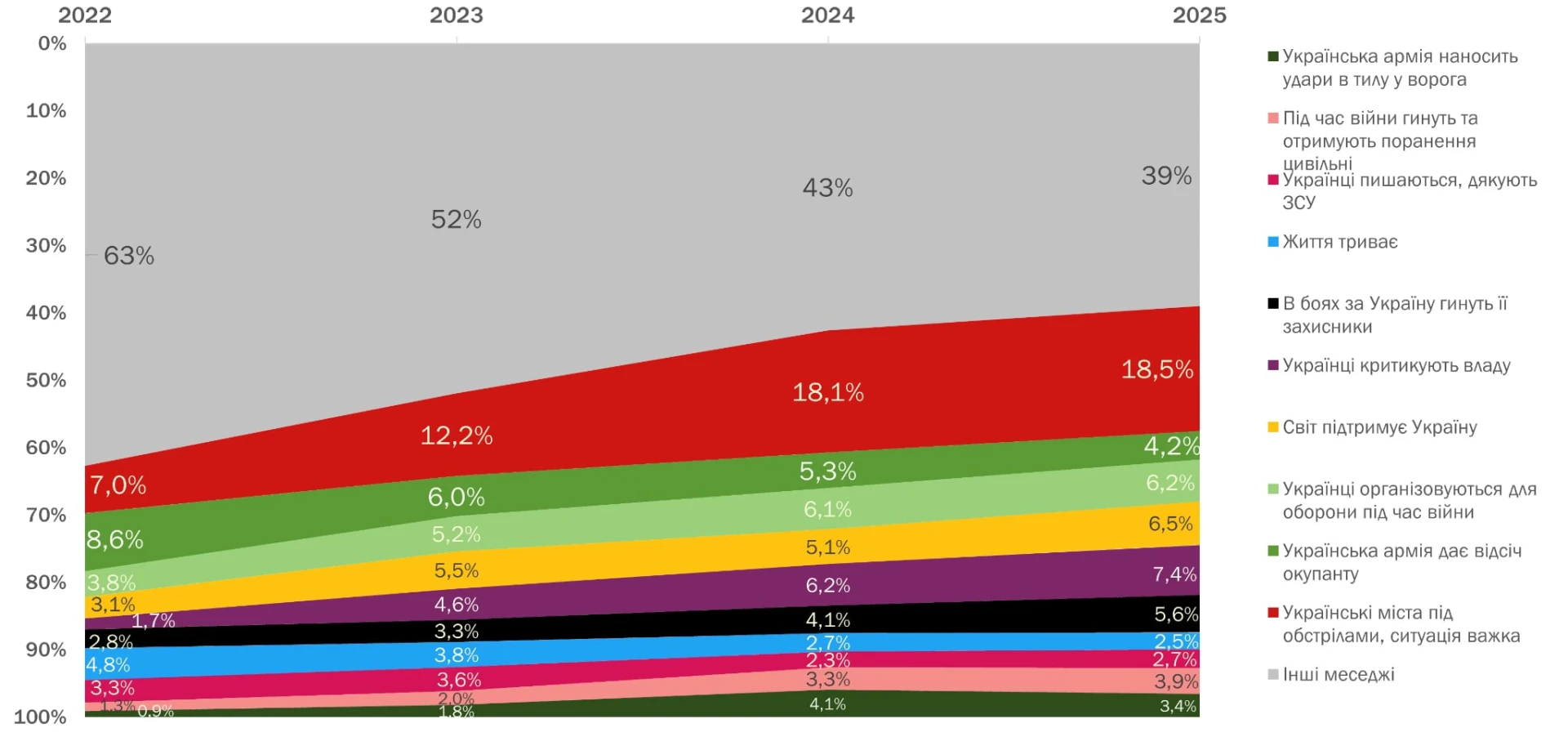 The most frequent narratives (topics) from Ukraine (unoccupied territories) for 11 months of 2025
But even during the war in Ukraine, pluralism of opinion is raging – from 2022 to 2025, criticism of the government increased 4 times – from 1.7% to 7.4% of the total volume of posts on social networks on topics related to the war, this is almost every 13th post.
However, in this material, CAT-UA GO analysts will present their observations and reflections specifically regarding the Russian infofield in 2025.
Joy of the year: “The USA does not want to support Ukraine” There was a radicalization of the views of Russian supporters of the war. The narrative about the extermination of all dissenting Ukrainians finally supplanted mentions of the fraternal nation.
The media say that the situation with the civil infrastructure in Ukraine will only worsen in the future due to the attacks of the Russian Federation.
After the arrival of Donald Trump in the White House, the main message is that the world is beginning to understand and support Russia. And thanks to this world support, the Russian Federation will win the war.
In the fall of 2025, the message of understanding with the USA was not so strong in Russia, but even then they did not position the USA as their enemy. Europe remains the enemy. And the USA is in a gray area. In many cases, the propaganda took a wait-and-see attitude towards the actions of Donald Trump, without determining, as usual, whether he is good or bad. Her message: the USA does not want to support Ukraine in the future, and therefore, in such a situation, Russia will win the war.
Recruiting in the style of “input ruble – output two” The percentage of messages about recruiting in the Russian Federation is 8% of the total mass. In the year when Ukraine agreed to the US initiative and began to discuss the possibility of a serious compromise regarding the freezing of the war with the actual occupation of its territory, the intensity of advertising for recruitment to the Russian army did not stop, but only increased. At the same time, the regions of the Russian Federation are massively reducing surcharges during mobilization.
There was a shift in the emphasis in advertising from the usual recruitment, typical for 2022-2023, to a targeted one – on “non-combat” positions, which are positioned as a calmer option than “assault”. Such vacancies are called the positions of drivers, technicians and rear support personnel.
Another “light” format appeared – recruitment to the mobilization reserve under a special contract with the Ministry of Defense, which promises not to be sent to war. It provides for training, assembly (“no more than 6 months a year”) and the performance of local tasks, in particular, in mobile fire groups for air defense in the residential area with the preservation of the workplace.
 An example of an occupation army advertisement
And young conscripts, who, unlike Ukraine, continue to be called up by Russia, are very actively enticed “voluntarily-compulsorily” to sign contracts with “SVO” after the end of or even during their military service.
Bullying Europe This year, campaigns that can be interpreted as “pumping up” the psychological readiness of the population for war in other directions, besides Ukraine, in particular, in Europe, have become particularly noticeable. For the first time, such attempts appeared in the past, in 2024.
During the campaign of drone attacks, the official position of the Russian Federation sounded like “we are not there” with a simultaneous “wink to our own”, which in fact, yes, it is us.
The warlords developed this hideous line with mockery and joy: “wow, we are so cool, no one can stop us, Russia is showing the world who is who.” It seems that they are downplaying the potential enemy and also preparing the population (or pretending to) that at some point an armed conflict/war with Europe will have to start.
The regime’s official line continues to develop nuclear rhetoric through, in particular, the tests of the Tempest and Poseidon weapons. But if in 2022 many people took the threats seriously, now it seems that neither the West, nor Ukraine, nor Russia itself believe Medvedev’s nuclear bravado. However, all these “analogue stormtroopers” still evoke emotions in Russians – pride for their state and its power, they say, it is terribly feared and respected by everyone in the world.
Their home is war It does not seem that the Russian population is being prepared for reconciliation. Opinions about freezing are spot on, because “if this war ends, there will be other ones.” A mass campaign, on the other hand, works to involve people in the war in one way or another. Measures to militarize children continue, with the narrative “we will always defeat everyone.”
Unemployment is rising in the regions, so signing a contract and big money, even with the reduction of lifting payments in 2025, still remain an attractive “career growth” for mercenaries.
In 2025, the Russians began to feel the war a little more, because Ukrainian retaliatory strikes, in particular, on Russian refineries, intensified.
Dissatisfaction is also caused by disconnection of the Internet. The authorities decided to shut down communications during the attacks, saying that Ukrainian drones were controlled through telecommunications towers.
There is already one case of complete disconnection of the mobile Internet until the “end of the SVO” in the Ulyanovsk region. Other regions complain that they, too, have no interns for months at all that
Gasoline interruptions are also noticeable, especially in the Far Eastern Federal District.
For the front-line districts neighboring Ukraine, war is becoming the norm. If earlier the shelling of the Central Federal District (the center in Moscow) was something new and resonant, then in 2025 they became commonplace. The discussion of strikes mostly remains within the boundaries of the regions themselves.
The Russians quickly got used to retaliatory strikes from Ukraine. Pathos about “red lines” has disappeared. This has become the norm, “we have to endure, because we will show them anyway.”
Muscovites, who are one of the most important audiences for the regime, do not feel the war enough for themselves, instead they follow it as fans. Although sometimes interruptions in airports and with the Internet affected them as well.
We can assume that the coming of war to a larger number of Russians rather tires and frightens them than mobilizes them to fight.
Russians are tired of volunteering. Many “tearful” volunteer posts, why does no one report and help weave nets, etc. They even offer money or lunch for the help of the army. A characteristic feature of 2025 in this context is a series of exposures of well-known volunteers in fraud (R. Alyokhin, T. Montyan), which undermines the motivation of ordinary Russians to donate to support the army.
Both explosions and sirens are tiring, but what scares them the most is not the fear of death, injuries or damage to property, like, for example, Ukrainians who constantly read news about the dead and destruction, but the side effects. Such as closing airports, because for Russians this is an important part of logistics due to the size of the country. The general sense of loss of prospects for the future of Russia for those who are not involved in the “movement” is also exhausting.
Encapsulation of the information field In 2025, there was a normative and legal strengthening of censorship – the criminalization of “unwanted” information.
Restrictions were introduced – the expanded definition of “extremism”, fines and punishments even for searching for “forbidden” content, increased control of VPN platforms. “Limited” messengers – voice and video calls in the Russian Federation in WhatsApp and Telegram. Instead, the state-run MAX messenger is promoted. In December, FaceTime and Snapchat messengers were added to the block, as well as the popular game space Roblox among children and young people.
Critical oppositional information seems to be quite limited in this information capsule that is Russia now.
The percentage of posts opposing the war from the territory of the Russian Federation was at the level of 3-4% in 2022 and remained so. At the same time, not all of them were written by those who can be called the opposition. There are many people with very different views – from communists to nationalists – who are unhappy with the war for various reasons, but generally support Putin.
In 2025, racism campaigned and increased pressure on Russians who were ready for underground activity against the regime. We record an increase in posts about the detention of “saboteurs”, “extremists”, etc.
The age of criminal responsibility for sabotage has recently been lowered to 14 years. It can be assumed that some of these arrests are “performances” by the Russian special services, but there are probably real underground people, in particular, those who do not post any anti-war content on social networks, but instead act.
Also, the first precedents and persecution of those who only searched for “forbidden content” on the Internet began.
Russians are annoyed by the accumulation of trifles They began to write less about the heroes of the front. Unlike Ukraine, there are almost no media leaders among the military in Russia. There are “disposable heroes” who are being promoted for some feat like “one against ten Bandera residents”. They are dragged on the airwaves, in schools, and then they disappear. Although there are formats for these “minimalist heroes”. For example, such as the series of graphic novels “Knowledge. Heroes” about various soldiers and their exploits in the war, which are distributed among children in schools.
The memorial memory of the killed Russians is being normalized, although the total numbers are not mentioned.
Attention to veterans in the rear, their careers within the framework of the slogan about “new elite – veterans of the SVO” continues. But there are already cases of certain tension and conflict between veterans who “came to power” and want changes, and old elites who are used to living in the old way, and whose system is unlikely to want to change much.
People sometimes fear that those who previously wronged them will return from the front. After all, criminals are often offered to go to “SVO” instead of going to prison. Rapists and murderers will return as heroes to the same communities where they committed their crimes, and their victims will feel unprotected. Although in 2024 there was more information about the crimes of “SVO” veterans, probably because then the contracts of those mobilized from prisons in 2023 began to expire en masse.
The coverage of the fight against corruption in the defense sector has decreased, compared to 2024, when the new Minister of Defense Belousov came and there were many investigations.
In general, it is rather the accumulation of small problems that the war accumulates that annoys Russians. It is they who tie them to reality: not a nuclear confrontation, but the fact that a person, for example, cannot fly to another place, cannot call, transfer money. This sharpens the mood of Russians, although these are not very visible topics, but with a cumulative effect.
Russians were affected by the ban on opening new accounts in Europe, as well as the ban on issuing multiple-entry Schengen visas. For example, it has become more difficult to make payments through Chinese banks, there are interruptions with crypto. Such everyday troubles actually have a great effect on the morale of Russians.
There are signs of fatigue among the volunteers, they say, “How long can such a war last?”. Critics from the Z-community ask questions: why are our regions suffering from the protection of the LND, why are rockets flying at us when Putin promised peace, why are there sanctions, shutdowns, closed airports, why is the front advancing so long and slowly, why are there problems at the front, where a harsh response to the crossing of the “red lines” is promised?
Taboo topics: meat assaults, “liberation” of ruins, lack of a tangible goal, life after Putin
As for those who died in the war, it is highlighted in such a way that the great losses of the Russian Federation are not true, and even if they are true, the Ukrainians’ losses are still much greater. Since 2025, they have stopped promoting the message “there are almost no losses”, the topic is simply being hushed up.
Incidents of violence in the army are also kept silent. Nothing is said about the concept of “zeroing” – systematic shootings as punishment at the front. Instead, you can sometimes find reports that the Ukrainians are finishing off their wounded. This is a mirroring tactic, when Russians attribute their “sins” to others in order to “cloud” the information. Judging by the fact that Putin recently spoke about the “reference to the slaughter by a corrupt regime”, the theme of his own great losses is also noticeable for racism.
Another taboo topic is the pace of the offensive, because for the Russians, with their Nazi aplomb of confidence in their superiority over the Ukrainians, the inability to win even after a vile surprise attack and the subsequent brutal war of attrition undermines their worldview. That is why the capture of every small town or village is described with maximum pathos, like Putin’s invitations of journalists to the “Pokrovsky Cauldron” about taking Pokrovs have been reporting in the Russian Federation for almost a year.
A traditionally taboo topic is what are the real achievable “goals of SVO” at the current stage. They ritualistically continue to talk about “demilitarization/denazification”, but do not explain what lies behind these euphemisms. Regarding territorial conquests: the further fate of Kherson and Zaporizhzhia is taboo.
They keep silent about Ukrainian hits on objects in Russia.
Another topic is the fate of the first mobilized in September-October 2022, who were not paid large bonuses for signing the contract. The regime, with some difficulty, managed to extinguish the media presence of the protest of the wives of these mobilized people, after which most of these “mobs” were voluntarily and forcibly, under the threat of being “sent to the assault”, transferred to a contract. However, this problem remains relevant, given the number of mobilized people and their outraged relatives. After all, these “mobikes” are not marginals who were bought for money. These are law-abiding citizens who “foolishly” followed the summons, they are waiting at home, they have social connections.
The fact that the Russian Federation “liberates” ruins instead of Ukrainian cities with a population is another taboo topic. However, Z-authors in Telegram regularly mention this nuance without further sanctions. The situation is the same with “crippling regiments” (when disabled wounded are driven into an assault) and systematic “zeroing”.
Questions like: what will happen to the Russian Federation after Fuhrer Putin is another taboo, traditional for personalist dictatorships.
Economic problems are not taboo at the moment: they are reported quite frankly by the pro-government TsMaKP (connected to Minister Bilousov), the heads of “Sbyer” and VTB, and other well-known speakers. But there is a nuance: economic problems can be stated in complex scientific language, relatively silent are simple negative statements like “from the second half of 2026 we will not be able to finance SVO” or “the coal industry is collapsing, miners are losing their jobs en masse”, which have the potential to spread virally.
Plans for Ukraine are traditional – internal unrest In communication within the Russian infofield, it is noticeable that racism is aimed at continuing to work on the division of Ukrainian society. The main theme in this regard in their social networks is that Ukraine will not survive this winter.
Two scenarios are considered. First, political pressure on the Ukrainian authorities so that Ukrainians are ready to protest against the authorities, up to armed action, to force Ukraine to capitulate/peace on Russia’s terms.
Secondly, they say, energy attacks will help to collapse the front, and this will allow us to capture more territories.
Racists also like to describe what scandals and problems we have. Any statements of Ukrainian opposition politicians are happily picked up by the Russians and spread, in particular, about the scandal “surrounding Mindych”. Another favorite topic is the mobilization of women in Ukraine, which, they say, shows Ukraine’s weakness. They also like to mention the permission to leave for men aged 18-22, which will “finish the Ukrainian economy”.
Propaganda also shows videos in the Russian Federation with “the horrors of TCC people-hunters.” This contrasts with “civilized” Russia, where people are mobilized through contracts and recruitment, respectfully. Therefore, there is a fear among ordinary Russians that if there is a mobilization in the Russian Federation, then everyone will be “busified as in Ukraine.”
They rejoice at the shelling of Kyiv and Ukraine, when the capital and the entire country are without electricity, for Russians this is a kind of symbol of victory.
In general, there are many topics that the Russians throw at us in Ukraine, or that they promote, and it will only increase. Therefore, Ukrainian society needs to keep itself “in tune” with regard to this influence and realize in time: where is constructive criticism for the real development of Ukraine, and where is parasitism (consciously or not) on painful narratives that the Russians have fanned.
Accustoming the opposition Opposition Russians have become more informationally passive. They pay more attention to their problems and quarrels among themselves than to try to understand with Ukrainians for the common goal of stopping the war and changing Putin’s regime.
The number of Russians attending rallies has decreased, even abroad. Previously, for example, FBK constantly held some kind of protests. Now there is much less effort to call on Russians to express an anti-war position.
Regarding topics, opposition Russians pay attention to how much money is spent on war instead of social issues. They also mention the problems of the Russian army: abuse of people on the front lines, deaths, illegal mobilization. There are publications that tell how to avoid mobilization or how to issue a postponement.
Conclusions: legalization of war through negotiations with the USA while maintaining the goals of destroying Ukraine and “defeat of the West”
The main leitmotif of propaganda throughout the year is the promotion of the idea of the inevitable military victory of Russia and the complete collapse of Ukrainian statehood. Russian troops are constantly conducting a “victorious offensive”, “liberating” territories and cities. Whereas the Ukrainian army is portrayed as weak, demoralized and unable to hold the front.
At the same time, the Ukrainian government is called illegitimate. A favorite message of Russian propaganda is that there is terrible corruption in Ukraine, including in the leadership and in the army. The Ukrainian military is regularly accused of “unbelievable atrocities”, terror against the civilian population and torture of prisoners. Strikes by the Defense Forces against Russia or the occupied territories are presented as “despicable” and “terrorist”.
Europe, especially Great Britain, but increasingly the EU, is portrayed as an aggressive threat to the Russian Federation, which is preparing for war. The domestic Russian narrative is aimed at total mobilization and preparation for future wars.
The goal of the complete destruction of the Ukrainian energy industry to cause a blackout and the collapse of the front is declared, as well as the territorial seizure of up to 7 regions of Ukraine, because “Russian people live there.”
In general, Russian propaganda tries as much as possible to create a feeling of superiority, quick victory and world domination in Russians. They have already “caught” their main “chips”, which suit the Russians well, such as: “power of Russian weapons”, “weakness and disunity of the West”, “collapse of the Armed Forces”, etc., and they do not experiment, but scale everything that they successfully perceive to the maximum.
Russian Infopole-2025 is permeated with the ideas of destroying Ukrainian statehood and preparing for new wars.
A natural question arises: how does this belligerent domestic narrative fit with the external rhetoric of deal-making and peaceful coexistence?
Analysts of GO CAT-UA worked on the material: Maryna Fursenko, Angelika Machula, Artem Zakharchenko, Yevhen Luzan, Denis Samygin.
***
The column was prepared as part of the CAT-UA NGO project with the support of the International Renaissance Foundation. The material represents the position of the authors and does not necessarily reflect the position of the International Renaissance Foundation.
A column is a type of material that reflects exclusively the point of view of the author. It does not claim objectivity and comprehensive coverage of the topic in question. The point of view of the editors of “Economican Pravda” and “Ukrainian Pravda” may not coincide with the point of view of the second The editors are not responsible for the accuracy and interpretation of the given information and perform exclusively the role of a carrier.