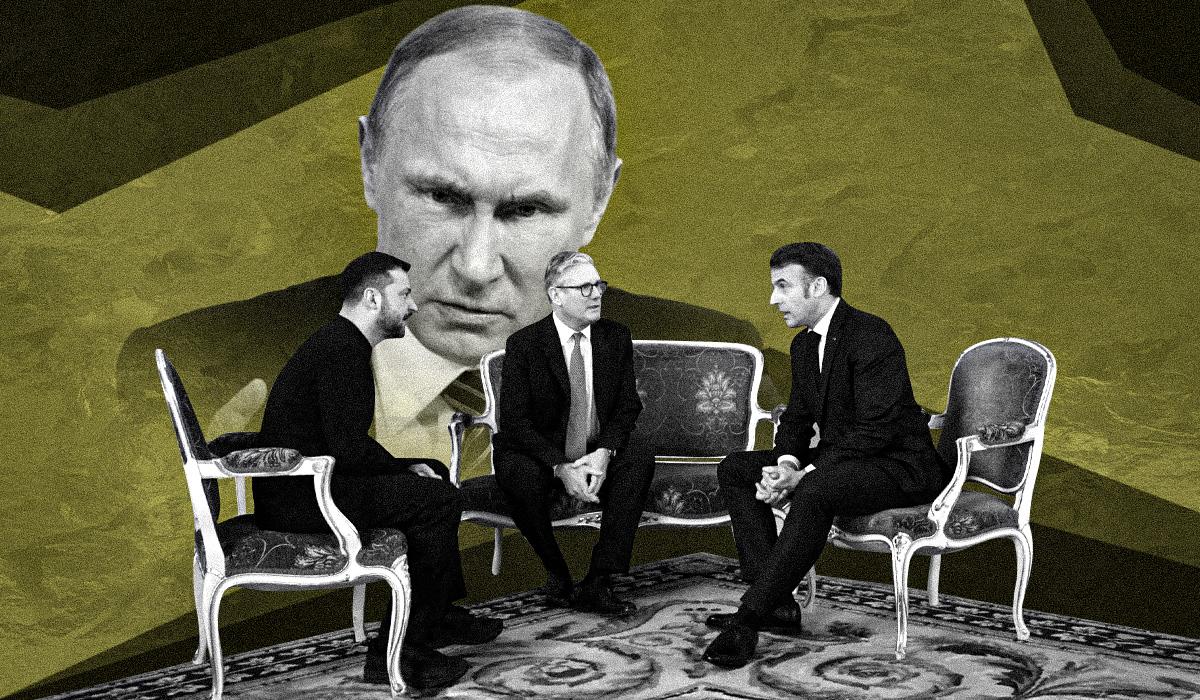
“According to the political scientist, Russia will begin to oppose the deployment of peacekeepers in Ukraine, but then they will have to explain their position to the United States.”, — write: www.unian.ua
According to the political scientist, Russia will begin to oppose the deployment of peacekeepers in Ukraine, but then they will have to explain their position to the United States.
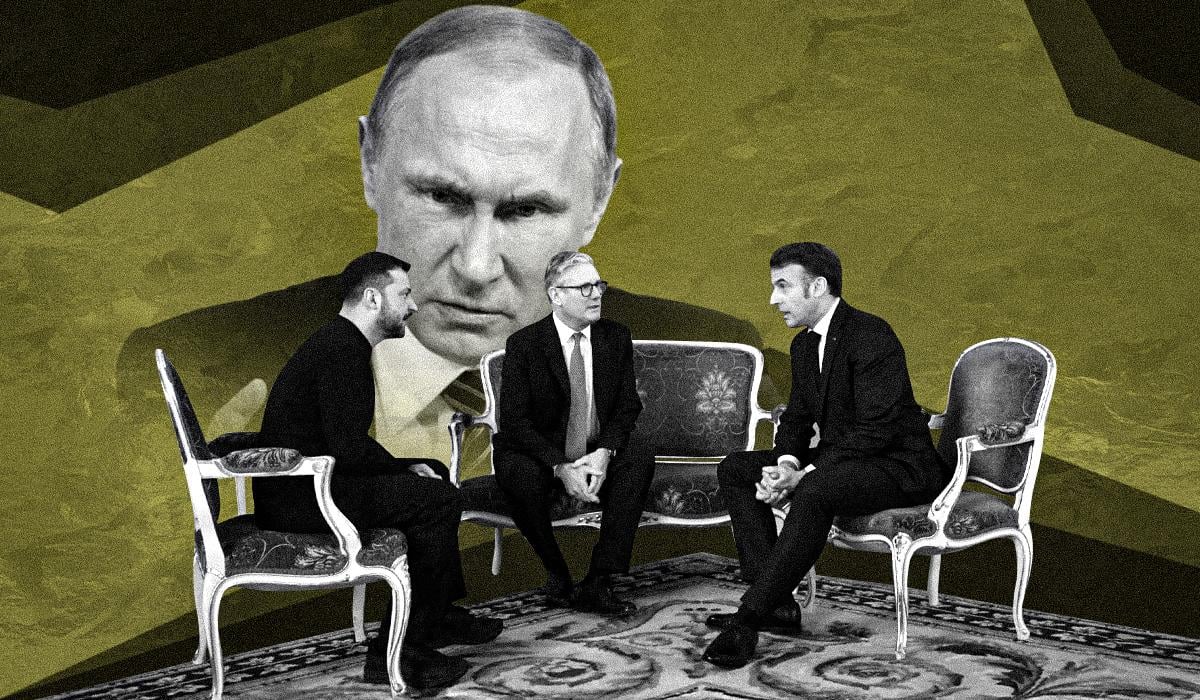 The political scientist recalled that Russia was categorically against the idea of NATO troops in Ukraine / UNIAN collageUkrainian President Volodymyr Zelenskyi, French President Emmanuel Macron and British Prime Minister Keir Starmer on January 6 signed a declaration of intent to deploy multinational forces in Ukraine after the end of the war. The French leader noted that mechanisms for monitoring the ceasefire regime in Ukraine were agreed at the summit in Paris, and that they will be provided by the United States. In an interview with UNIAN, political scientist Ihor Reiterovych told what function the peacekeepers will perform, how important this is a security guarantee, and what Russia’s reaction might be.
The Coalition of the Willing signed a document on the deployment of a contingent of Western troops in Ukraine. Will Russian dictator Vladimir Putin agree to these terms? If not, then why was it signed?
Russia was categorically against the idea of NATO troops in Ukraine, but there is a nuance here: if we are talking about bilateral or tripartite agreements, then it is no longer the presence of NATO troops. The country simply says that British troops are present here, but they are not, in this case, the troops of a NATO member state. By the way, this is what the Americans often do when they are at war around the world, they officially declare that the actions of the United States are the actions of the United States as a country, not as a member of NATO.
Therefore, another thing is important here: if such an agreement is signed and, in fact, these issues are discussed in detail, then it is obvious that the Americans authorized its signing, and they will be ready to present this idea to Russia. Well, and accordingly, probably, to defend it, because it is about the security guarantee. Any sovereign country, Ukraine being one, has the right to decide which troops of which countries to station or not to station on its territory.
By the way, no one prevented even the aggressor country from signing an agreement with North Korea and bringing its troops to the territory of the Russian Federation. I think if Russia gets on its horn and starts to oppose this, then they will have to explain to the United States why this is happening.
For us, in any case, this is the right story. We should talk about it now, because there is not one document on the end of the war, but four. And, accordingly, one of them is precisely about security guarantees. Therefore, we are doing what we have to do, and then the Americans will defend or not defend this thesis before the Russian Federation.
Macron said that “thousands of French soldiers” could be sent to Ukraine after the ceasefire. He clarified that “these are not forces that will be involved in hostilities.” What role will they play to ensure security guarantees for our country?
They will deal with issues of protection of the Ukrainian sky, protection of Ukraine on the water. This was specifically announced by the French president. Plus, – training and retraining of the Armed Forces of Ukraine.
That is, they will provide logistical and other assistance, which is, of course, an insufficient option for us, but as a second or third line of defense, why not. These will not even be military bases, but rather centers, hubs where they will be located. It is obvious that this is also a deterrent for Russia. For example, if they start another aggression, they should understand that by striking, for example, the cities in the west of Ukraine, they can hit the British or French military, which is a casus belli (pretext for war), and can provoke more involvement of these countries in the war against the Russian Federation. It seems to me that this is the maximum that we could achieve in the conditions that exist today.
But will these military hubs be located very far from the demarcation line, exclusively in the West?
Very far from the dividing line. Monitoring will be carried out by completely different means. Macron talked about the participation of the Americans, but so far there are no Americans in the final version of this communique. I think they will appear, because the main thing is that it was signed with the participation of the Americans, and a separate delegation flew in. So they must have agreed to this story.
What does German Chancellor Friedrich Mertz’s statement mean that Germany is ready to deploy a contingent in Ukraine’s neighboring NATO countries? In addition, he made it clear that his country has no intention of stationing German troops in Ukraine even after the ceasefire. Italy expressed a similar position.
They speak, taking into account the situation as of now. By the way, Belgium said the same, for example, that we will not send troops, but we will help Ukraine in other areas in which we can. It is simply necessary to understand that the position of the voters, for example Mertz and Maloney, is such that they are not yet ready for this. But the story in general with the placement of foreign troops in Ukraine will be. Now it is not like that, but it will be. This is the classic story of the Overton window – the main thing is to start. And when someone first takes some steps, everyone will see that there is nothing extraordinary or terrible about it.
Therefore, I do not rule out that the position of the Germans or Italians may change. And of course, Trump’s position is important: if at some point he says that we support the cool document, but let’s increase the presence of various countries, then perhaps these countries will also change their position. All the more so if it is planned that everything will take place under the management of the United States, but without the direct participation of the American military in these processes on the territory of Ukraine. Roughly speaking, they will sit somewhere on NATO bases in Europe and manage all these processes.
Mertz also stated that compromises will be needed to achieve peace in Ukraine. What compromises are we talking about?
They are all actually talking about one compromise – this is a compromise related to the territories, because on other issues Ukraine has already demonstrated the maximum it could. The main thing is that when they talk about compromises, they do not forget to talk about compromises from the side of the Russian Federation. This is the key point. Because Ukraine, in principle, has already done a lot. The very idea that we are ready to end the war, for example, along the demarcation line that exists today, is already a compromise on the part of Ukraine, because all other territories do not cease to be Ukrainian. But if we are ready to discuss this issue, it is already a compromise. I think that they meant it, and sooner or later they will raise this issue and will also say that Ukraine has done everything it could from its side, we now want to see a similar situation from the side of the Russian Federation. All the more so since Russia has almost no major successes on the front, which it can boast of and which it can use as pressure on Ukraine.
Ukraine was given but guarantees, some of which are similar to Article 5 of NATO on collective defense. However, if there is a new escalation, will these countries really fight for Ukraine? If so, what prevents them from doing so now?
I would even put the question differently. And if Russia attacks Estonia tomorrow, will NATO’s fifth article work? There is no guarantee, and it will not appear. Now they are prevented from fighting by the fact that they do not have any signed documents with Ukraine. And they are afraid to get into this conflict with the Russian Federation. But if the document is signed, it will be a different situation. It’s like with Israel. Why, for example, the United States, Britain or other countries participate in repelling attacks on Israel, which were carried out by Iran? Because they have relevant contracts. And these treaties oblige them to help Israel in this matter. When we have the same contract, then there will be a slightly different conversation. The main thing is that this agreement should have a binding character, and not be similar to the Budapest memorandum.
Most of the countries from the Coalition of the Willing need the support of parliaments for signed decisions. How high are the chances that the provisions on the defense of Ukraine, which, as Zelensky said, are “legally binding”, will be voted on?
It depends on the country. For example, in Britain, I think there is no problem, because there is bipartisan support, and it does not matter whether Starmer is in power or someone else will be. In France, at least as of today, I think this is a possible story. And in general, it is necessary to look at each individual country at the moment when these decisions will be made, because it is obvious that all of these are democracies. And there are forces that continue to take such a position that we should distance ourselves as much as possible from the Russian-Ukrainian war, should not get into it, help Ukraine, but no more than the format that exists today. Therefore, I believe, we just need to wait for a specific, ready-made document, where the position of each individual party will be spelled out. And depending on this position, we will be able to conclude to what extent the parliaments will be ready to support or not support these initiatives.
Separately, I would like to talk about guarantees at sea. In particular, Turkey is ready to take responsibility for the maritime component of security guarantees for Ukraine. How much can we count on Ankara in this matter?
Turkey can do this without any problems, because the Turks have the best presence in the Black Sea. It is really very powerful in them, they have a powerful fleet. No Russia is the dominant power there. Therefore, Turkey can absolutely safely do it. This is not a problem for her, and they have been talking about it for a long time, because for the Turks it is, among other things, an element of raising their status, it is a geopolitical story that they are ready to implement. And for us, in principle, this story looks quite positive.

Ihor Reiterovich
Candidate of political sciences, political scientist
From 2021, he is an associate professor of the department of parliamentarism of the Educational and Scientific Institute of Public Administration and Civil Service of Taras Shevchenko Kyiv National University.
You may also be interested in news:
- Boldly triple the number: an expert on peacekeepers in Ukraine
- Zelenskyy answered whether the partners are ready to extend the nuclear umbrella to Ukraine
- Europeans will never agree that their soldiers die for Ukraine, – Dykiy