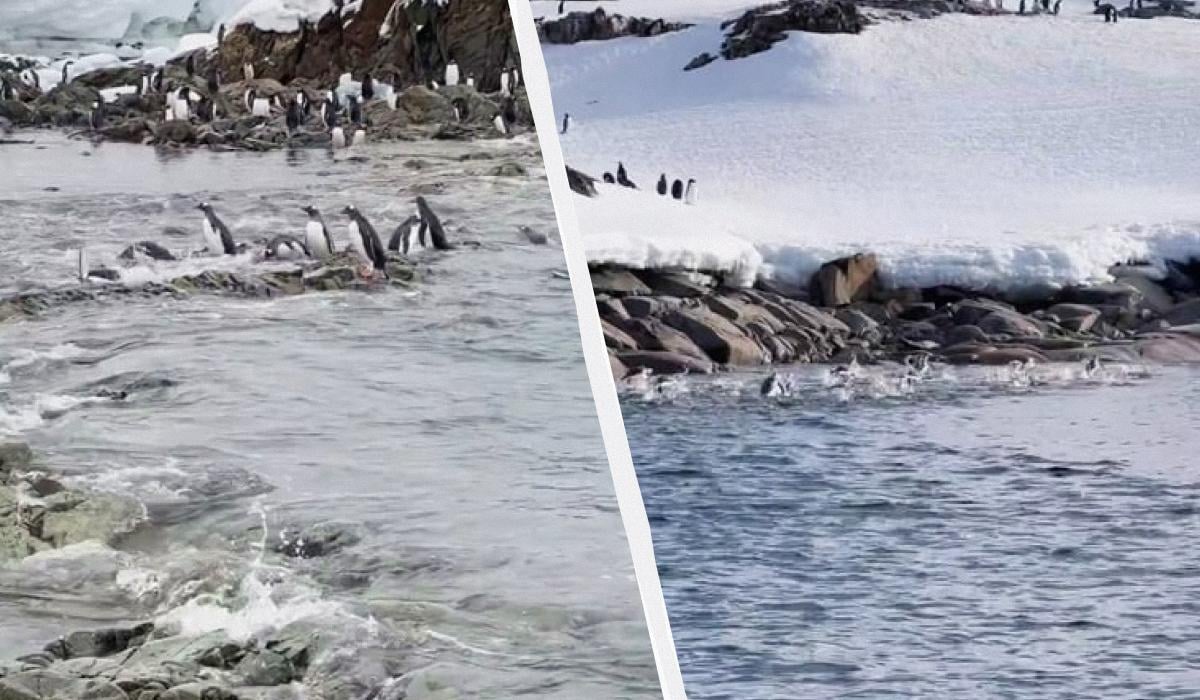
“Researchers have recorded how penguins jump out of the water onto land.”, — write: www.unian.ua
Researchers have recorded how penguins jump out of the water onto land.
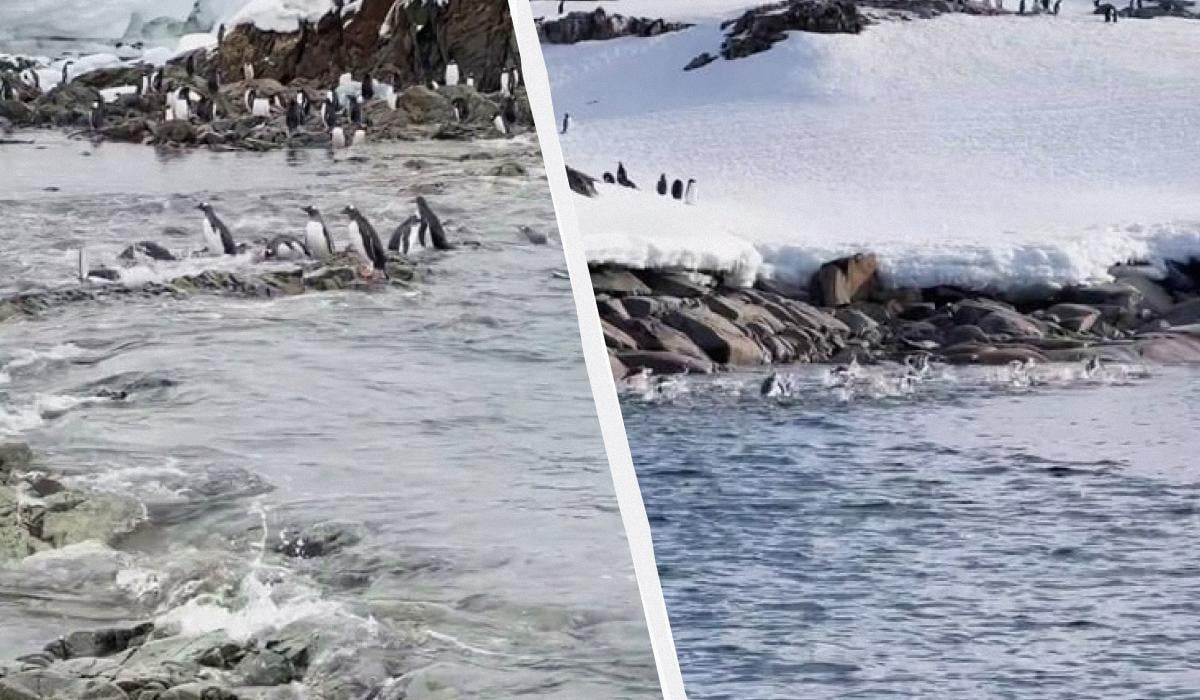 Polar explorers recorded interesting behavior of animals / UNIAN collage, screenshotsUkrainian polar explorers from the “Akademik Vernadskyi” station recorded how penguins living on Galindez Island and the surrounding areas jump out of the water onto land. The corresponding video was published on the Facebook page of the National Antarctic Science Center.
“Usually, for this, penguins choose a flat shore and use the same places. However, it is not a problem for them to jump to a high edge – up to 3 meters. For example, if there is a low tide in their usual location and the shore is no longer so convenient for exiting,” the scientists said.
For a high jump, the researchers add, penguins first gain speed in the water, and then use their paws and tail to change the angle of movement and literally soar into the air.
In a selection of videos by biologist Zoya Shvydka, you can see how birds jump out of the ocean like little black-and-white rockets.
Polar explorers showed the underwater life of penguinsRecently, Ukrainian polar explorers showed footage of the underwater life of subantarctic penguins. These birds can accelerate in the water to almost 40 km/h. To study the life of these birds, a GPS tracker and a camera are attached to their backs. The penguin’s back has a large area, constant curvature and almost no movement, so the equipment can be securely fixed with special tape and glue. The camera is removed after a day, the tracker – after about three weeks according to a separate procedure that does not harm feathers and is completely safe for animals.
You may also be interested in news:
- Lack of ice and earthquakes: the researcher told about the alarming changes in the Antarctic
- Odesa may go under water: the researcher explained the conditions under which this will happen
- Thousands of years of ice reserves in Antarctica are melting, and new ones are not forming, – the scientist