“Researchers recorded the second documented stay of the wavy albatross in the northern territory of Central America. A bird reproducing in the Galapagos Islands has been recorded near the coastline of central California. Scientists working on a research vessel off the coast of central California have identified a wavy albatross, marking only the second confirmed sighting of the bird north of Central America. About […]”, — write: businessua.com.ua
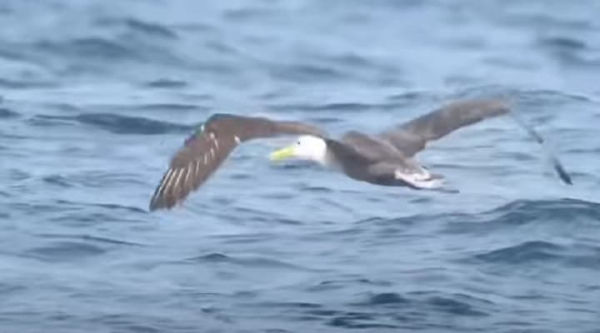
Scientists working on a research vessel off the coast of central California have identified a wavy albatross, marking only the second confirmed sighting of the bird north of Central America. This is reported by Science Alert, this is reported UNN.
Details The yellow-billed bird with black, button-like eyes, which has a wingspan of up to 2.4 meters and spends much of its life in the air above the ocean, has also raised questions, with researchers wondering how and why a species known to breed in the Galapagos Islands – some 4,800 kilometers away – ended up so far north.
For scientists, it is a “wandering” bird that migrates far beyond its usual place of residence. It was spotted 37 kilometers off the coast of Point Piedras Blancas, almost halfway between San Francisco and Los Angeles.
Doesn’t seem to want to go back south. I can’t even believe what I saw. I am still surprised
– marine ornithologist Tammy Russell commented on the video.
According to her, it is almost impossible to determine exactly why the bird ended up so far from its native places. There is a possibility that it could have been carried north by a storm. However, some birds have a tendency to “wander” and simply fly farther than others.
It probably did not breed last season, as adults lay eggs in the spring and chicks leave the nests by January. He may have taken a trip on his “off year” and will later return to the Galapagos to reunite with his mate next season. It is not known how long he will stay here and whether he will return at all. That is why such finds are so unique
– predicts the scientist.
For reference The International Union for Conservation of Nature describes albatrosses – the largest birds in the Galapagos Islands – as the most endangered species. According to the American Bird Conservation Society, its range is limited to tropical zones. It builds nests on lava fields among scattered boulders and sparse vegetation.
The lifespan of these birds can reach 45 years. Their diet consists mainly of fish, squid and crustaceans.
We will remind In Lviv, a pair of swans from Lake Levandiv was temporarily moved to the Shelter of Rescued Animals due to approaching -20°C frosts. The birds will stay there until the weather warms up, the rescue operation went without complications.
Please wait…