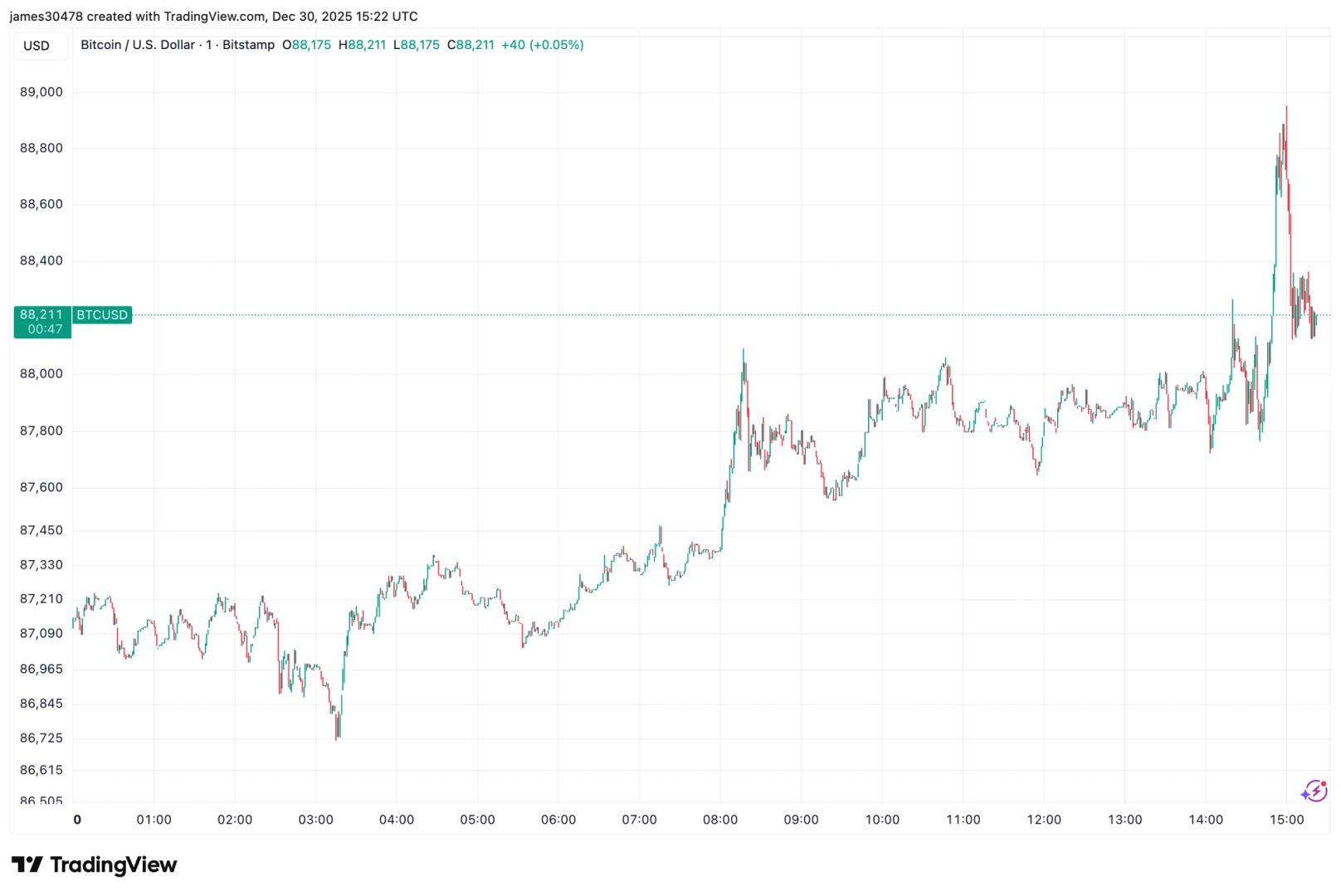
“Open interest data suggests the advance is likely short-covering, rather than fresh longs entering the market.”, — write: www.coindesk.com
Bitcoin being higher during US market hours is a notable shift after the past month in which prices have seemingly dropped every single day during the US session. Indeed, bitcoin has seen about a 20% cumulative decline during the American trading day over the last 30 days, according to Velo data.
As for Wednesday’s small advance, Coinglass data shows bitcoin open interest denominated in BTC has fallen since the US market opened, dropping from 514,000 BTC to 511,000. This decline in open interest alongside rising price action points to short positions being closed rather than new leveraged longs being added.
Crypto-related stocks like Coinbase (COIN), Robinhood (HOOD) and Circle (CRCL) were all little-changed, as were the broader S&P 500 and Nasdaq.
Year-end de-risking, record ETF outflows, and thin holiday liquidity are keeping the market subdued, according to Wintermute strategist Jasper de Mare.
All three major crypto assets remain below key systematic levels, with price action largely driven by rollover flows and tax-related positioning, he continued.
Spot bitcoin ETFs saw $19.3 million in net outflows on Monday, marking the seventh straight day of redemptions. In mid-December alone, $1.29 billion was pulled from bitcoin funds, led by a $157 million single-day outflow from BlackRock’s IBIT, according to de Mare. While IBIT has recorded $25 billion in inflows year-to-date, he said December’s risk-off rotation may reflect tax-loss harvesting. He added that altcoins, largely outside the IRS’s wash-sale rules, have not shown the same selling pressure.
On the derivatives side, over $27 billion in BTC and ETH options expired on Dec. 26 in the largest single-day expiration in crypto history, according to Deribit data. Funding rates and open interest — which peaked at $70 billion in June — have steadily declined into year-end.
BTC’s 7-day realized volatility fell sharply into Dec. 25, but has started to pick up, driven by erratic intraday swings. De Mare advised traders to avoid overfitting short-dated signals until institutional flows return in early January.
 L1 tokens broadly underperformed in 2025 despite a backdrop of regulatory and institutional gains. Explore the key trends defining ten major blockchains below.
This report analyzes the structural decoupling between network usage and token performance. We examine 10 major blockchain ecosystems, exploring protocol versus application revenues, key ecosystem narratives, mechanics driving institutional adoption, and the trends to watch as we head into 2026.
View Full Report
 US market structure legislation is poised to be the dominant force for digital assets, while near-term concerns about quantum computing are overdone.
- Grayscale expects a bipartisan US crypto market structure bill to pass in 2026.
- Clearer rules could accelerate institutional adoption and onchain activity.
- Quantum computing risks are real, but unlikely to affect prices next year, the asset manager said.
Read full story