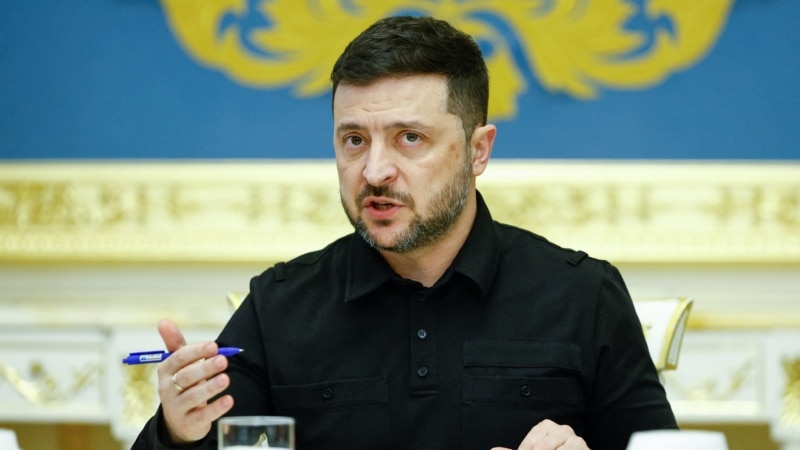
Ukrainian President Volodymyr Zelensky stated in a recent interview that elections in Ukraine will only take place after the conclusion of the ongoing war with Russia, rather than during any temporary ceasefire. This declaration was made public on March 3 in an interview with the Italian newspaper Corriere Della Sera.
Zelensky emphasized, “The real question is when we can hold elections. They will definitely take place after the war ends, not during a temporary ceasefire. I am not entirely sure I will run; I will see what the Ukrainian people want.” Previously, both Zelensky and other Ukrainian officials had not ruled out the possibility of conducting elections before reaching a peace agreement with Russia, contingent on a ceasefire lasting at least several months.
According to Ukrainian law, elections cannot be held during a state of martial law. As a result, the presidential and parliamentary elections originally scheduled for 2024 have been delayed, meaning Zelensky has remained in office for nearly seven years despite being elected for a five-year term.
The Central Election Commission has suggested a six-month transitional period between the end of martial law and the start of the electoral process. Reports indicate that the United States has been advocating for elections in Ukraine, a point raised by former President Donald Trump. In response, Ukrainian officials have stated that elections could theoretically be organized, but only with security guarantees during the electoral period. Zelensky mentioned in December 2025 that elections could be feasible under these conditions, and in February 2026, he reiterated that Ukraine could hold elections if there were at least a two-month ceasefire.
In the same interview, Zelensky reiterated his refusal to withdraw Ukrainian troops from territories in Donbas currently under Ukrainian control, warning that yielding to such demands from Russia could lead to further concessions. He expressed hope for the continuation of trilateral peace talks involving Russia and the United States, suggesting potential venues such as Switzerland, Austria, the Vatican, or Turkey for the discussions.
Meanwhile, Kremlin spokesman Dmitry Peskov stated on March 3 that the date and location for negotiations have yet to be determined, explicitly ruling out Abu Dhabi as a venue. The UAE capital has been experiencing attacks from Iran following military operations by Israel and the U.S. against Tehran, resulting in irregular flight connections to Abu Dhabi.
The Institute for the Study of War (ISW) has noted that the Kremlin continues to discuss future elections in Ukraine as part of its narrative questioning the legitimacy of the current Ukrainian government, emphasizing its desire to exert influence over Ukrainian political processes. Analysts have pointed out that the Kremlin signals it will reject any election outcomes that do not lead to the establishment of a pro-Russian government in Ukraine.
Ukrainian President Zelensky has confirmed that elections will only occur after the war with Russia concludes. He also reiterated his stance against troop withdrawals from Donbas and expressed hopes for upcoming peace negotiations.