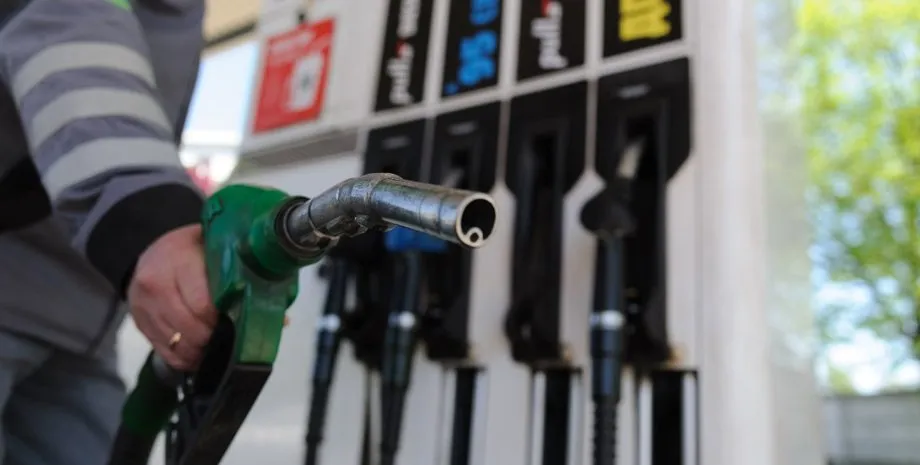
“Coffee, hot dog, windshield washer and something “from the heart” – from January 2026, the standard set of offers at gas stations will change somewhat. On December 26, the Cabinet of Ministers allowed the sale of over-the-counter medicines directly at gas stations, subject to obtaining a license. The Ministry of Health explains: this is about the availability of medicines in villages, front-line communities and at night, when”, — write on: ua.news
Coffee, hot dog, windshield washer and something “from the heart” – from January 2026, the standard set of offers at gas stations will change somewhat. On December 26, the Cabinet of Ministers allowed the sale of over-the-counter medicines directly at gas stations, subject to obtaining a license. In the Ministry of Health explain : it is about the availability of medicines in villages, frontline communities and at night, when pharmacies are closed.
Also listed are the conditions (apart from the license) under which medicine can be sold at gas stations:
- compliance with the storage conditions of medicinal products specified by the manufacturer;
- ensuring the processes of obtaining medicinal products and carrying out input control by an authorized person of the economic entity, who has a document of higher education not lower than the initial level (short cycle) in the specialty “Pharmacy, industrial pharmacy”;
- setting up a separate area in the gas station premises for the proper storage of medicines in accordance with the manufacturer’s requirements, separately from other goods.
Medicines can be dispensed at gas stations by station employees. Trading through vending machines is also allowed – if the gas station meets all the necessary conditions.
“They allowed the sale of over-the-counter drugs at gas stations, subject to obtaining the appropriate license. This is about situations when there is no pharmacy nearby: in the village, in front-line communities or late at night outside the boundaries of large cities. These are only safe over-the-counter medications that people use on their own. This is especially important in times of war, because gas station networks often remain stable even during power outages. Prescribed requirements for trade at gas stations allow to guarantee the quality and safety of medicinal products. This will help reduce prices and make medicines more affordable,” – explained Minister of Health Viktor Lyashko.
On paper, everything looks logical: pharmacies work unstable, gas stations are almost always open, they have generators and logistics. Only over-the-counter drugs will be sold, subject to a license, subject to storage conditions and quality control. The state, according to the Ministry of Health, “retains full control.” But there is, as always, a distance between documents and reality.
After all, along with a hot dog, coffee and something “for the stomach”, the Ministry of Health actually offers Ukrainians self-medication in a place that has never been either a pharmacy or a medical space.
Who will actually gain access to the market
Despite the rhetoric about rural communities and frontier regions, the first to take advantage of the new rules will be the large gas station chains – with legal departments, licensing resources and agreements with distributors.
In a small village without a pharmacy, there is often no full gas station. It is also known that in the front-line towns gas stations are “closed”, while pharmacies are recovering after shelling and continue to work. In addition, for the sale of drugs in the premises, separate areas for the storage of drugs are required, sales can only be carried out by authorized pharmaceutical specialists, and it will not do without an entry control system. So is it really about accessibility for the vulnerable population, or rather about expanding sales channels for the farm market through large commercial chains?
Gas station workers as “providers”
Of particular concern is the rule that allows the dispensing of over-the-counter drugs by gas station employees. Formally – under the responsibility of an authorized person with pharmaceutical education “within one region”.
In fact, this means the sale of drugs by people without medical or pharmaceutical training. No consultation, no risk assessment, no explanation of drug interaction. In the best case, it will reduce the dispensing of medicines to the format of “goods off the shelf”. At worst, it will increase the risk of improper self-medication.
Vending with pills: convenient or dangerous
Another element of innovation is the permission to sell over-the-counter drugs through vending machines. In the context of war, this is presented as innovation and quick access.
However, the machine is not able to distinguish back pain from heart pain, nor will it warn about contraindications and advise you to consult a doctor. In a country where the love of self-medication is already excessive, this decision may have long-term consequences that the state has not yet calculated.
Control on paper and in life
The Ministry of Health assures: the State Medical Service will check storage conditions, availability of specialists and compliance with requirements. However, even in a traditional pharmacy network, the state does not always effectively monitor these standards.
Expanding the market to hundreds of gas stations automatically multiplies the load on the control system – without an obvious increase in its capabilities.
So, while the Ministry of Health talks about civilized retail, industry experts who know the inner kitchen of pharmacy are preparing for the worst. Journalists talk about real risks, changing concepts and manipulating the “European experience”. UA.News spoke with Yulia Klymenyuk, executive director of “9-1-1” pharmacies. Her vision of the situation removes illusions about “taking care of the patient”.
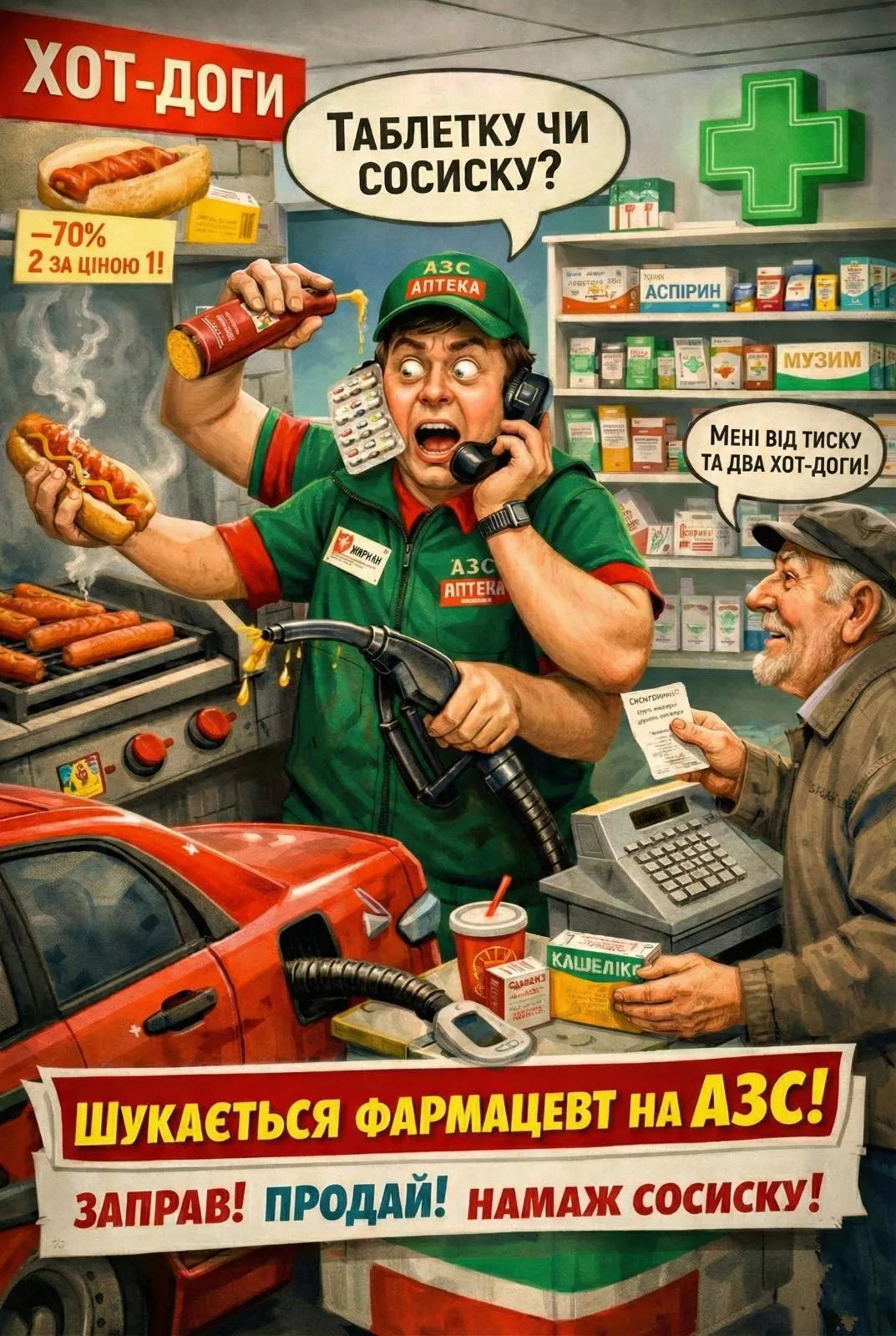
About the inequality of license terms
Pharmacies operate within strict regulatory limits: a certain area of the sales hall, availability of rooms for staff, compliance with DBN, inclusiveness (tactile tiles, ramps) and strict temperature regime. A pharmacist cannot clean with a broom – only with a wet mop, cannot put different types of drugs on one shelf. There is nothing like that at the gas station. The question arises: why are these conditions mandatory for pharmacies, but not for gas stations? This is the creation of completely unequal conditions for business.
About “European experience” and manipulation
The argument that “that’s how they do it in Europe” is not entirely correct. In many countries (Czech Republic, Slovenia, Hungary) gas stations do not sell medicines at all – only dietary supplements. In countries where sales are allowed, the list of drugs is as limited as possible. These are specific dosages (e.g. paracetamol only 200 mg, not 500 mg), small packages and limits of “one pack in one hand”. In Ukraine, they are trying to allow a much wider list without proper control.
About the safety of drivers and the risk of road accidents
Selling certain categories of drugs on the highway is dangerous. For example, vasoconstrictor drops or certain anti-cold drugs can affect the driver’s condition. If a person is stressed or tired and takes a drug that has side effects on concentration, it can trigger an accident. In Europe, such risks are minimized precisely due to microdosing, which is not prescribed in our project. That is, the driver injects himself with something helpful and therapeutic and flies into the oncoming lane at speed. Who among the refuelers knows about the side effects of the drugs?
About availability in front-line areas
The authorities say that it is under will increase the availability of medicines in the frontline areas. But I personally went around Kupyansk, Vovchansk, Kherson after the liberation – there are no gas stations there, they did not return there. Instead, the drugstores are back! We opened on the 19th-20th day after the de-occupation. That is, the thesis about “saving front-line territories with gas stations” is just a good wrapper for lobbying someone’s interests.
About professional ethics and quality control
Pharmacists turned into people with faded eyes. They studied for 7-8 years, studied eight types of chemistry and pharmacology for what? So that a person now wipes his hands after shawarma or a gas gun and goes to release the painkiller? The pharmacy has “entry control”, the manager checks batches, monitors the temperature regime and quarantine measures. At the gas station, no one will keep temperature logs or track expiration dates according to all the rules of pharma control. This is a complete degradation of the industry.
About historical context and marketing
If we are already on the path of expanding the assortment at gas stations, then let’s allow pharmacies to return to historical traditions, when pharmacies had wine cellars. Seriously, as a marketer I see the absurdity of the situation: how to advertise promotions at gas stations? “Buy a bottle of vodka – get a sorbent as a gift”? This looks like complete regulatory chaos where professional medicine is replaced by retail convenience.
The government’s decision is presented as concern for people in the difficult conditions of war. But it also opens up a new, potentially profitable market for big players – pharmaceutical distributors and gas station chains.
So is the health care system ready to take responsibility for the consequences if “convenience” turns out to be more important than medical feasibility? These and a number of other questions of the publication UA.News stated in an official request to the Ministry of Health. Therefore, there will be a continuation. Do not rush to self-medicate.
Read us on Telegram and Sends