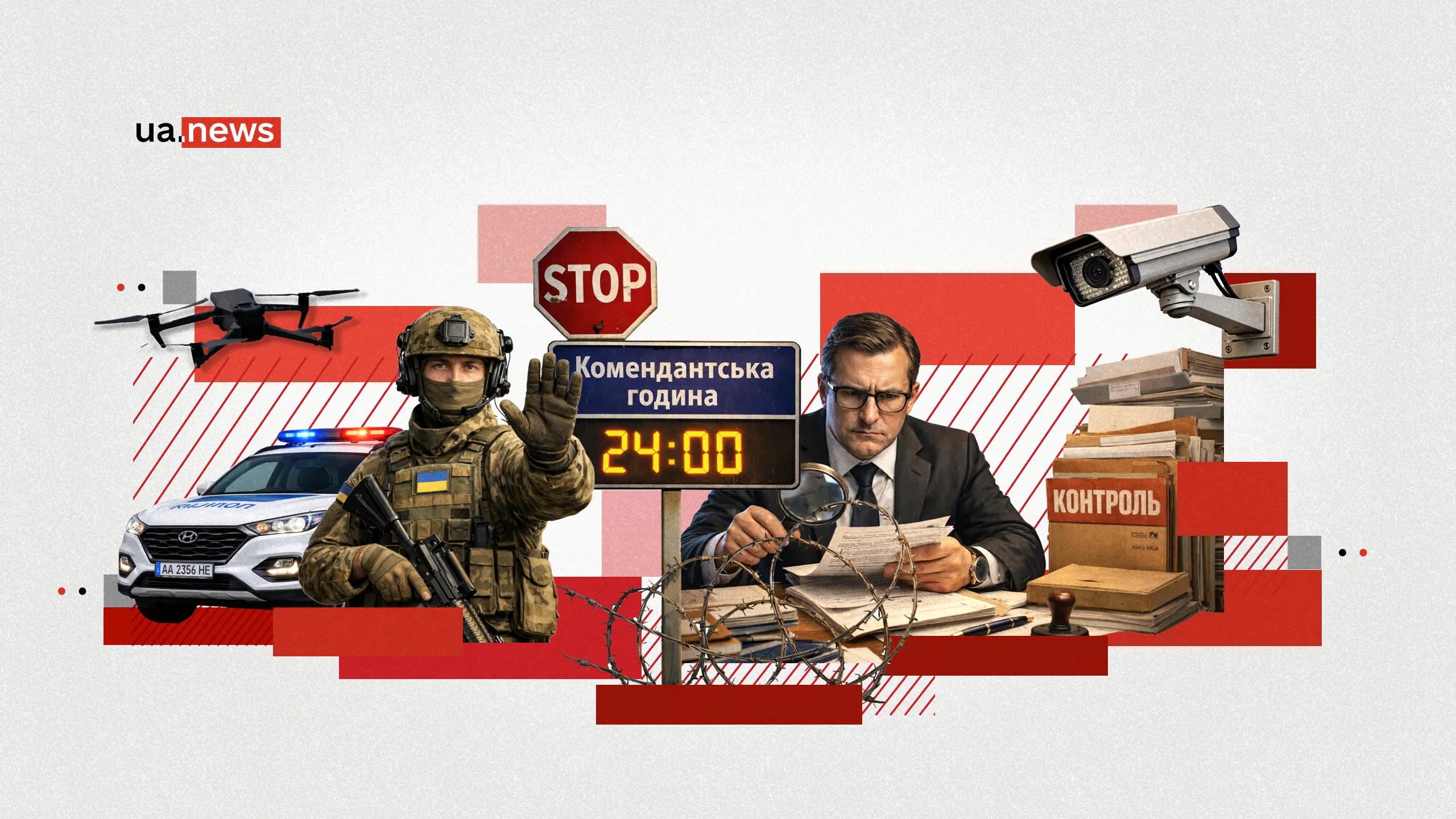
“Almost four years of the great war left a deep mark in all spheres of Ukrainian life, bringing many new restrictions to public life. One of the most noticeable was the curfew. The night is in itself a kind of “commandant” that regulates the presence of citizens on the streets and in public places. Somewhere it is 1-2 hours longer, somewhere shorter, however”, — write on: ua.news
Almost four years of the great war left a deep mark in all spheres of Ukrainian life, bringing many new restrictions to public life. One of the most noticeable was the curfew. The night is in itself a kind of “commandant” that regulates the presence of citizens on the streets and in public places. Somewhere it is 1-2 hours longer, somewhere shorter, but the essence (almost) is always the same: you have to stay at home at night, period.
Curfew has become so commonplace in our lives that it seems as if it has always existed. However, this is not the case: as a mass and long-term administrative practice in Ukraine, it is not even four years old.
Recent critical events in the energy sector, in particular massive attacks by the Russian Federation on infrastructure facilities, led to the announcement emergency situation in energy. In the context of this, in Kyiv and some other regions, curfews for businesses and citizens have been significantly relaxed — and de facto almost abolished. The logic is simple: a business (gas station, shopping mall, pharmacy or cafe) can work as a point of invincibility, where you can warm up and charge your gadgets, and citizens have the right to get to such places at any hour of the day.
This precedent became a catalyst for a not too active, but already existing public debate: is there any sense at all in curfew now, at the end of the fourth year of the war? Is it really a necessary security measure — or has it become an anachronism that slows down the economy and restricts freedoms without adequate returns in the security context? This issue becomes especially acute if we remember that there is a city in Ukraine that is a proof of an alternative approach — Uzhgorod, a regional center that never knew a curfew during the entire war.
Where did the phenomenon of “curfew” come from, why exactly is it necessary and should Ukraine not think about the potential cancellation of this administrative regime? UA.News political columnist Nikita Trachuk discussed the issue together with experts.
Curfew: essence and historical context
The curfew as an institution has a deep historical basis, but it makes no sense to dig deep into the thicket of the past. Suffice it to say that in the modern understanding it is usually a temporary (!) restrictive measure implemented by the state authorities in a certain territory during periods of a state of emergency, martial law, mass riots or a natural disaster. Its essence is the prohibition or restriction of citizens’ stay in public places without special permits at certain hours, usually at night. The goal is to maintain public order, prevent crime, facilitate control of the situation by security forces and, most importantly for wartime, reduce the risk of civilian casualties.
In the Ukrainian context, the era curfew began on February 24, 2022, with the declaration of martial law. It became one of the first manifestations of a new, strict lifestyle. At first, it was a completely correct response to an absolutely unprecedented threat, an attempt to order the chaos of the first days of the war, to protect people who could become targets for subversive groups, and to give the security and defense forces maximum freedom of action in the dark hours of the day. At that time, this measure was rightly perceived by society as absolutely necessary and even life-saving.
However, time passed. The front stabilized relatively, society learned how to function in the conditions of war, and the curfew remained practically unchanged, turning from a temporary emergency measure into a permanent and usual administrative routine.
Potential curfew lifting: pros and cons
It is important to note: currently no one has canceled the curfew anywhere – except in Uzhhorod, where it never existed in principle. In Kyiv and in the regions with effect state of emergency in the energy sector, this regime was relaxed.
However, knowing Ukrainians, it is de facto — not de jure — that we can talk about temporary cancellation. After all, now anyone on a Kyiv street can say that he is heading to the point of invincibility — or returning home after visiting this very point. And how to prove that this is not true, and a person just decided to go for a walk? The question is rhetorical.
In this context, it is interesting to imagine purely potentially what would happen in the case of a real cancellation of the curfew. Among the advantages is in the first place human factor — it would be about psychological and physical relief for millions of citizens. The ability to move freely at night, especially if it is a warm season, is an important element of normalizing life, a way to fight burnout and the long-term stressful state in which society is. It is also a symbolic step that demonstrates confidence in the relative stability of the situation in the rear and a movement towards a retreat from the “totalitarianization” of our everyday life.
However, they still look the most important economic advantages. The curfew almost completely eliminates the potential of the so-called “night economy”. Restaurants, cafes, clubs and other similar places are forced to close much earlier than before the war, losing a significant part of the revenue – especially on weekends. At the same time, it is not a secret for anyone that “rogue” establishments operate in all major cities. That is, virtuous entrepreneurs close for the night, and those who have “made a mistake” work quietly in the shadows. This entails reduced tax revenues, job losses and difficulties for entire industries, such as entertainment and the hotel and restaurant business.
Taxis and delivery services which are traditionally in great demand at night, also work with total restrictions or require special permits, which complicates their work and increases costs. In general, the effect of the curfew on logistics and industry is critical. Many shipments are scheduled at night to avoid congestion, and production cycles in factories are often continuous.
The need to issue special passes for every driver or employee who must travel at night creates bureaucratic barriers, slows down processes and increases the costs of a business that already operates in extremely difficult conditions. Abolishing the curfew could be a powerful stimulus for economic activity in the hinterland regions, adding at least a few working hours to the economic life of cities.
The main and, by and large, the only serious argument in favor of preservation curfew remains security. Night is the traditional time for enemy missile and drone attacks. At first glance, everything sounds logical: fewer people on the streets and in institutions means fewer potential victims in the event of a hit. However, upon critical examination, this argument reveals its own significant weaknesses.
First, there is the example of Uzhhorod. Being the regional center, this city did not impose a curfew throughout the war. Life in the center of Transcarpathia demonstrated that the absence of night restrictions does not lead to chaos, some catastrophic increase in danger, crime or anything else.
Secondly, the issue of security in general is frankly painful. It is said that everyone should stay at home for safety. However, the curfew does not guarantee safety in the house! Almost all the victims of night shelling died in their homes, where every time rockets hit and drones. The risk of hitting a night establishment, where dozens of people may be, is very serious, but at the same time, statistically, it does not exceed the risk of hitting a residential building, where there are no less, if not more, people. Thus, the security argument, while critically important, is not absolute.
Opinions of experts
Political scientist, director of the Center for Applied Political Research “Penta” Volodymyr Fesenko reminds: currently it is not about cancellation, but about a more flexible regime of curfew. And it is right: it is necessary to facilitate this administrative regime.
“When the law on martial law was written, it was copied: both from Soviet models and from some others. It was an abstract situation that no one seriously thought about. It was hypothetical, all these restrictions that are written there. And now it is obvious that in the current conditions, and especially in the conditions of such an energy crisis or massive shelling – what kind of curfew is there? Additional measures to ensure order at night are needed here. And a more flexible format of restrictions for the civilian population is definitely needed. All these nighttime bans made sense in the old wars. It is already a different era, a different situation, and restrictions on the movement of people must be abolished. But I’m sure there should be restrictions on all kinds of entertainment – after all, we’re at war. That is, a hybrid: it should not be like it was in peacetime. But people should be able to meet their basic urgent needs at night, especially at such a time.” Volodymyr Fesenko is confident.
Political scientist, head of the “Third Sector” center Andriy Zolotaryov is more skeptical. He believes that the curfew serves primarily a corruption and political function, not a security one.
“The curfew has actually been minimized in Kyiv, although almost from the very beginning it was clear that it was more of a police action against its own citizens than ensuring a real fight against the enemy, countering the DRG and everything else. The curfew has long since turned into a “feeding ground” for corrupt police officers and some officials. At the same time, wealthy people, people with connections have the opportunity to move around calmly even during the curfew. For example, some taxi services work all the time during the curfew, but it costs completely different money than during normal times. We see that there was no curfew in Transcarpathia for all 4 years of the war, and we can say that the need for it, with the exception of the frontline regions, is very, very doubtful. But it was not introduced for that reason. It was essentially a police tool for “training” the population, forcing it to a certain pattern of behavior. In fact, until now, this is how it all works: it reminds that there is a war, and “educates” its own population.” Andriy Zolotaryov noted.
Summing up, the curfew issue in Ukraine at the end of the fourth year of the war has already gone beyond a simple administrative procedure. It became a kind of marker of how the state balances between security and freedom, between a permanent regime of total emergency and people’s desire for normalization of life.
The final decision, of course, rests with the authorities. It should be based on a careful assessment of the risks of specific regions, the capabilities of security forces and warning systems. However, there is a feeling that the curfew in most of Ukraine, especially in the west and in the center, has gradually and imperceptibly turned into an outdated atavism, a rudiment of the first months of the war. Perhaps the time has come for a gradual, regionally differentiated transition to more flexible models.
Read us on Telegram and Sends