“The risks of the new version of the Central Committee were analyzed: discrimination, moral control, ignoring human rights and European standards.”, — write: www.pravda.com.ua
The public reacted quickly and so vividly that the trigger norm was immediately promised to be removed, and an alternative version of the code was submitted without it. Now the Verkhovna Rada is considering two drafts of the new Civil Code (No. 14394 and No. 14394-1).
This made life much more difficult for public organizations and deputies who still want to read everything carefully. Because these are more than 3,000 pages of a legal document in total, which were prepared without proper public discussions and consultations with relevant organizations.
Advertising:
Both versions differ much less than they try to show in public communication.
Registration of an alternative draft law does not mean the rejection of problematic norms: the main draft has not been withdrawn, the profile committee has not reviewed it, and therefore the risk of adopting “marriage at 14” remains regardless of assurances about “taking into account the position of the public”.
So now the civil society is forced to read in an emergency mode what legal feedbacks have been prepared by the developers of the Civil Code – which, in fact, regulates all our everyday life, family, property, money, contracts, inheritance, business and personal rights.
When lawmakers talk about morality, it’s time to worry When blurred moral categories such as “good faith”, “morality” and “immorality assessment” appear in the law, one gets the impression that the parliament has not just opened the wrong door, but is very confidently stepping in the direction of the Russian legal tradition, where the state has long decided how to live, give birth and remain silent.
Both drafts of the new Civil Code begin with the solemn introduction of “bona fides” as one of the basic foundations of civil legal relations. Good faith implies openness, lack of ulterior motives, and respect for the legitimate interests of the other party, but this category is very easily transformed into a universal moral argument.
“Openness of intentions” in itself does not guarantee anything. A person can act sincerely, consistently and without any ulterior motives, but at the same time violate the rights of others or reproduce violent practices that the state is obliged to restrain, not legitimize. That is why it is not an abstract good faith that is important, but clear boundaries of acceptable behavior, defined by the law, and not by a personal idea of ”correct”.
At the request of Ruslan Stefanchuk, another key regulator can be “propriety” — that is, a set of moral norms, standards of ethical behavior, and generally accepted ideas about proper behavior, the violation of which will result in legal consequences.
In fact, the acceptance of “normality” opens the way to moralistic restriction of rights, in particular in matters of bodily autonomy, sexual orientation and gender identity, reproductive rights and even private life in general, since the concept itself is too evaluative. At the same time, among other general principles of civil legislation, there is no direct indication of the priority of human rights or non-discrimination.
They forgot about international obligations, European integration and the norms of the Istanbul Convention It would seem that in recent years we are gradually moving towards overcoming discrimination.
In particular, an important point was the implementation of the Istanbul Convention, but the new Civil Code, in both editions, contradicts it as well. For example, the article proposed under number 278 on the beginning of the statute of limitations establishes the following new norms:
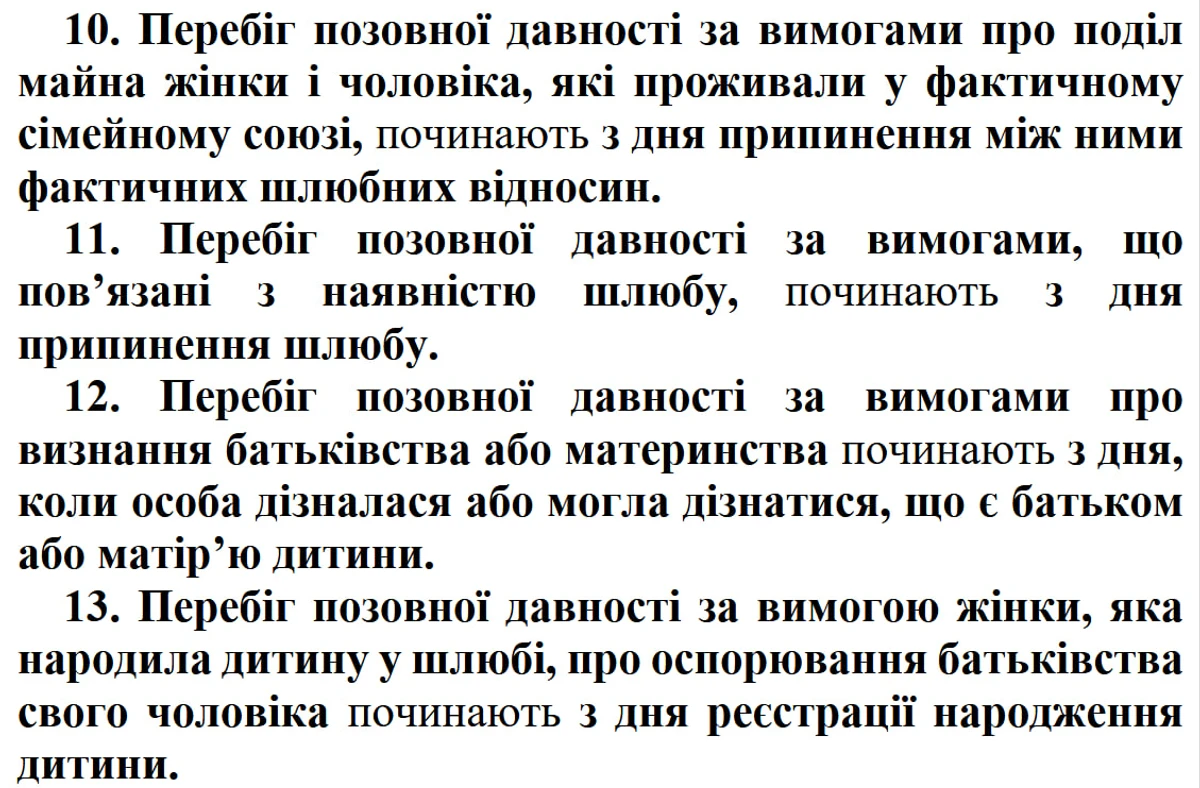
Formally, this looks like a technical clarification of the terms, but in fact it contradicts Ukraine’s obligations in the field of European integration. Articles 49 and 50 of the Istanbul Convention oblige the state to ensure effective judicial processes that are accessible to victims and take into account their security situation.
Running the statute of limitations from the moment the de facto marital relationship ends or the birth of a child fails to take into account the real context of violence, fear, control and dependence in which a woman may be.
In the practice of domestic violence, the period after a formal separation or after the birth of a child is the most dangerous. The victim may need more time than the general statute of limitations of 3 years in the case of property division and 1 year in the case of paternity disputes to recover and find the strength to seek justice.
Tying procedural deadlines to these moments means that the deadline may expire even before a person can actually go to court without endangering himself or the child.
Although the new formulations appear to be gender neutral, they have a disproportionately negative impact on women in particular. For example, “caring” for children at the cost of not protecting women is traced in another article.
The revision of the Civil Code in draft law 14394 prohibits divorce during the wife’s pregnancy and within one year after the birth of the child” (Article 1512).
Such a norm was in the Family Code of Ukraine (Article 110) for a long time, but it was excluded on December 19, 2024 by Law of Ukraine No. 4073-IX within the framework of European integration and the implementation of the principles of the Istanbul Convention, as it significantly hindered the access of victims of domestic violence to justice.
Another version of the Civil Code, registered as draft law 14394-1, no longer contains the return of this outrageous norm. Special attention should be paid to this moment when voting.
If you look at other articles of the Central Committee, you get the impression that its authors bathed in misogyny, otherwise there is no way to explain a number of innovations.
How do you like the idea of not paying alimony? We see the following innovation in the Code (Article 1636 of the Civil Code in both draft laws):
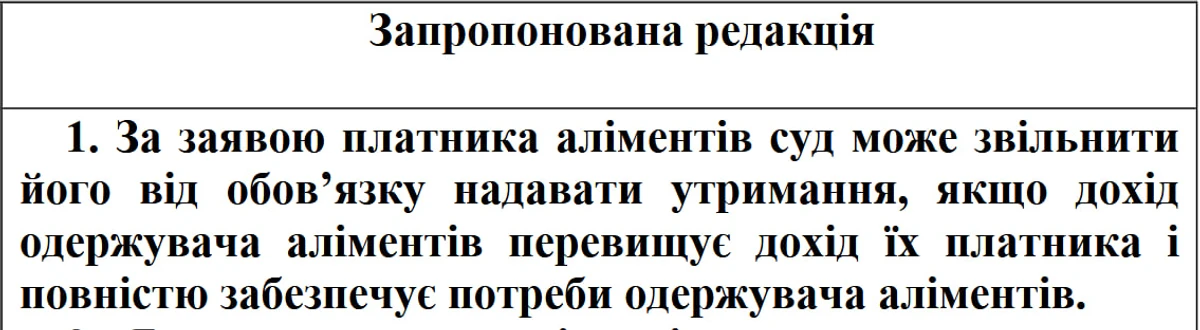
The proposed wording does not clarify which alimony recipients are concerned — children or adults (for example, ex/former spouse, parents, etc.).
Alimony is the property of the child, but if it is paid by a court decision through a state enforcement agency or a private executor, it will be credited to the debt collector’s account. In other words, if the child’s mother applies to the court for the collection of alimony, then the funds are transferred to her account, and it is she who stands in the “recipient” column, although she has the obligation to use these funds in the interests of the child.
Taking into account such a conflict of wordings, in the event that the father proves that the mother’s income is sufficient to provide for his own needs and the needs of the child, but instead he has certain difficulties, the court can relieve him of the obligation to pay alimony, but this contradicts the logic of protecting the rights of the child, because alimony is the obligation of parents to the child, not to each other, and the higher income of one of the parents does not cancel responsibly a hundred others. Which of the articles is the priority? After all, the law cannot have a double interpretation.
Rejection of abortions? Article 305 of the Civil Code entitled “Reproductive rights” appears in both new editions.
Fortunately, it does not restrict abortion. The only nuance is the wording that “artificial termination of pregnancy up to 12 weeks is possible only with the informed written consent of the woman.”
Another article of the Central Committee defines that any medical intervention and so it happens with such consentso in a heap with the already mentioned “benevolence”, as well as the fact that in the current version “a woman’s desire” is enough for such an interruption, there is a suspicion that women may face intimidation in medical institutions and refusal to have an abortion.
“Pregnant at 14” was canceled. What else after pregnancy? Another norm of the same article raises more questions.
Thus, in the new edition it is indicated that “Programs of assisted reproductive technologies are used only for medical reasons and with the informed written consent of an adult natural person with legal capacity”.
Such a proposed norm directly contradicts the Order of the Ministry of Health No. 787. In the “Procedure for the use of assisted reproductive technologies in Ukraine”, clause 4.9 clearly indicates that intrauterine insemination can be carried out for medical and social indications, that is, at the woman’s will.
Mostly single women fall under this point. Moreover, inclusive access to reproductive technologies (RT), in particular access to them by single women, as well as female and male same-sex couples, is one of the criteria of the European Atlas of Infertility Treatment Policy, which evaluates the legislation and availability of RT in different European countries.
At the same time, Article 1527 of the Central Committee (variant of draft law 14394 and 14394-1) states that “A single woman and a single man have the right to motherhood and parenthood, including as a result of the use of assisted reproductive technologies,” which in fact creates a medical and social basis for DRT, however DRT in the same edition possible only for medical reasons. Thus, the law either silently introduces medical and social grounds for DRT, or creates an exception without clear rules.
Despite the fact that the state limits the possibility of pregnancy for a single woman, pregnancy is not required of a married woman.
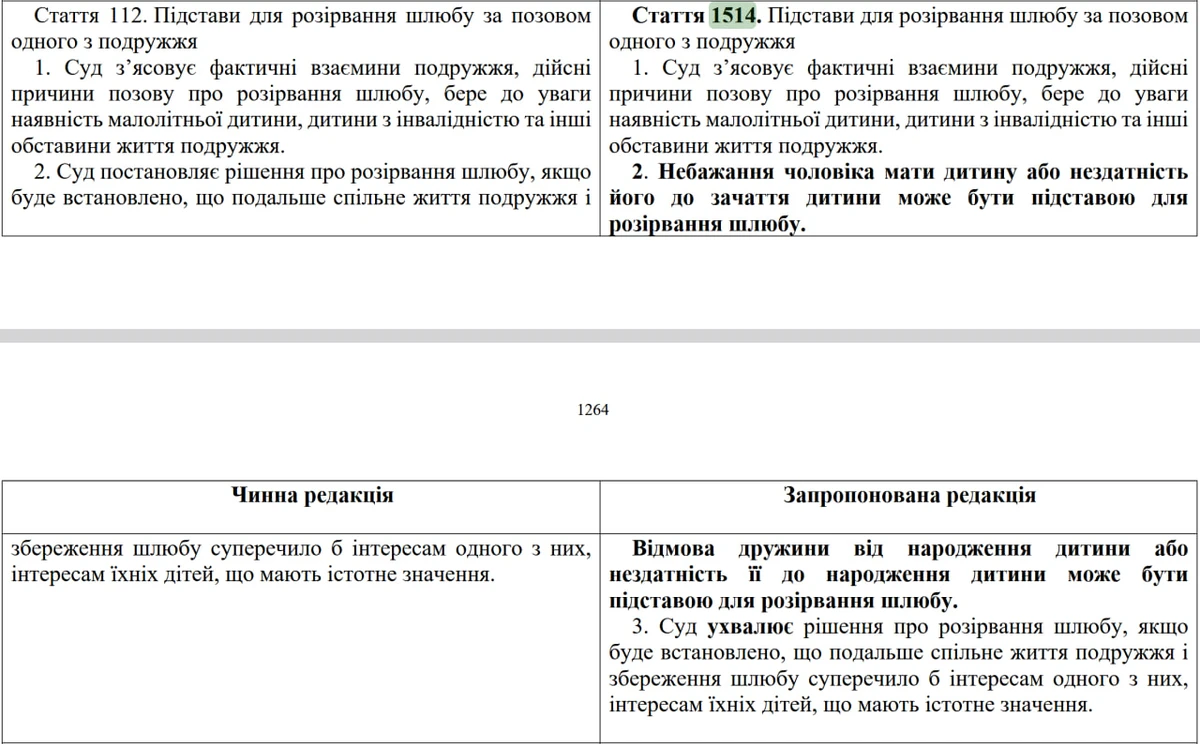
In effect, the state arrogates to itself the right to evaluate a couple’s reproductive decisions, and makes this reproductive choice a significant reason for intrusion into private life.
In addition, gender asymmetry is already embedded in the norm itself: yes, a man has an “unwillingness to have a child”, while a woman has a “refusal to have a child”. This is a literal reproduction of the traditional role of a woman as the one who “must give birth”, the possibility of her “reluctance” is not even considered.
The formula “wife’s refusal to give birth to a child” sounds as if a woman violates someone else’s expectations, and for this there are legal consequences. On the other hand, if we rely on European integration principles, then the decision not to give birth is a right, not a basis for legal assessment.
Duties of children However, the state demands not only from children, but also from children. Article 1565 of the Civil Code (options 14394 and 14394-1) introduces the norm that “A child at any age is obliged to honor and respect his mother and father.”
Morally this seems clear, but legally it is problematic. The formula “at any age” includes children from birth, but the law usually does not impose legal obligations on minors, let alone abstract moral obligations.
The norm also does not say anything about situations where parents were abusers, existing domestic violence, neglect of the child’s interests, alcoholism, etc.
Therefore, the child’s obligation to “respect parents” and “take care of them” leaves no room for taking into account real life circumstances.
This is contrary to the approach enshrined in the Istanbul Convention, which requires the state not to create additional obligations for victims of violence, as well as the practice of the ECtHR, where family obligations cannot ignore the experience of violence.
Engagement and marriage Another “interesting” new article is 1488 CC (variant 14394 and 14394-1) “Engagement”.
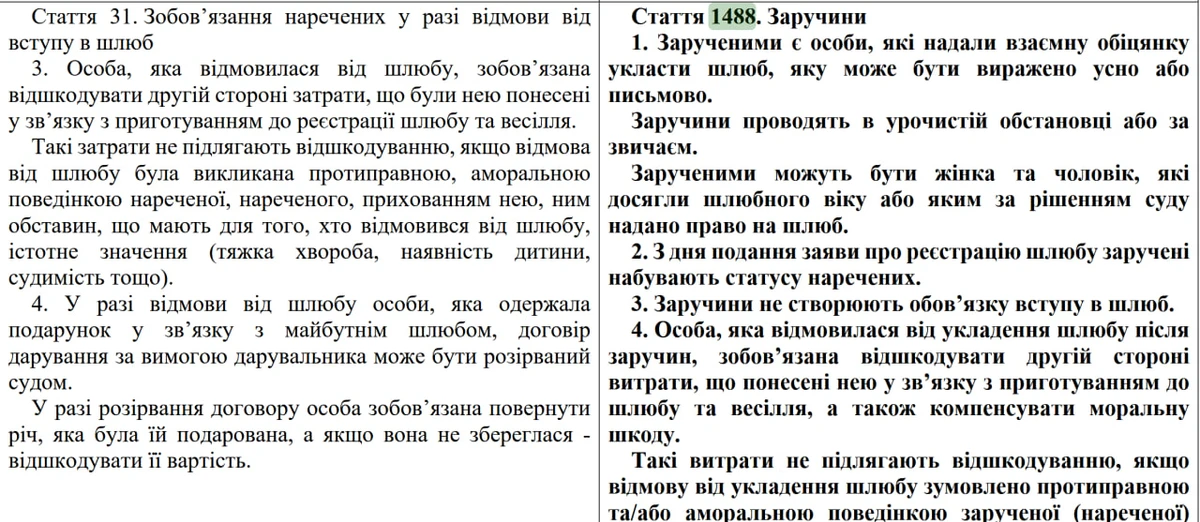
The proposed rules on engagement actually hit women first of all. Formally, the law does not force marriage, but it allows to collect money and “moral damage” from the person who changed his mind.
In practice, this means financial and psychological pressure specifically on women, who are more likely to refuse marriage due to violence, danger or inequality in relationships.
This approach contradicts Article 51 of the Constitution of Ukraine, where marriage is based on free consent, and Article 8 of the European Convention on Human Rights, which protects private life from moralizing state interference.
It is especially dangerous that courts are offered to assess the “immorality” of behavior and demand the disclosure of sensitive circumstances — in particular, a change of gender or the presence of a child.
In fact, it turns the right not to marry into the risk of being punished for one’s own choice, which has nothing to do with the European understanding of freedom and equality.
An alarming innovation is the fact that “the Law can establish legal consequences religious marriage ceremony” (Article 1473 of the Civil Code, version 14394 and 14394-1).
Such a norm is fundamentally problematic, as it undermines the fundamental principle of the secular state enshrined in the Constitution of Ukraine.
Secularism means a clear distinction between the private sphere of religious beliefs and the public-legal regulation of a person’s civil status. Giving a religious rite potential civil-legal force blurs this line and creates a dangerous precedent in which religious norms and practices can indirectly affect the scope of a person’s rights and responsibilities.
In addition, such a construction opens the way to unequal treatment of citizens depending on their religious beliefs or their absence, as well as to the legalization of practices that may contradict the principle of equality of spouses and the voluntariness of marriage.
What about LGBT+ rights? The new version of the Civil Code actually… legalizes discrimination. Thus, Article 317 of the Civil Code (options 14394 and 14394-1) “The right to individuality” defines that “a natural person has […] free choice of forms and ways of expressing one’s individuality, if it does not contradict the Constitution, this Code and/or another law, courtesy”.
As we’ve already established, “normalcy” is an evaluative and uncodified category that lacks a clear legal definition, is very easily replaced by “traditional alignments,” and has historically been used against LGBT+, intersex, and non-binary people.
Accordingly, in practice, this will mean that the right to individuality exists as long as it seems acceptable to someone, which leads to the legalization of discrimination. This directly contradicts the European integration approach, because the morality of the majority cannot be an independent basis for limiting someone’s rights.
The largest number of homophobic norms is collected in the sixth book – “Family Law”. Thus, in the new edition of the Central Committee (14394; 14394-1), “the family is natural and the main center of society”.
That is, the family is not defined as a social and legal institution according to European law. What is a “natural center”, which does not have any legal certainty, remains unknown.
It is logical to assume that such a formula opens the door for arguments about the “natural” and “unnatural” family and the hierarchization of family forms, which allows excluding LGBT+ families.
And this assumption is confirmed by the following article – 1473 of the Civil Code (variant 14394 and 14394-1) “Marriage” – which defines that “marriage is the family union of a woman and a man.” The current Ukrainian legislation does not provide for the registration of same-sex marriages, but allows judicial recognition of the fact of family life through de facto cohabitation. The draft of the new Civil Code proposes to define also “actual family union” (Article 1474 of the Civil Code for 14394 and 14394-1) exclusively as a cohabitation of persons of different sexes.
This means that same-sex couples are completely excluded from the possibility of being recognized as a family; the state deprives them of any legal instrument of protection.
Article 1480 of the Civil Code (14394; 14394-1) confirms this, stating that marriage is based on the free consent of a man and a woman. In addition, Article 1495 of the Civil Code (14394; 14394-1) annuls a marriage with a person who has changed gender without clearly defining the moment of such change. Because of this, even those marriages that were concluded legally after changing the gender marker in the documents are at risk.
Pressure on freedom of speech In general, the formality with which the entire civil code is permeated creates many questions. For example, Articles 17, 25 and 26 of the Civil Code (both under 14394 and under 14394-1) significantly expand the concept of moral damage and compensation for it + the court receives wide discretion to determine the “depth of suffering”, “reputational losses”, etc.
In practice, this can lead to so-called SLAPP-suits, when public criticism, journalistic investigation or expert commentary can be assessed as a “violation of a legitimate interest” and require significant compensation for moral damages.
Result All this is happening in a country that lives in a full-scale war.
Countries where LGBT soldiers fight, die, but still do not have basic legal protection their relationships, the right to a family, to inheritance, to hospital decisions, etc.
Instead, the parliament proposes a new version of the Civil Code, which enthusiastically climbs not to the places where there are real legal gaps, but to the places where it would be worth not changing anything.
Instead, they chose to restrict and punish – for “immorality”, “morality” and “wrong” life decisions.
This code is strange not only in its content, but also in the choice of priorities.
I wonder if the developers were focused on the USA, where the rights of LGBT+ people are restricted, or on Russia, where the state calls for earlier and more births, directly targeting the programs at teenagers?
Instead of a movement towards equality and protection of private life, we get increased control, expanded judicial discretion and the legalization of intrusions into privacy. At the time of war, the state decides not to protect freedoms, but to test their strength, moreover, by very familiar and very Russian methods.
As you can see, the repeal of the 14-year-old marriage rule, which most triggered the public, did not improve the situation much.
The main problem of the Civil Code is its secret development, the lack of real public hearings (not for the sake of a tick) and consultations with specialized organizations. Therefore, both draft laws (No. 14394 and No. 14394-1) should be withdrawn as a whole and be revised in compliance with the transparency and democracy of the process.
Alyona Gruzina, culturologist, head of the communications and advocacy department of the expert resource ” Gender in details“, specially for “Ukrainian Pravda”.
A column is a type of material that reflects exclusively the point of view of the author. It does not claim objectivity and comprehensive coverage of the topic in question. The point of view of the editors of “Economic Pravda” and “Ukrainian Pravda” may not coincide with the author’s point of view. The editors are not responsible for the reliability and interpretation of the given information and perform exclusively the role of a carrier.