“Review of a collection of articles on modern fascism in Putin’s politics, the Russian Federation’s war against Ukraine, and scholarly debates about the term.”, — write: www.pravda.com.ua
Review of the book Russia and Modern Fascism: New Perspectives on the Kremlin’s War Against Ukraine (“Russia and Modern Fascism: New Perspectives on the Kremlin’s War Against Ukraine”).
The term “fascism” has become an almost meaningless concept of political controversy. A significant role in this was played by Soviet propaganda, which applied it to all its enemies – from social democrats to Zionists. Putin’s regime continues this tradition by attacking Ukraine.
Thus, is it an attempt to turn the enemy’s weapon against himself when this accusation is leveled against the policies of Putin himself? This issue has long been a subject of debate. Even researchers who in no way justify Russia’s policy of violence have in the past expressed objections to the “F-word” (or even “F-bombs”).
Advertising:
This collection, containing 12 articles by researchers from Great Britain, Poland, the USA, Germany and Ukraine, examines this debate. The name of the book is not “Russian fascism” and “Russia and modern fascism” indicate a certain caution.
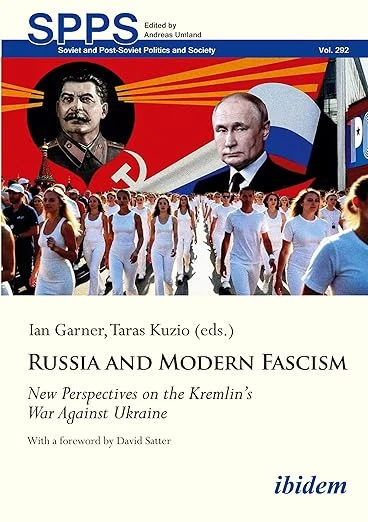
Similarly, the image on the cover is a carefully composed collage: next to Putin’s portrait is not Hitler or Mussolini, but Stalin; there is no swastika or lictor’s bundle, but there is a sickle and a hammer. We don’t see black or brown shirts marching grimly, but young people, mostly athletic women, marching in casual white clothes.
The book is part of the series “Soviet and Post-Soviet Politics and Society”, in which, despite the fact that it focuses on (post-)Soviet topics, another seminal collection of essays on fascism in general was already published in 2006 under the title “Fascism Past and Present, West and East: An International Debate he Concepts and Cases in the Comparative Study of the Extreme Right” (“Fascism Past and Present, West and East: An International Debate on Concepts and Case Studies of the Comparative Study of the Far Right”).
The focus of this 20-year-old volume was on the definition of fascism as “palingenetic ultranationalism” developed by Roger D. Griffin (Oxford Brookes University) and based in particular on the work of Alexander Dugin (1962).
The introduction to the book “Russia and Modern Fascism”, written by two editors, Jan Garner (Piletsky Institute, Warsaw) and Taras Kuzy (Kyiv-Mohyla Academy), raises this topic.
In their opinion, the revival of a degenerate nation with the help of violent redemption from 2020 is a modern form of fascism in Russia.
In their own article included in the collection, they show how the merciless destruction of Mariupol in 2022 illustrates the “cycle of destruction and rejuvenation” (p. 272) in perpetual war.
This interpretation of violence as an example of fascist projection of death and rebirth is quite understandable. But is the destruction of cities in Chechnya or Syria by Russian troops also an expression of “revival”? And does the planned colonization of Mariupol by hundreds of thousands of Russian settlers mean the “rebirth” of Russia itself?
The only attempt to approach this question systematically, using clear categories, belongs to Alexander J. Motyl (Rutgers University, Newark).
According to Motyl, authoritarian dictatorship, mass support, cult of personality and personalistic leadership style are the decisive factors of fascist rule.
In his typology from democracy to semi-authoritarian and fully authoritarian rule, including fascism, Putin meets all the criteria of authoritarianism. In addition, he is a personalistic dictator who enjoys mass support. According to Motyl, this makes Putin’s authoritarianism a kind of fascism.
In his chapter in the collection, the editor of the book series “Soviet and Post-Soviet Politics and Society” Andreas Umland (Swedish Institute of International Relations (UI), Stockholm) pays great attention to the concept of palingenesis, which Motyl rejects as too general.
But even the promotion of fascist thinking by the Putin administration, especially Ivan Ilyin (1882–1954), and the rise of Dugin do not lead to full fascism, but rather to “quasi-fascism.”
Umland is right in his observation when he emphasizes that the full-scale attack on Ukraine is caused not only by a shift towards ultra-nationalist revolutionary zeal, but also by a cynical policy of preserving power and a mistaken assessment of the situation.
Joanna Getka (University of Warsaw) and Jolanta Darczewska (1950–2025, OSW Center for Oriental Studies, Warsaw) argue that there is a marginal Russian fascist tradition, both in the Russian emigration and within the country after the collapse of the USSR.
As proof of gradual fascisization (that is, not fully developed fascism), they cite the infamous pamphlets about the “denazification” of Ukraine – fascism with an anti-fascist mask, but also only a caricature of fascism, albeit a dangerous and aggressive one.
Similarly, in his article on the Russian Orthodox Church and its role in modern Russian “imperialism”, Michal Wawzhenok (Ignatianum University, Krakow) vacillates between the claim of modern fascism and the more cautious statement that pan-Russian ideology is “presumably” comparable to Italian fascism and German Nazism of the interwar period (p. 175).
In his chapter, Andreas Heinemann-Gruder (University of Bonn) singles out the motif of “holy war” in anti-Ukrainian propaganda. He comes to the conclusion that this is not a repetition of totalitarian (especially fascist) approaches of the 20th century, but rather an expression of “religious-fundamentalist” state ideology.
Here, the narrative about the defense of Russia in the tradition of the Second World War, which is imposed in the “neo-totalitarian” society as the only acceptable interpretation, plays an important role.
More important than the consistent qualification is the diagnosis that these quasi-religious discourses amount to a justification – and even a demand – for a state of perpetual war.
This can also be seen in the efforts being made under Putin in the education system, which Maria Domanska (OSW Center for Oriental Studies, Warsaw) describes as “fascist education” in a regime she also calls “neo-totalitarian”.
Since 2008, the cult of militarism has been promoting historical myths, in particular the demonization of Ukrainians as “Nazis”.
In fact, the shift to a “Nazi” rather than primarily “fascist” enemy of Russia is a linguistic innovation that deserves closer study.
Is it possible that the term “neo-Nazi” has replaced the term “fascist” to refer to enemies because too many supporters in the Russian camp itself openly adhere to fascist or fascist-related concepts?
The chapter of Domanska’s book certainly cannot fully shed light on how effective propaganda is. In any case, it is interesting that, according to a 2024 study cited by Domanska, military history is not particularly popular among the younger generation.
The information about the brainwashing of young people in the territories occupied by Russia, which was collected by Yaroslava Barbieri (Royal Institute of International Relations, Chatham House, London), causes concern. Intimidation, forced assimilation, and the recruitment of teachers from Russia are used here; Ukrainian online education is available only to a minority.
In the closing remarks, Paul D’Agnieri (University of California, Riverside) admits that the book will not end the debate about whether the concept of fascism can be applied to Russia.
However, such a label, which takes into account the cult of violence, war and masculinity, is necessary. Because, unlike in 2015, Russia is no longer “just another authoritarian state” (p. 304).
In general, the book raises more questions than it answers. Again and again there are estimates that assume other classifications. Even Motil, the most ardent supporter of the label “fascism”, in one place calls Putin the new “tsar” (p. 52).
In the chapter dedicated to Mariupol, the editors diagnose that a key component of imperial nationalism, as it was in the tsar and the “white” emigrants, is the denial of the Ukrainian nation. But how does this fit with their announcement that the city museum in Mariupol will be named after Stalin’s close associate Andriy Zhdanov (1896–1948)?
The book does not discuss the extent to which “fascism” was already present in Stalinism, which the fascist leaders themselves sometimes admitted.
At first glance, the label “Stalinism” may seem contradictory, given that today’s terror is not directed against one’s own people, as it was during the heyday of Stalinism.
However, you can look at it in another way: doesn’t Putin consider the Ukrainians, against whom he is waging war for their “treason”, his legal subjects? And doesn’t the new form of fascism involve a stronger hierarchization of ethnic groups and their “natural” inequality than is currently demanded by Russian propaganda?
Ukrainians, who are the object of hostility, are not classified as fundamentally different, but as equal (in value) to Russians. In the chapter dedicated to Mariupol, the editors show how Russian propaganda accuses Ukrainians of wanting to consider themselves independent, “confused” by Western propagandists.
Widespread homophobia, in turn, has the appearance of “fascist”, in contrast to the almost complete absence of anti-Semitic propaganda; none of these topics are discussed in the book.
And the call for the unity of the peoples of the Russian Federation, which, as the editors describe, is embodied in the monuments during the restoration of Mariupol, is not typical of fascism.
However, this does not diminish the value of the book. The aforementioned contradictions are inevitable and reflect the openness of the ongoing search.
It’s not the answers that matter, but the questions. Discussion of terms and categories ultimately serves to sharpen and deepen observations and evaluations.
Andreas Umland also emphasizes in his chapter that such attributions cannot be irrefutably right or wrong, but are always based on convention. In addition to scientific classification, there is also a subjective aspect, especially in the specific perception of the people of Ukraine.
Provoking counterarguments is not a weakness, but a strength. In this way, the book can generate many fruitful discussions. Anyone who wants to think more deeply about “Putinism” should consult the articles included in this collection.
Dr. Matthias Fetter
A column is a type of material that reflects exclusively the point of view of the author. It does not claim objectivity and comprehensive coverage of the topic in question. The point of view of the editors of “Economic Pravda” and “Ukrainian Pravda” may not coincide with the author’s point of view. The editors are not responsible for the reliability and interpretation of the given information and perform exclusively the role of a carrier.