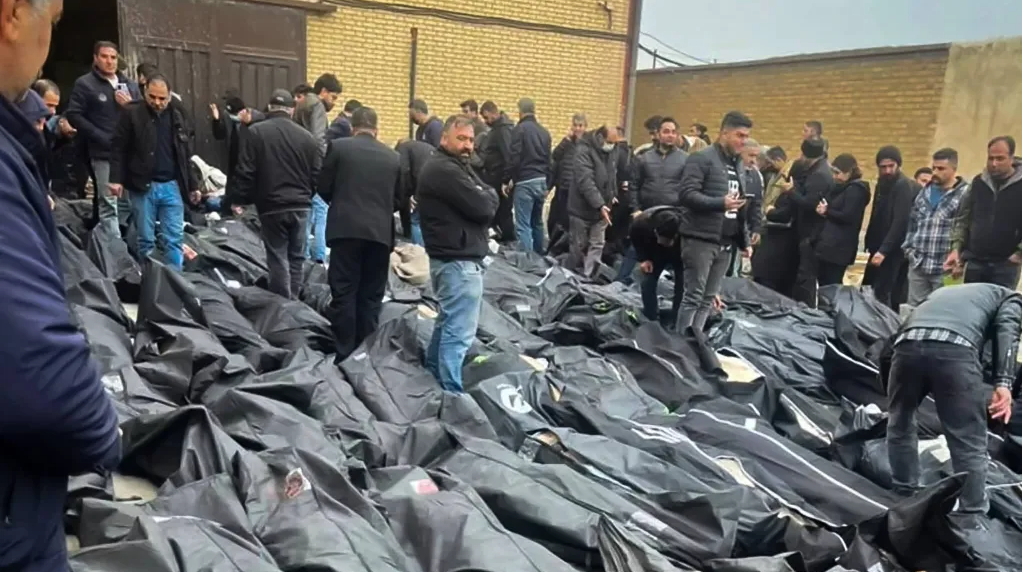
“The Iranian regime killed at least 16,500 people and injured more than 330,000 during its brutal crackdown on anti-government protests. The mass killings are taking place in the conditions of a total blackout of the Internet and telephone communication, which doctors on the ground described as “genocide under the cover of digital darkness.””, — write: www.pravda.com.ua
Source: The Sunday Times with reference to the report of the network of Iranian doctors, the data of human rights defenders and the testimony of eyewitnesses
Details: The publication managed to get information from doctors who continue to work in Iranian hospitals. The medics transmitted the data using Starlink satellite communication terminals that had been smuggled into the country.
Advertising:
According to the report, which is based on statistics from eight major eye hospitals and 16 emergency departments, the death toll ranges from 16,500 to 18,000. The number of wounded is estimated at 330–360 thousand. Most of the victims suffered during the two days of the most intense massacre by the Islamic Revolutionary Guard Corps (IRGC) and the Basij militia.
Dr. Amir Parasta, an Iranian-German surgeon and medical director of Munich MED, who coordinated the data collection, emphasized the change in security forces’ tactics. If during the 2022 protests the authorities used mainly rubber bullets and shotguns, now they are using military-style weapons against the crowd. Doctors record bullet and shrapnel wounds to the head, neck and chest, caused by Kalashnikov assault rifles and machine guns mounted on pickup trucks.
“These are deliberately underestimated minimum numbers,” Parasta notes, explaining that many injured people avoid going to hospitals because of the fear that law enforcement officers can arrest them just from their hospital beds.
Parasta’s direct speech: “This is a whole new level of brutality. I’ve spoken to dozens of doctors on the ground and they’re really shocked and crying. These are surgeons who have seen war. It’s genocide under the cover of digital darkness. They said they’re going to kill until it stops, and that’s exactly what they’re doing.”
Details: The newspaper was also able to contact several people who managed to escape from Iran. One person from Mashhad said that “on Friday they were shooting at everyone. The IRGC calmly aimed at people’s heads.”
Another eyewitness from the town of Kerage said that “snipers on the roofs were shooting people in the back of the head.”
“We were walking when suddenly several people next to us fell to the ground, covered in blood. When we tried to approach them to pick up the bodies, they opened fire on us,” he said.
The report pays particular attention to the number of eye injuries. Between 700 and 1000 protesters lost one eye. 7,000 eye injuries have been documented in the “Noor” clinic in Tehran alone. Witnesses report that in just one night in the capital, more than 800 operations were performed to remove eyes due to gunshot wounds.
Doctors are forced to choose who to save first, in the face of a catastrophic shortage of donor blood. It is reported that the security forces in some cases prohibit blood transfusions for the wounded, and the patients themselves are taken out directly from the operating rooms.
“We fight for hours to save lives, but we lose patients because they are not allowed to receive blood transfusions,” said one of the surgeons in Tehran.
To hide the scale of the tragedy, the regime uses complete information isolation. Activists were able to bring about 50-60 thousand Starlink terminals into the country, but their use is associated with a deadly risk: security forces conduct raids to detect satellite dishes.
Among the dead are a large number of young people under the age of 30: students, athletes, artists. In particular, the death of 28-year-old Yasin Mirzai, who was preparing to enter doctoral studies at the University of Bristol, was confirmed. He was shot in the head during his first protest in the city of Kermanshah.
What preceded:
- The first wave of protests began on December 28, 2024. The merchants of the Grand Bazaar in Tehran were the first to take to the streets, protesting against hyperinflation and devaluation of the national currency. They were quickly joined by students and youth with political slogans and demands for regime change.
- Protests intensified after January 8, when the son of the late Shah of Iran, Reza Pahlavi, called on Iranians to take to the streets en masse. In response, the regime launched a brutal crackdown, putting armed patrols on the streets and blocking communications.
- On January 13, the Speaker of the Iranian Parliament, Mohammad Bagher Ghalibaf threatened the US president For Donald Trump, it will be an “unforgettable lesson” if the US strikes the country.
- On January 17, for the first time since the beginning of the unrest, the supreme leader of Iran, Ayatollah Khamenei, acknowledged the fact of the deaths of people, stating “several thousand” killed. In a televised address, he called the protesters “US foot soldiers” and claimed that they were allegedly armed with foreign-made live ammunition.
- The protesters were hoping for the support promised by Donald Trump from the USA. Instead, on January 16, Trump thanked the Iranian regime for “cancelling 800 scheduled executions” and said that he himself convinced himself not to attack Iran.