“
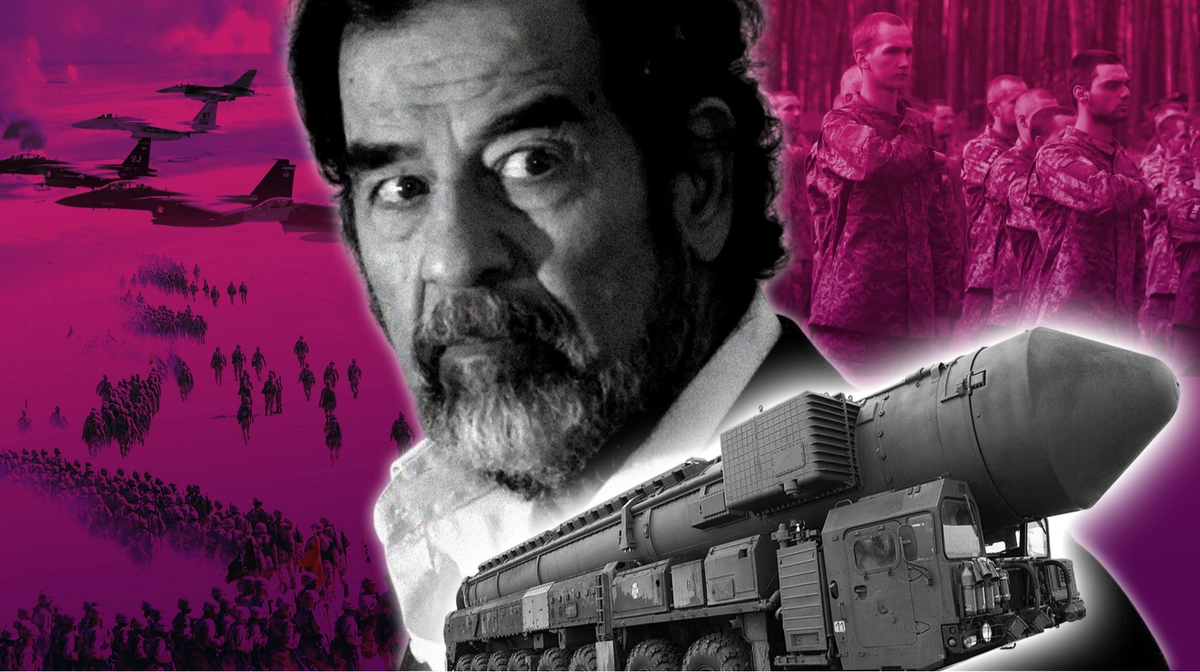
It was preceded by Iraq’s invasion of neighboring Kuwait in 1990, the occupation and annexation of an independent state, UN Security Council Resolution No. 678 with an ultimatum to Iraqi dictator Saddam Hussein, and, finally, the formation of a multinational military coalition led by the United States.
42 countries of the world came out against the aggressor and invader from Baghdad: from Great Britain, France and Saudi Arabia to Luxembourg, Honduras and Singapore.
Advertising:
For five and a half weeks, a campaign of airstrikes against Iraqi strategic targets continued, and on February 24, the allies launched a large-scale ground offensive against occupied Kuwait and southern Iraq. Saddam’s army of half a million was defeated in a few days.
On the morning of February 28, US President George Bush Sr. solemnly announced: “Kuwait is completely liberated!”. In the confrontation with the collective West, the Iraqi dictator suffered a crushing military defeat, and even the newspaper “Red Star” – the official organ of the Ministry of Defense of the USSR – printed a complimentary article “This is how professionals fight”…
Yes, it was a real civilizational triumph of the Western world – and thirty-five years later, this triumph stands in stark contrast to the inability to tame Putin and the Russian Federation.
The area of Ukrainian lands occupied by Russia at the beginning of 2026 exceeds six Kuwaitis. But the liberation of this territory by the forces of the collective West was not even discussed.
The limit of Western ambitions is to convince Putin not to go further and to deploy limited military contingents in the unoccupied part of Ukraine already after a hypothetical armistice. Moreover, it is not at all a fact that these modest plans will be implemented in practice.
35 years ago, “Desert Storm” gave mankind faith in a just world. A world where well-armed evil does not go unpunished.
Where the strong come to the aid of the weak. Where the UN is not a place to pound water in a mortar, but an influential body capable of dealing with an invading dictator. And where behind the concept of “international law” is real military power.
The demonstration of American military capabilities under Donald Trump could remind someone of the events of 1991; but this superficial resemblance is deceptive. In fact, today’s reality is the complete opposite of that time.
Only incorrigible romantics mention international law these days. The Kremlin’s evil is destroying a neighboring country without meeting an adequate response. The UN looks like a silly copy of the League of Nations. And the weak are guilty of not being strong enough.
Thirty-five years ago, many believed that the planet had entered a new historical era. With the end of the Cold War, it seemed, there was no place left on Earth for aggressive tyrants like Saddam, who had previously been tolerated and supported as “their sons of bitches.”
It seemed that almost the whole world recognized the Americans and their Western allies as the guarantors of global security. Even the Soviet Union voted for the resolution of the UN Security Council, which was lobbied by Washington and which provided for military measures against Iraq. And communist China, which previously promised similar resolutions, refrained this time.
Today, looking back, we realize the naivety of those hopes. What in 1991 looked like a new historical norm was actually a lucky and unique coincidence.
By that time, Moscow had already weakened too much, and it was possible to bribe it with economic aid. Beijing has not yet strengthened enough and could be tempted by American preferences. And the militant Iraqi regime failed to acquire its own nuclear arsenal, which in the 21st century actually frees the hands of the Russian regime.
If Baghdad had nuclear weapons, the story of the occupation and annexation of Kuwait could have ended very differently.
However, the bestseller “The Fist of God”, published by the British author Frederick Forsyth a few years later, in 1994, is based on this assumption.
According to the plot of the novel, at the beginning of “Desert Storm” Iraqi scientists manage to make a single atomic bomb. Saddam intends to use it in the event of an allied ground offensive. This turns out to be enough to create unacceptable risks for the UN coalition:
“You didn’t need to be an expert to assess the consequences. An atomic bomb explosion would instantly kill more than a hundred thousand young soldiers.
And in a few hours, the radiation cloud, absorbing billions of tons of radioactive desert sand, would begin to drift, sowing death in its path.
The ships would have time to move to less contaminated regions of the ocean, but the ground forces and the civilian population of Saudi cities…
The cloud, gradually expanding, would drift eastward, first capturing Bahrain and allied airbases, poisoning the sea, then hovering over the Iranian coast, destroying those whom Saddam Hussein would have counted among those who did not have the right to life…”
After learning about the bomb, the allied command postpones the ground operation against Iraq for several days. Meanwhile, valiant British intelligence establishes the location of a secret Iraqi weapon, and an equally valiant American aircraft destroys it with a high-precision strike.
In the fictional fictional reality, the indomitable West was not afraid even of an atomic threat!
This is exactly the image of the Western world – strong, decisive, practically omnipotent and at the same time ready to defend international law – existed in Ukraine for many years.
The mix of real military and political successes and good PR did its job: in Kyiv, they believed that nothing is really impossible for the collective West. That if necessary, the US and its allies will defeat any aggressive dictator.
We waited in vain for a corresponding reaction from Washington and Brussels in 2014, and then in 2022. For a long time, we did not want to admit that Putin is not Saddam Hussein; and that he is unlikely to repeat the fate of his late Iraqi colleague. Like, after all, the fate of Venezuelan Nicolas Maduro.
Today’s West is no longer the same as it was in the early 1990s: but the point is not only that.
The main problem is that a collective West of Ukrainian hopes – ready to fight a nuclear state through an invasion of a third country – never existed at all.
There was only an attractive mirage, to which the events of thirty-five years ago provided sufficient plausibility.
In 2014 and especially in 2022, our hopes cost us too much. But we were saved by the fact that independent Ukraine is not Kuwait. Ukraine foiled the plans of the aggressor, and the enemy army failed to capture it in a matter of days. Ukraine did not have to wait for its own “Desert Storm” – a rescue operation from the outside, which in our case simply would not have happened.
Mykhailo Dubynyanskyi
”, — write: www.pravda.com.ua
It was preceded by Iraq’s invasion of neighboring Kuwait in 1990, the occupation and annexation of an independent state, UN Security Council Resolution No. 678 with an ultimatum to Iraqi dictator Saddam Hussein, and, finally, the formation of multinational forces of this coalition led by the United States.
42 countries of the world came out against the aggressor and invader from Baghdad: from Great Britain, France and Saudi Arabia to Luxembourg, Honduras and Singapore.
Advertising:
For five and a half weeks, a campaign of airstrikes against Iraqi strategic targets continued, and on February 24, the allies launched a large-scale ground offensive against occupied Kuwait and southern Iraq. Saddam’s army of half a million was defeated in a few days.
On the morning of February 28, US President George Bush Sr. solemnly announced: “Kuwait is completely liberated!”. In the confrontation with the collective West, the Iraqi dictator suffered a crushing military defeat, and even the newspaper “Red Star” – the official organ of the Ministry of Defense of the USSR – printed a complimentary article “This is how professionals fight”…
Yes, it was a real civilizational triumph of the Western world – and thirty-five years later, this triumph stands in stark contrast to the inability to tame Putin and the Russian Federation.
The area of Ukrainian lands occupied by Russia at the beginning of 2026 exceeds six Kuwaitis. But the liberation of this territory by the forces of the collective West was not even discussed.
The limit of Western ambitions is to convince Putin not to go further and to deploy limited military contingents in the unoccupied part of Ukraine already after a hypothetical armistice. Moreover, it is not at all a fact that these modest plans will be implemented in practice.
35 years ago, “Desert Storm” gave mankind faith in a just world. A world where well-armed evil does not go unpunished.
Where the strong come to the aid of the weak. Where the UN is not a place to pound water in a mortar, but an influential body capable of dealing with an invading dictator. And where behind the concept of “international law” is real military power.
The demonstration of American military capabilities under Donald Trump could remind someone of the events of 1991; but this superficial resemblance is deceptive. In fact, today’s reality is the complete opposite of that time.
Only incorrigible romantics mention international law these days. The Kremlin’s evil is destroying a neighboring country without meeting an adequate response. The UN looks like a silly copy of the League of Nations. And the weak are guilty of not being strong enough.
Thirty-five years ago, many believed that the planet had entered a new historical era. With the end of the Cold War, it seemed, there was no place left on Earth for aggressive tyrants like Saddam, who had previously been tolerated and supported as “their sons of bitches.”
It seemed that almost the whole world recognized the Americans and their Western allies as the guarantors of global security. Even the Soviet Union voted for the resolution of the UN Security Council, which was lobbied by Washington and which provided for military measures against Iraq. And communist China, which previously promised similar resolutions, refrained this time.
Today, looking back, we realize the naivety of those hopes. What in 1991 looked like a new historical norm was actually a lucky and unique coincidence.
By that time, Moscow had already weakened too much, and it was possible to bribe it with economic aid. Beijing has not yet strengthened enough and could be tempted by American preferences. And the militant Iraqi regime failed to acquire its own nuclear arsenal, which in the 21st century actually frees the hands of the Russian regime.
If Baghdad had nuclear weapons, the story of the occupation and annexation of Kuwait could have ended very differently.
However, the bestseller “The Fist of God”, published by the British author Frederick Forsyth a few years later, in 1994, is based on this assumption.
According to the plot of the novel, at the beginning of “Desert Storm” Iraqi scientists manage to make a single atomic bomb. Saddam intends to use it in the event of an allied ground offensive. This turns out to be enough to create unacceptable risks for the UN coalition:
“You didn’t need to be an expert to assess the consequences. An atomic bomb explosion would instantly kill more than a hundred thousand young soldiers.
And in a few hours, the radiation cloud, absorbing billions of tons of radioactive desert sand, would begin to drift, sowing death in its path.
The ships would have time to move to less contaminated regions of the ocean, but the ground forces and the civilian population of Saudi cities…
The cloud, gradually expanding, would drift eastward, first capturing Bahrain and allied airbases, poisoning the sea, then hovering over the Iranian coast, destroying those whom Saddam Hussein would have counted among those who did not have the right to life…”
After learning about the bomb, the allied command postpones the ground operation against Iraq for several days. Meanwhile, valiant British intelligence establishes the location of a secret Iraqi weapon, and an equally valiant American aircraft destroys it with a high-precision strike.
In the fictional fictional reality, the indomitable West was not afraid even of an atomic threat!
This is exactly the image of the Western world – strong, decisive, practically omnipotent and at the same time ready to defend international law – existed in Ukraine for many years.
The mix of real military and political successes and good PR did its job: in Kyiv, they believed that nothing is really impossible for the collective West. That if necessary, the US and its allies will defeat any aggressive dictator.
We waited in vain for a corresponding reaction from Washington and Brussels in 2014, and then in 2022. For a long time, we did not want to admit that Putin is not Saddam Hussein; and that he is unlikely to repeat the fate of his late Iraqi colleague. Like, after all, the fate of Venezuelan Nicolas Maduro.
Today’s West is no longer the same as it was in the early 1990s: but the point is not only that.
The main problem is that a collective West of Ukrainian hopes – ready to fight a nuclear state through an invasion of a third country – never existed at all.
There was only an attractive mirage, to which the events of thirty-five years ago provided sufficient plausibility.
In 2014 and especially in 2022, our hopes cost us too much. But we were saved by the fact that independent Ukraine is not Kuwait. Ukraine foiled the plans of the aggressor, and the enemy army failed to capture it in a matter of days. Ukraine did not have to wait for its own “Desert Storm” – a rescue operation from the outside, which in our case simply would not have happened.
Mykhailo Dubynyanskyi