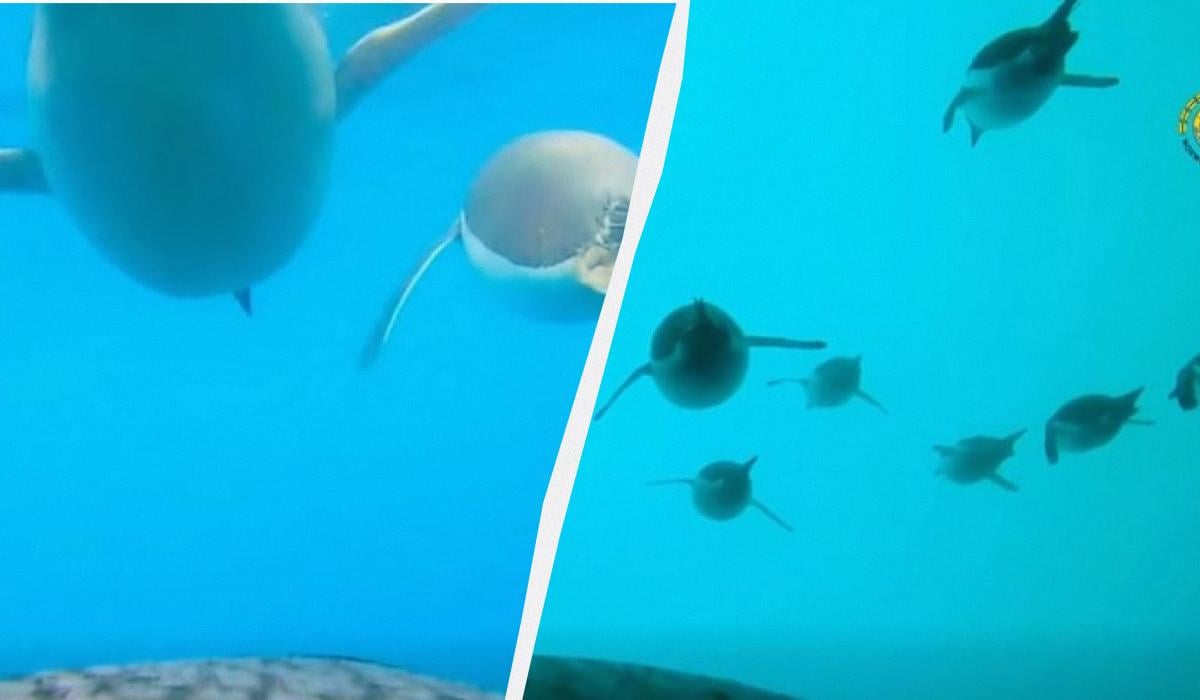
“The GPS tracker and camera are attached to the bird’s back.”, — write: www.unian.ua
The GPS tracker and camera are attached to the bird’s back.
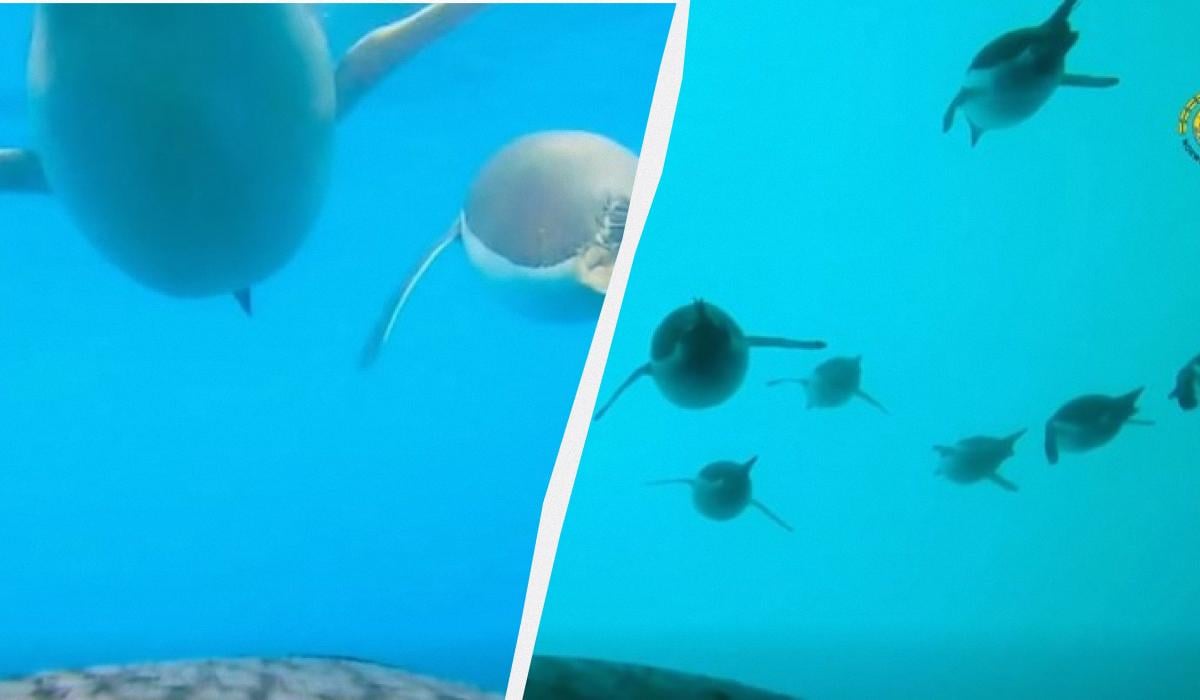 There were no accelerations of the recording – the video shows the real speed of movement of subantarctic penguins under water / UNIAN collage, screenshotsUkrainian polar explorers showed a real video of the underwater life of subantarctic penguins, which can accelerate to almost 40 km/h. The relevant footage was released by the National Antarctic Scientific Center.
“A friendly warning: if you have a very sensitive vestibular apparatus, it’s better to sit down. The recording is very dynamic and may “wobble” a bit,” the scientists joke.
They explain that no acceleration of the recording was done – the video recorded the real speed of movement of subantarctic penguins under water. These are the fastest penguins – they can accelerate up to 36 km/h.
An interesting fact about sensors. The GPS tracker and camera are attached to the bird’s back, which has a large area, constant curvature and almost no movement, so the equipment can be securely fixed with special tape and glue. Scientists remove the camera after a day, the tracker – after about three weeks. As the scientists explain, there is a separate procedure for this that does not harm feathers and is completely safe for animals.
The video clearly shows how the penguins hunt for krill, which is lost in dense clusters. At some points, it literally “rolls” into a strip, and penguins fly into this flock.
Also, the center explains, on the video you can watch how penguins release air from under their feathers for better “gliding” in the water. In addition, you can see how they move underwater, like birds in flight, flapping their wings, and not “swimming” in the usual sense. You can see how they clean their feathers, turning from side to side.
“Feather care is critically important for penguins, because thermal insulation and swimming speed depend on it,” the researchers emphasize.
News about penguinsWe will remind you that 1,200 penguins were born on Galindez Island, near the Ukrainian polar station “Akademik Vernadskyi”. In some penguin families, children are actively growing up, there are couples in which children have just been born.
In total, there are now babies in 730 nests on Halindaz. It was said that some of the penguins were still hatching eggs, and some were still carrying them.
You may also be interested in news:
- Caught in a camera trap: a rare animal was caught in the Odesa region (video)
- In Thailand, rare wild cats were discovered, which were considered extinct for almost 30 years
- An underground leak of mercury into one of Europe’s largest lagoons was discovered in Spain