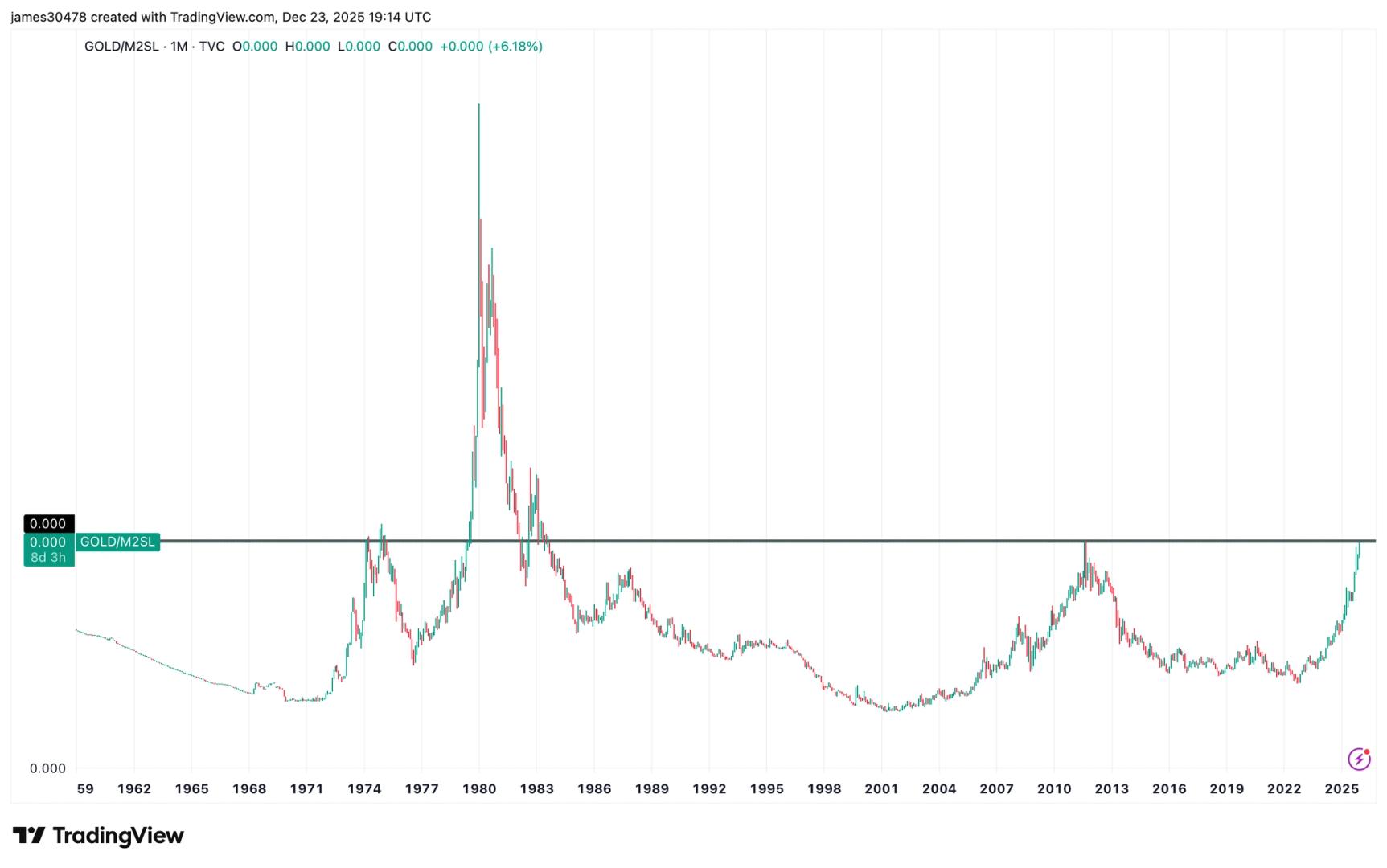
“Measured against US money supply, gold is back at levels that marked major historical peaks, while bitcoin retraces toward a key cycle floor.”, — write: www.coindesk.com
In contrast, bitcoin BTC$87,735.31referred to by some supporters as digital gold, has dropped towards a support level, revisiting lows it last touched during the “tariff tantrum” in April.
Back in 2011, gold cost $1,800 an ounce. It’s now around $4,500. When plotted against the money supply, which represents the total stock of dollars circulating in the US economy, including cash, bank deposits and liquid savings, the price has reached a level that’s historically acted as a major resistance zone.
To get there, the precious metal has surged 70% this year. This sharply contrasts with bitcoin, which is down roughly 10%. Still, bitcoin continues to make fresh highs relative to the US money supply each cycle, and the current support level also marks the previous cycle high in March 2024.
 BTCUSD/M2 Money Supply (TradingView)
 L1 tokens broadly underperformed in 2025 despite a backdrop of regulatory and institutional gains. Explore the key trends defining ten major blockchains below.
This report analyzes the structural decoupling between network usage and token performance. We examine 10 major blockchain ecosystems, exploring protocol versus application revenues, key ecosystem narratives, mechanics driving institutional adoption, and the trends to watch as we head into 2026.
View Full Report
 Such sudden price changes are often due to thin liquidity and can be exacerbated by fewer active traders during quieter hours.
- Bitcoin briefly dropped to $24,111 on Binance’s BTC/USD1 pair before quickly rebounding above $87,000.
- The price fluctuation was isolated to a stablecoin pair backed by World Liberty Financial and did not affect other major BTC pairs.
- Such sudden price changes are often due to thin liquidity and can be exacerbated by fewer active traders during quieter hours.
Read full story